Synaptrix: I think, therefore I can
|
August Wittgenstein, Drew Henderson
"We are building toward a future where we can directly interact with the fundamental biological substrate of human life through a new class of human-machine interfaces." - Aryan Govil, CEO
We believe that the devices surrounding us will one day be controlled by our minds. Synaptrix is building the technology to make this possible, decoding our brain's complex activity into simple device command. They have proven the concept by building a thought-controlled wheelchair. Now, they are building towards a general-purpose interface for technology itself. This memo sets out our thesis on Synaptrix and why we backed the company.
What does Synaptrix do?
Our brains are electrical. Every thought, intention and sensation is encoded in a pattern of voltage spikes across billions of neurons. Synaptrix builds large deep-learning foundation models that power the company's "Portal" headset: an EEG headset that users can simply place on their head to non-invasively read their brain's activity and understand their intent.
Portal is engineered to read specifically from the motor cortex - the region of the brain that plans, guides and executes movement and is therefore central to the way we interact with technology through today's interfaces. Almost every digital command must first be translated into a physical action: the push of a button, the drag of a cursor across a screen, the tilt of a joystick. That translation creates a bottleneck, since these interfaces are much lower in bandwidth and dimensionality than the information our brains can generate and the data today's technology can process. The motor cortex effectively collapses the brain's complexity into simple hand and finger movement. Keyboards and touchscreens act as low-bandwidth filters that constrain what we could really achieve with today's technologies.
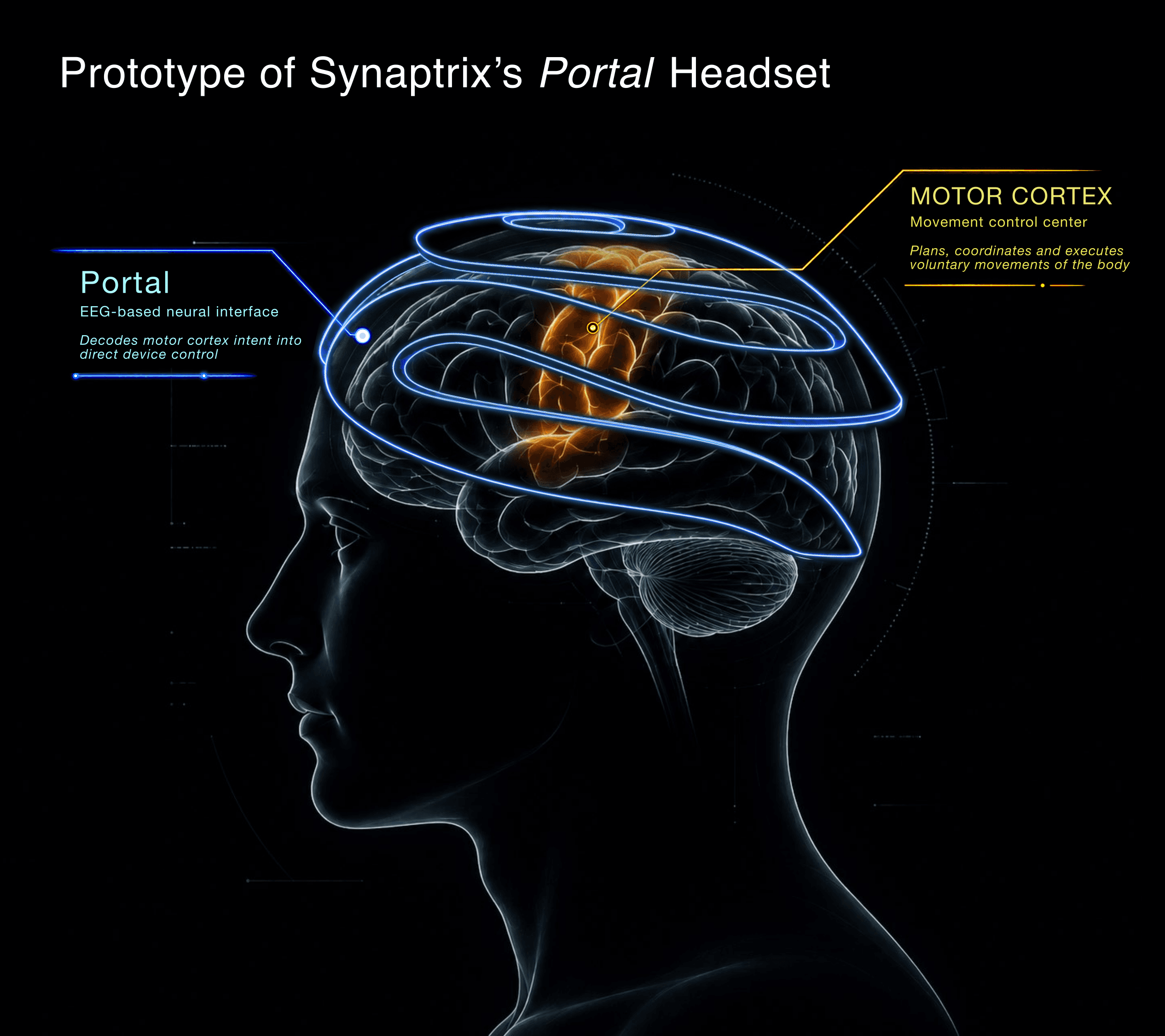
With a neural interface, we can skip these low-bandwidth filters entirely and directly translate our thoughts into digital commands. Synaptrix makes this possible by building foundation models that precisely decode neural activity in our motor cortex. Portal reads the movements our minds intend for our legs, arms and hands; Synaptrix's motor foundation models translate those intentions into direct device control.
Synaptrix’s Target Market
With Portal, Synaptrix is building the foundation for the future of assistive technology - a market that, at $67 billion, was more than double the size of the global recorded music industry in 2025. For people with partial or severe paralysis, a neural interface is not just a way to increase their interaction bandwidth with tech; it is a way for them to regain a sense of independence. It acts as a prosthetic for the mind, giving people back the ability to interact independently with the digital devices that define our everyday lives - phones, cars, consumer electronics.
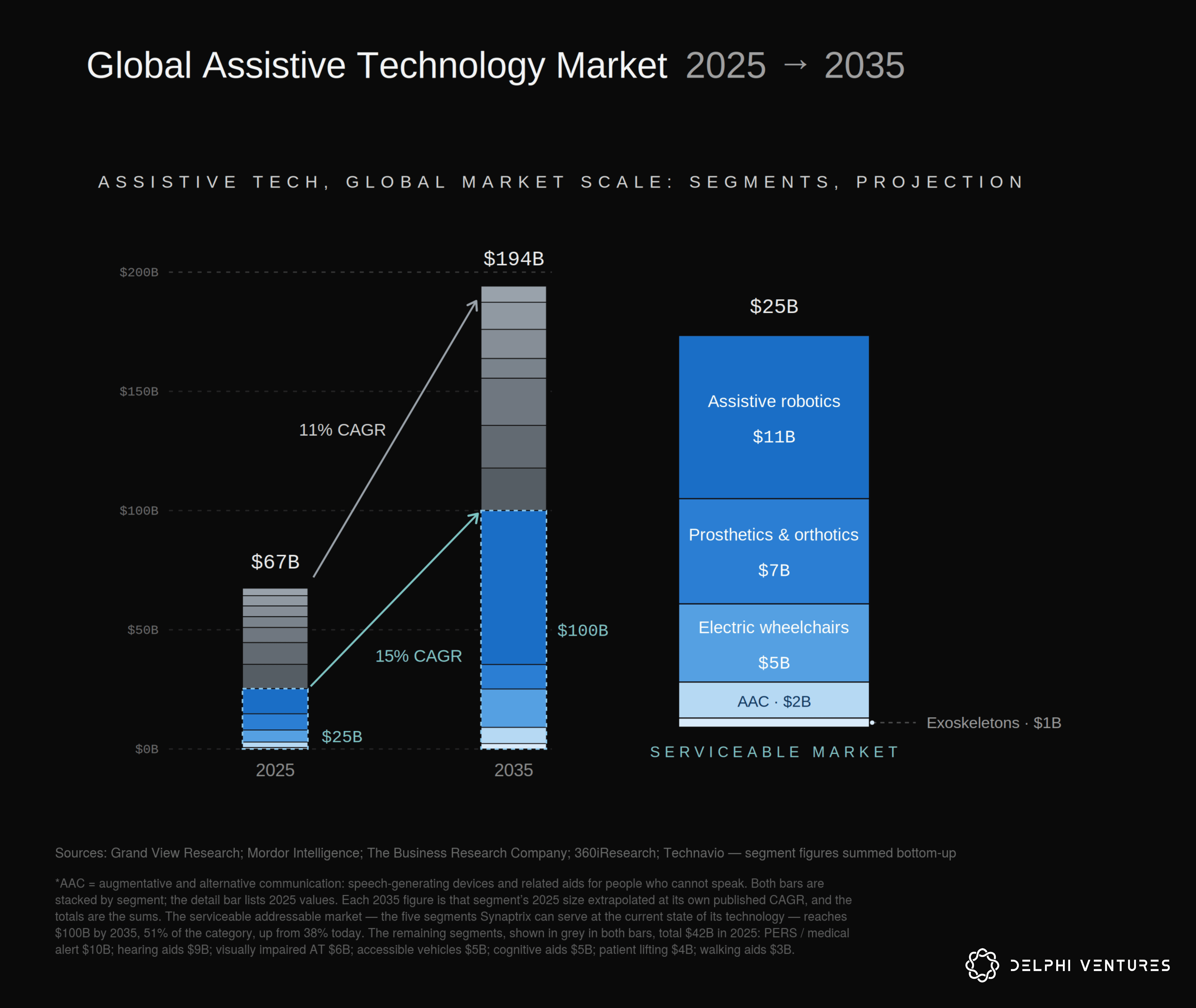
Within today's global assistive technology market, the motor-decoding capabilities Synaptrix has built into Portal allow it to address the market segments centred on translating human motor intent into device control. Those segments alone represent 37% of the market: assistive robotics, prosthetics, powered wheelchairs, AAC and exoskeletons.
Synaptrix is entering this opportunity through wheelchairs that can be steered purely with the mind. Traditional powered wheelchairs for fully paralysed patients rely on a pipe that a patient blows into or sucks on, or an over-engineered headrest that a patient leans against to carefully jerk their wheelchair along. With Synaptrix, all a patient has to do is imagine where to go. Portal decodes an intended direction, speed and angle, and steers the wheelchair accordingly.
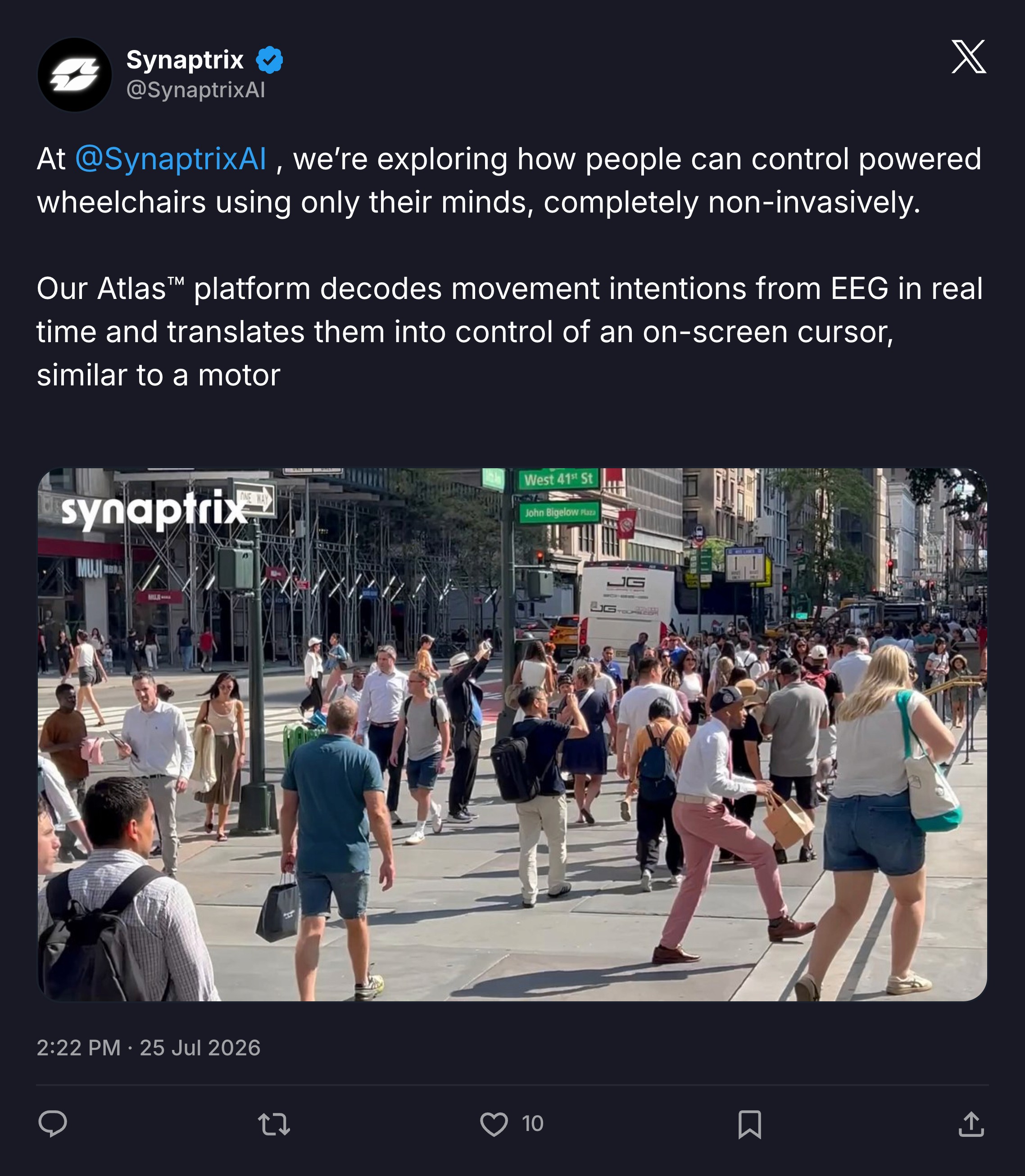
Following a seed round in October 2025, the team built what it says is one of the largest publicly known non-invasive datasets for decoding motor cortex activity. Synaptrix's motor foundation models, trained on top of that dataset, have been shown to maintain signal-processing accuracy and denoising performance on New York's busiest streets. Until now, achieving comparable performance, even in a shielded lab, required purpose-built clinical hardware. That pace of execution and technical achievement is among the most impressive we have seen in hardware neurotech to date.
Why non-invasive Neurotech beats invasive in Consumer Markets
The team at Synaptrix subscribes to a simple thesis: we don't need to open the skull to unlock the brain; we don't need implants to understand it. With the right software and precise hardware, we can capture - from the outside - what's going on beneath the skin.
"For me, the problem that Synaptrix is solving encapsulates the greatest frontier in human physiology. Unlocking the workings of a mind from outside the head will not only create a truly frictionless interface between human and technology, but also take a step towards a world free of neurodegenerative diseases." - Eric Yao, CTO
Generally, neurotechnologies divide into invasive and non-invasive. Invasive technologies physically interface with our neural pathways. They capture the nervous system's electrical activity cleanly at the source. Musk's Neuralink is the best-known commercial example of this, and they are part of an ever-growing group of invasive neurotech companies targeting some of medicine's most complex indications - from profound paralysis and dementia to brain cancer. However, the risk-benefit calculus of neurosurgery predominantly limits invasive brain-computer interfaces (BCIs) to patients with the most severe impairments; essentially, to patients for whom the alternative to an implant is completely losing the ability to interact with the world.
Neural signals can also be captured from outside the body. Electrical activity generated by populations of cortical neurons propagates through multiple layers of brain tissue, the skull and scalp. Scalp electrodes detect the resulting summed activity, which arrive attenuated and spatially blurred. Every layer of tissue and bone reduces signal strength and adds spatial imprecision, making it harder to determine where in the brain each signal originated. Any muscle movement on the user's head, such as blinking their eyes or clenching their jaw, introduces interference via the muscles' own electrical milieu. And in real-world settings, outside a shielded lab, as soon as these signals surface, surrounding power-line and radio-frequency interference further reduces their signal-to-noise ratio. What reaches a non-invasive neural sensor is not the clean trace an implant sees, but a smeared, attenuated version of it.
By feeding these "dirty" signals through specialised processing hardware and software, we can clean, interpret and eventually utilise them. Amplifiers sit directly at the on-skin sensor, boosting the signal before it has a chance to pick up interference on the way down the cable. Filters strip out the interference from the user's muscle movement and external electromagnetic noise. What is left is a faint but structured pattern of coarse rhythms produced by thousands of neurons firing in sync.
Each of those patterns across a specific region of the motor cortex maps to a particular sequence of muscle movements. When the user executes one such sequence - by saying a certain word or moving a finger in a certain way - a corresponding, tiny part of the motor cortex becomes active, measurably. Synaptrix builds the interpretation layer for these patterns. Portal captures and denoises neural activity from the motor cortex; Synaptrix’s large motor models learn these patterns, interpret them and map them to intended movement.
AI scaling laws in Neurotech
Three converging engineering trends unlock the non-invasive opportunity at commercial scale today. Deep-learning architectures have become capable of decoding complex neural patterns from low signal-to-noise data. On-device compute has become cheap and compact enough to run these architectures inside an off-the-shelf headset. Meanwhile, non-invasive sensing hardware has become increasingly commoditised. Together, these advances cross an important threshold: non-invasive neurotech can now read through the skull, denoise and precisely interpret neural activity - generalising across hundreds of users and surviving real-world artefacts. We are therefore starting to see systems like Portal that deliver useful neural control in environments where people actually use them, not just inside a shielded lab.
"Mass adoption of interfaces will come from the AI that processes the signals, not invasive implants or expensive custom sensors." - Aryan
While invasive interfaces trade surgical risk for signal quality, non-invasive ones rely on processing models to close the gap. And with those models, we see compounding effects: with every headset deployed and every thought decoded, each model becomes better and more precise. These dynamics occur over and over in tech. With every Tesla sold, every mile driven, their self-driving tech becomes more precise and autonomous. With every user added to Facebook's social graph, their products become more valuable to each individual account. That is what makes non-invasive neurotech investable today: an affordable headset acting as a decoding asset that rides AI scaling laws to reprice neurotech as a consumer software platform rather than medtech.
This is essentially what we underwrote in our neurotech investment thesis: as the hardware commoditises, the value in neurotech moves to whoever owns the decoding layer and the data. The first-mover advantage in non-invasive neurotech is a compounding lead.
In the Team’s own Words
"A lot of the work that we're doing is things that people consider to be science fiction. We say we're in the business of taking the impossible and making it possible." - Aryan
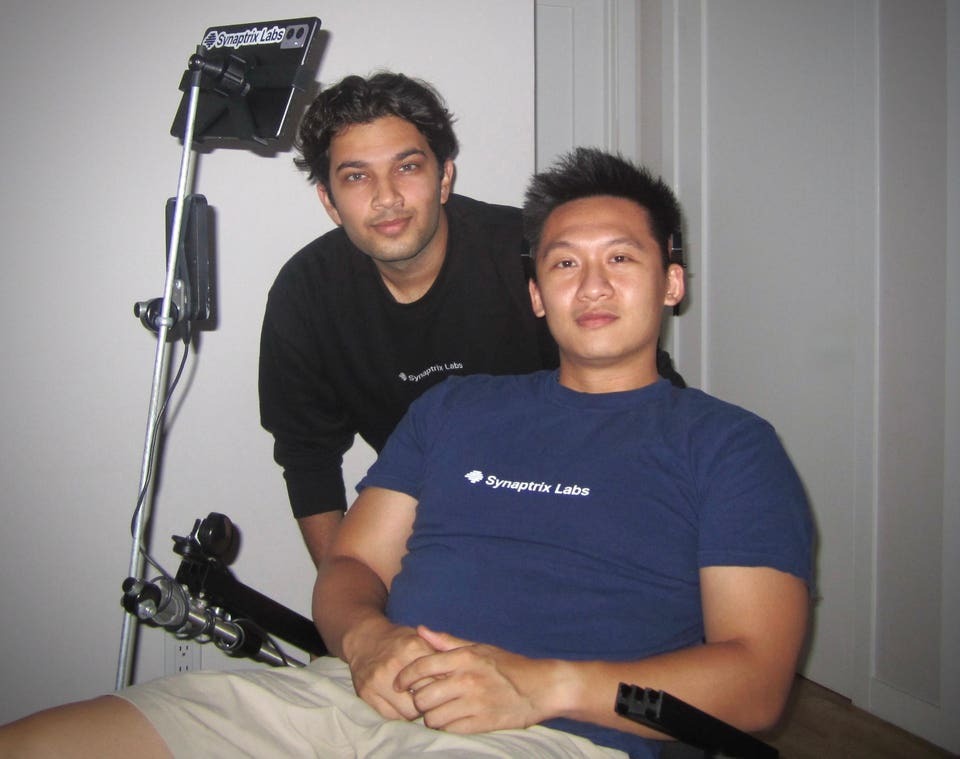
Source: Forbes
Synaptrix was born in 2023 out of conversations about exactly that compounding advantage in non-invasive neural interfacing. Aryan Govil and Eric Yao, his then-roommate and now Synaptrix’s CTO, compared what Tesla and Waymo had achieved in self-driving. Their conclusion was that the progress had come from the processing models, not from ever-better sensors, and that the same approach could work for BCIs. At the time, Aryan was conducting Alzheimer's research at NYU's Grossman School of Medicine. He watched the best-funded companies in neurotech answer the need for neural interfaces with increasingly sophisticated implants. However, in his view, their cost, risk profile and lack of scalability meant they would never reach most of the people who required them. The gap he saw was between where the capital went and what patients wanted:
"When you actually went into hospitals and talked to patients, very few people wanted an implant in their brain. At the same time, a lot of experts were writing off non-invasive neural interfaces as fundamentally non-viable. That never really made sense to me. The physics didn't say they were impossible. A lot of the limitations seemed to come from how we had historically approached the problem and our assumptions about what was possible." - Aryan
Aryan grew up in San Ramon, California. When visiting his grandparents in India, his grandfather, a renowned doctor who conducted charity work with tuberculosis patients, used to take him to orphanages and homeless shelters. His grandfather's work later inspired Aryan to volunteer in a dementia care ward at weekends, where he experienced first-hand what neurological disease takes from people - "there was something uniquely cruel to me about watching someone slowly lose their memories and pieces of who they were."
"There was also this one instance, […] an older lady […]. I think her son was a PhD in neuroscience but she was convinced I was her son and that I was curing her Alzheimer's. She would forget who I was every week when I went or what we had talked about the previous week. She would get upset that we weren't making any progress but then she would be really happy that we were working on it. She passed away and it was just really a jarring experience, because I was a 13- or 14-year-old kid in high school and I wasn't sure what I was supposed to do or if I was doing enough."
That experience left a mark on Aryan, inspiring him to study neuroscience. Conducting research at Columbia and UC Irvine, he ended up working on BCIs and quickly became hooked.
"I knew I wanted to become a doctor and work on Alzheimer's and the brain. I eventually applied to NYU in large part because of its Alzheimer's program. At 17, I managed to get into an Alzheimer's research lab that at the time only took PhDs, and I stayed there for all four years of undergrad."
Aryan took dual degrees in Neuroscience and Chemistry and graduated with top honours. Medical school was the natural next step. He took the MCAT, scored well, applied, and then, about a week later, withdrew his applications to build Synaptrix.
"The world was changing so rapidly with AI, and I started questioning whether seeing 10 or 15 patients a day as a doctor was actually the way I could maximize my usefulness. I wanted to build something that could eventually help 100 million people, or a billion people. […] That's ultimately why I started Synaptrix. I want to uncover some of the hidden mysteries of the brain and turn them into beautiful products that let people explore the world again, communicate again, move again, and be healthier. Basically deliver on everything neural interfaces have promised, but in a form people can actually use."
His CTO and co-founder, Eric Yao, studied Mathematics and Data Science at NYU, while his work in quantitative finance gave him a strong grounding in time-series forecasting and quantitative modelling. He later drew on that background to build Synaptrix's decoding layer and the technological core of the company's signal-processing stack. For Eric, the ambition extends beyond just building a better interface: decoding the mind non-invasively is one of the great remaining frontiers in human physiology, with implications ranging from how we interact with machines to how we understand and treat neurological disease.
"Aryan and I took our first steps in the field tinkering with open-source hardware in our apartment living room. Within 2 years we find ourselves at the frontier of non-invasive motor decoding. I find our partnership to be built on a shared view of a great product for our users, and an incessant drive to execute boldly compounded with excruciating attention to detail." - Eric
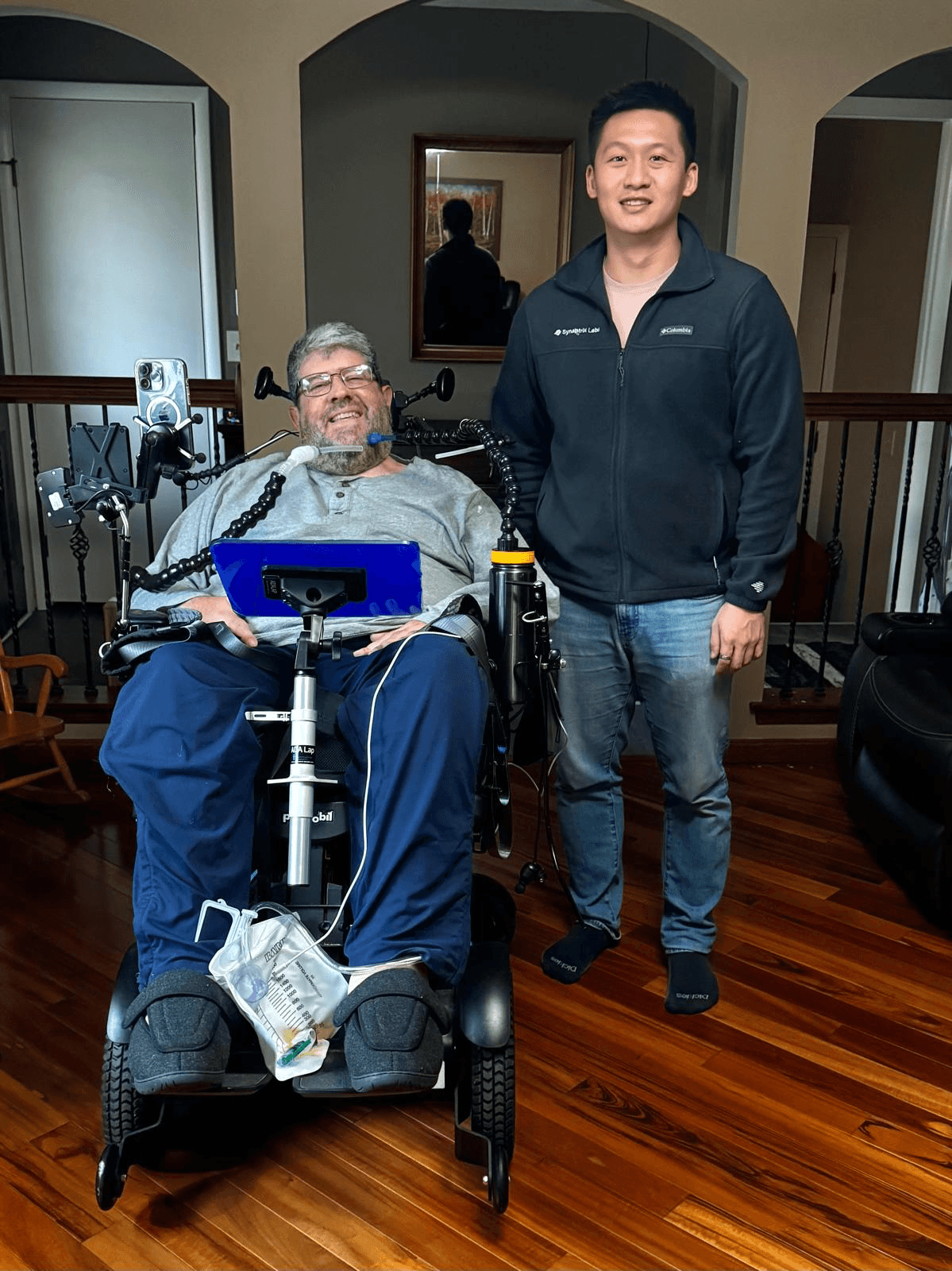
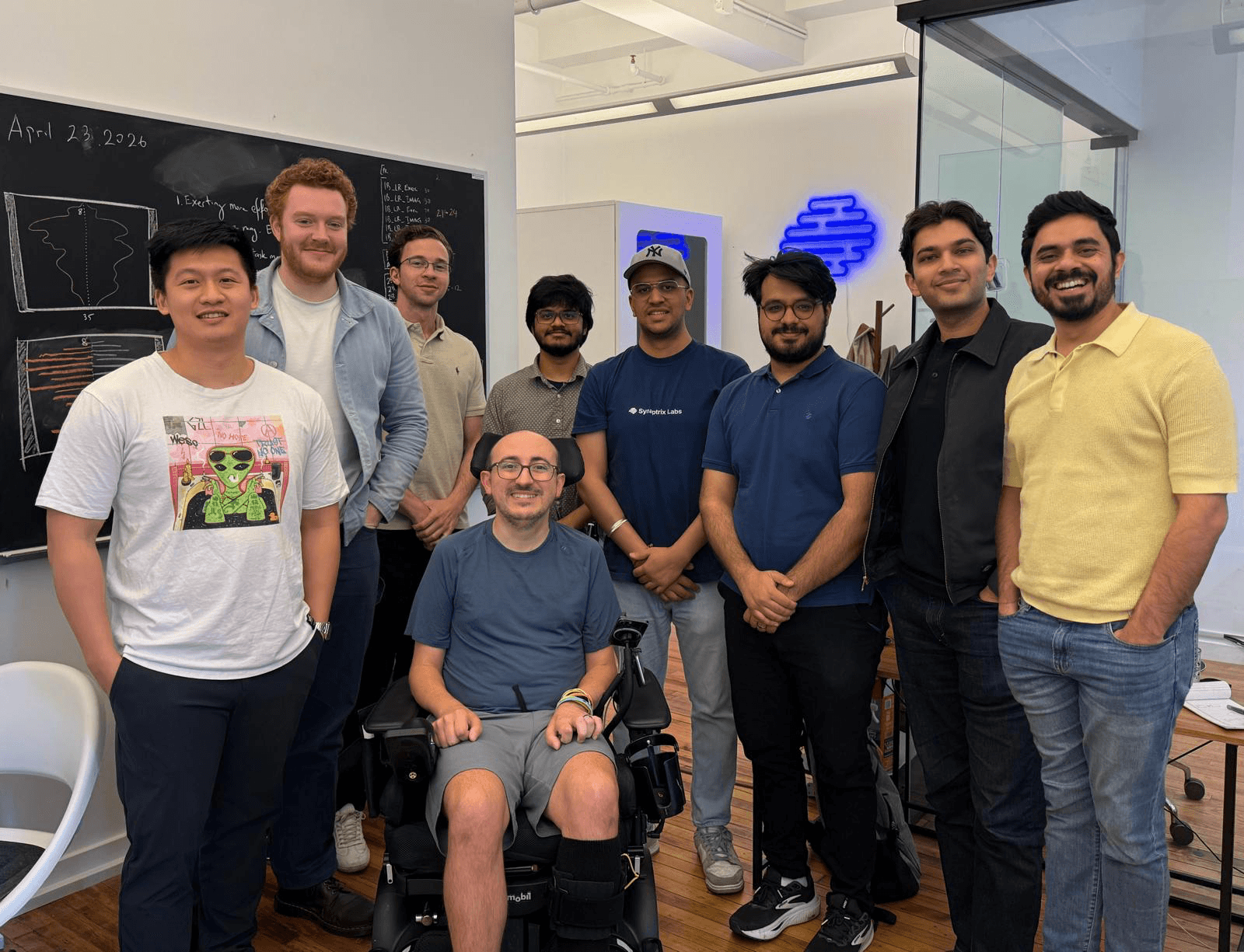
That drive shows up in how the entire company works. Every week, the team runs sprints with wheelchair users, while regular quality-of-life surveys test whether the device improves mental well-being as well as mobility. Columbia's advisers made the first patient introductions; every participant since has come through referrals and word of mouth within New York's ALS and SCI communities. Wheelchair trials with Columbia are now being lined up, while the VA's prosthetics group is in discussions about using the same platform for prosthetic control.
"We test with patients here in New York City and their families, and they're really excited for the day where they can actually keep the device and use them day to day. It works. It really works, and it's really magical. The quicker we get this done, the quicker millions of people around America have access to mobility, which I think is beautiful." - Aryan
Why we underwrite Synaptrix as a Tech Interface, not Medtech
Hardware commoditisation and AI scaling laws reframe non-invasive neurotech from medical technology to a software platform play. This is exactly where we see Synaptrix. Their compounding model advantage builds on high-quality neural data for model pre-training and hits escape velocity once deployed devices begin continuously adding to that dataset. The wheelchair market gives Synaptrix an unusually effective starting point for building that flywheel: the research infrastructure is already in place in the form of hospitals and rehab centres. Large wheelchair manufacturers are often the ones driving and funding the studies themselves. Synaptrix collects the data they need to fine-tune their models and can later turn those R&D partnerships into high-volume B2B contracts, creating contractual moats by being embedded in a manufacturer's product line.
"I founded Synaptrix with the belief that we were standing on the precipice of a new frontier. Not pharmaceuticals or traditional medical devices, but something else entirely." - Aryan
However, neither Portal nor their foundation models are wheelchair-specific. Synaptrix started with wheelchairs, but as Aryan puts it, "a joystick is ultimately just a bounded cursor." So the team has extended their system to freely moving cursor control on a screen, validating the scenario we underwrite at Delphi: the decoding layer being trained and commercialised through wheelchairs today can extend far beyond mobility - across assistive technology and eventually into any technology we currently control with our hands.
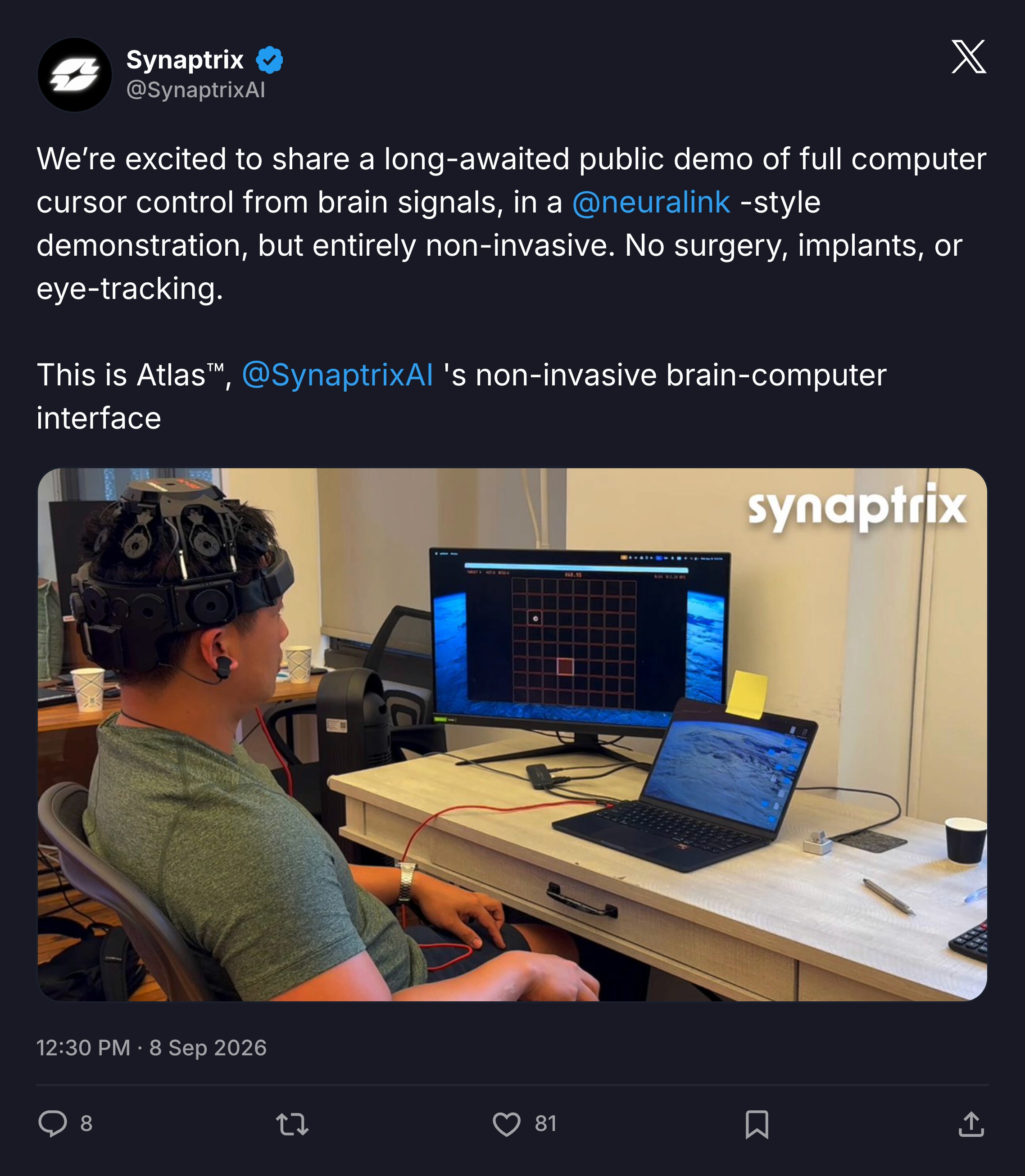
The movement of a cursor on a screen, the push of a button and the tilt of a joystick are all everyday modalities through which humans interact with technology today. At Delphi, we believe that within the next five years we will see thought-control options built into the technology all around us - into smartphones, VR/AR glasses, computers, the infotainment systems of our cars. Neural interfaces will expand the bandwidth of information that our brains can transmit to our everyday technology by moving beyond the low-dimensional input of our current interfaces. They will bypass the delay introduced by translating intent into action through muscle. And they will enable true digital multitasking to control multiple devices simultaneously - something our brains are capable of today, but that a single input modality such as a keyboard or touchscreen prevents. We see a realistic scenario in which all of this is powered by Synaptrix.
And they are already actively exploring that opportunity outside healthcare. The team is working with defence contractors and DARPA on applications where high-bandwidth, rapid interaction can have immediate operational value - from heads-up displays to drone swarms.
Closing Thoughts
At Delphi Ventures, we're invested in the decoding layer of the next human interface at the price of a wheelchair accessory. The market still looks at a company like this and sees a typical hardware medtech play: one device, one indication and no compounding data moat. What Synaptrix actually owns is one of the largest publicly known datasets for non-invasive motor-cortex decoding, and the models trained on top of it. Unlike an implant, that model gets better every time someone puts on their headset. Every session, every subject, every thought decoded makes Portal's decoding quicker and more precise.
Every interface we use ultimately resolves to intended movement: the button, the cursor, the joystick, the wheel. Portal reads that intention directly. Today, Portal already enables paralysed patients to control a wheelchair through imagined movement outside the lab. What we are underwriting is the possibility that the same decoding layer could extend far beyond mobility and underpin the next generation of human-machine interfaces.
—
Important Disclosures
This material is published by Delphi Ventures ("Delphi") for informational and educational purposes only. It reflects the opinions of Delphi as of the date of publication, is subject to change without notice, and Delphi undertakes no obligation to update it. Nothing herein constitutes an offer to sell, or a solicitation of an offer to buy, any security, fund interest, or advisory service, nor a recommendation to make any investment. Any offer of interests in a Delphi fund is made solely to eligible investors through that fund's confidential offering documents and definitive agreements, which control in all respects.
This material does not take into account the objectives or circumstances of any recipient. Investing involves risk, including the possible loss of principal. Investments in early-stage and privately held companies are speculative, illiquid, and may result in the total loss of capital. Synaptrix is a single portfolio company selected for illustrative purposes. It is not representative of any Delphi fund's overall portfolio, and it should not be assumed that any investment discussed was or will be profitable. Past or projected performance is not indicative of future results.
Statements regarding future events, markets, technologies, or outcomes are forward-looking, reflect assumptions and estimates, and are subject to significant risks and uncertainties. Actual results may differ materially. No representation is made that any forward-looking statement will be achieved.
Delphi and one or more of its affiliated funds as well as the authors hold, or may hold, an interest in Synaptrix and stand to benefit from the company's success and from favorable perception of the company. This material should be read as that of an interested party.
This material includes statements, data, and quotations from Synaptrix, its founders, and other third-party sources. Such statements are those of their respective sources, not Delphi. Delphi has not independently verified this information and makes no representation or warranty as to its accuracy or completeness. Descriptions of Synaptrix's technology, performance, datasets, partnerships, market position, and financing reflect information provided by the company and have not been independently verified by Delphi.
All trademarks, product names, and logos are the property of their respective owners and are used for identification purposes only. This material is not directed to any person in any jurisdiction where its publication or availability would be unlawful.