Neurotech Investing Into 2035
|
August Sayn-Wittgenstein & Drew Henderson
The human brain is the most sophisticated information-processing system ever observed. Today’s digital interfaces reduce that processing power to mere keystrokes and taps. Brain-computer interfaces (BCIs) access the brain directly - closing the gap between cognition and computation, and redefining what technology is capable of.
Experimental systems can already translate neural signals into real-time control of digital interfaces - typing messages, navigating software, interacting with virtual environments without any physical input[1]. Mass market adoption of such systems is no longer theoretical, but an engineering challenge with a probabilistic commercial timeline. We believe interfacing with the nervous system will define an entirely new layer of human capability - one that transforms machines from useful instruments into extensions of our minds. This thesis is our framework for investing in the companies that will redefine the interface between human and machine.
Fundamental Opportunities in Neurotech
The nervous system sits at the core of some of the most consequential challenges in medicine. Interfacing with and modulating neural activity therefore represents one of the most powerful and versatile approaches to treating these challenges. Deep brain stimulation (DBS) successfully alleviates symptoms in Parkinson’s patients; spinal cord stimulation has proved to reduce chronic pain; cochlear implants restore essential sensory functions, while emerging brain-computer interfaces are returning mobility to paralysed patients. Across a range of high-impact modalities, neurotech has already established itself as a commercially viable medical technology. Decades of clinical validation, improving reimbursement pathways and increasing regulatory acceptance have driven steady adoption. Established medtech leaders such as Medtronic, Abbott Laboratories and Boston Scientific have long been deploying institutional capital and decades of research and regulatory expertise to continue to scale these clinical markets globally.
Market data clearly reflect this development: global neurotech revenue was valued at roughly $17 billion in 2025 and is projected to reach nearly $65 billion by 2035, growing at a CAGR of approximately 13-14%[2]. Growth is driven by rapid advances in clinical brain-computer interfaces (BCIs), expanding clinical validation for adaptive neurostimulation and rising prevalence of neurological disorders in modern ageing societies.
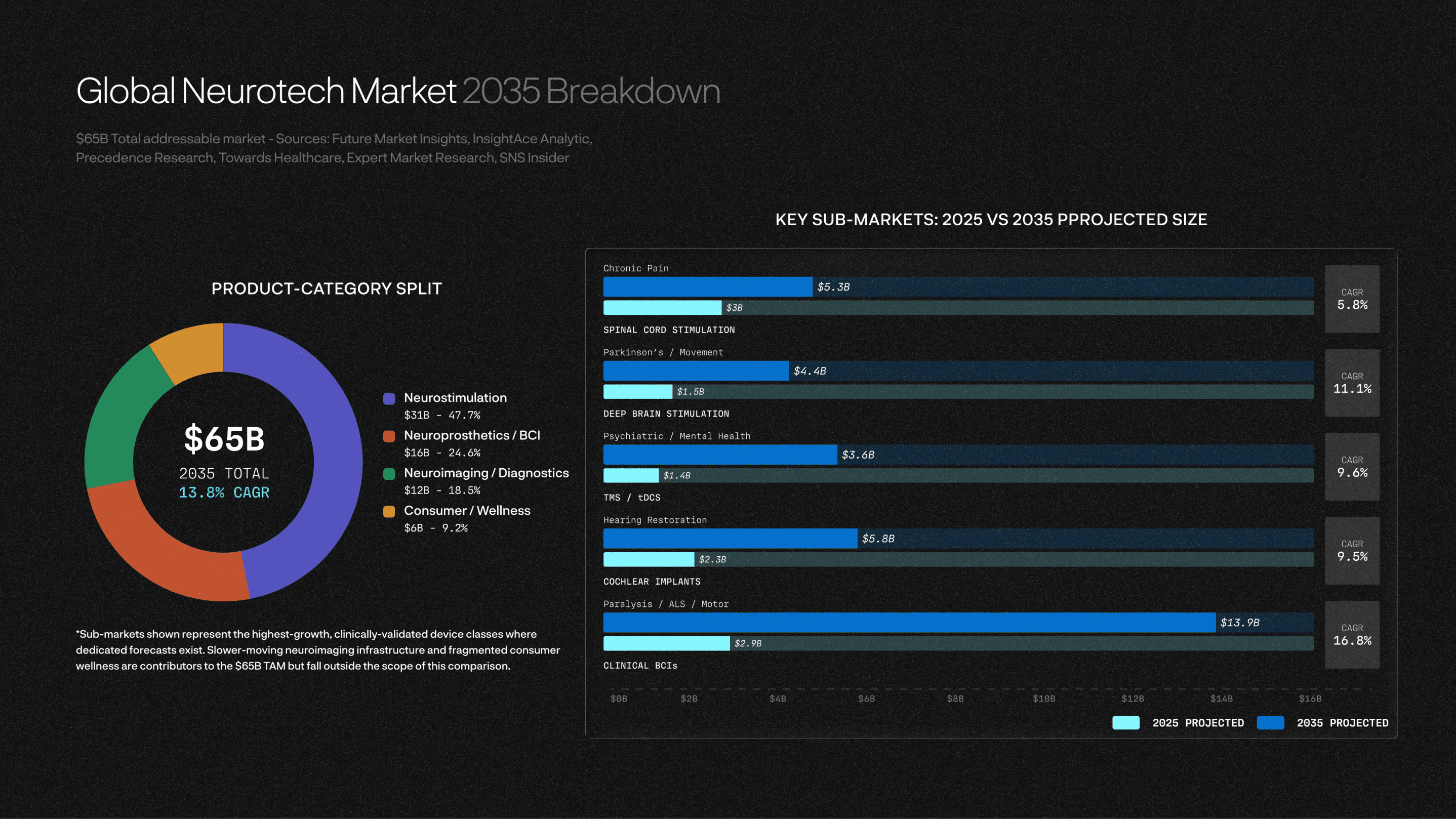
Breaking down the $65B clinical neurotech market - Neurostimulation leads with ~47% of the 2035 market, followed by neuroprosthetics and BCIs at 25%. Across sub-markets, clinical BCIs stand apart - projected to reach $13.9B at a 17% CAGR - while spinal cord stimulation and cochlear implants grow steadily on established reimbursement pathways. Deep brain stimulation and TMS accelerate toward 10% as indications expand into psychiatric disorders[3].
These numbers merely reflect the growing adoption of neurotechnologies that are already available in the clinic today. At the same time, a new generation of frontier-science-led efforts is turning neural interfacing into a platform for treating disease beyond the nervous system. Merck KGaA’s bioelectronics research, in collaboration with one of Europe’s most established neurotech startups, INBRAIN Neuroelectronics, is exploring how targeted neural stimulation of the vagus nerve can treat inflammatory and metabolic disorders in patients who are unresponsive to drug therapy[4]. Coherence Neuro is investigating whether neural signalling can be used to fight cancer progression[5]. Interfacing with the nervous system is emerging as one of the most potent therapeutic levers in medicine.
However, beyond medicine, an entirely new commercial opportunity is emerging.
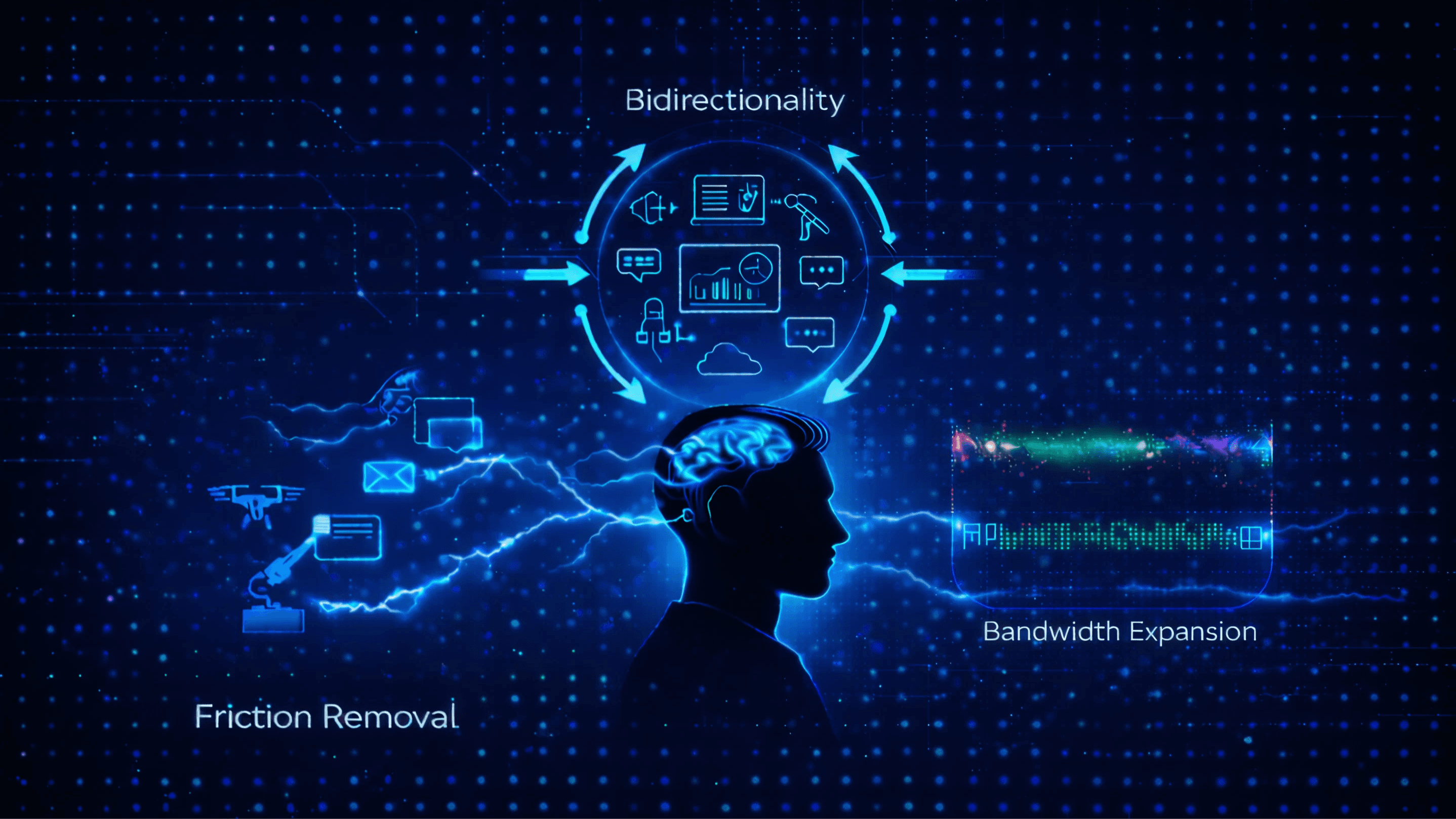
Fundamentally, our nervous system is built on an electronic architecture: it encodes and transmits information electrochemically, which in turn can be measured, interpreted and modulated. Digital systems can therefore directly interface with human cognition itself. With recent breakthroughs in AI-driven signal decoding, advanced bioelectronics and the economics of hardware manufacturing, this capability is becoming commercially accessible. A new field for neurotechnologies beyond medtech is materialising; one that will redefine the interface between humans and electronic systems altogether. Three fundamental modalities define the opportunity:
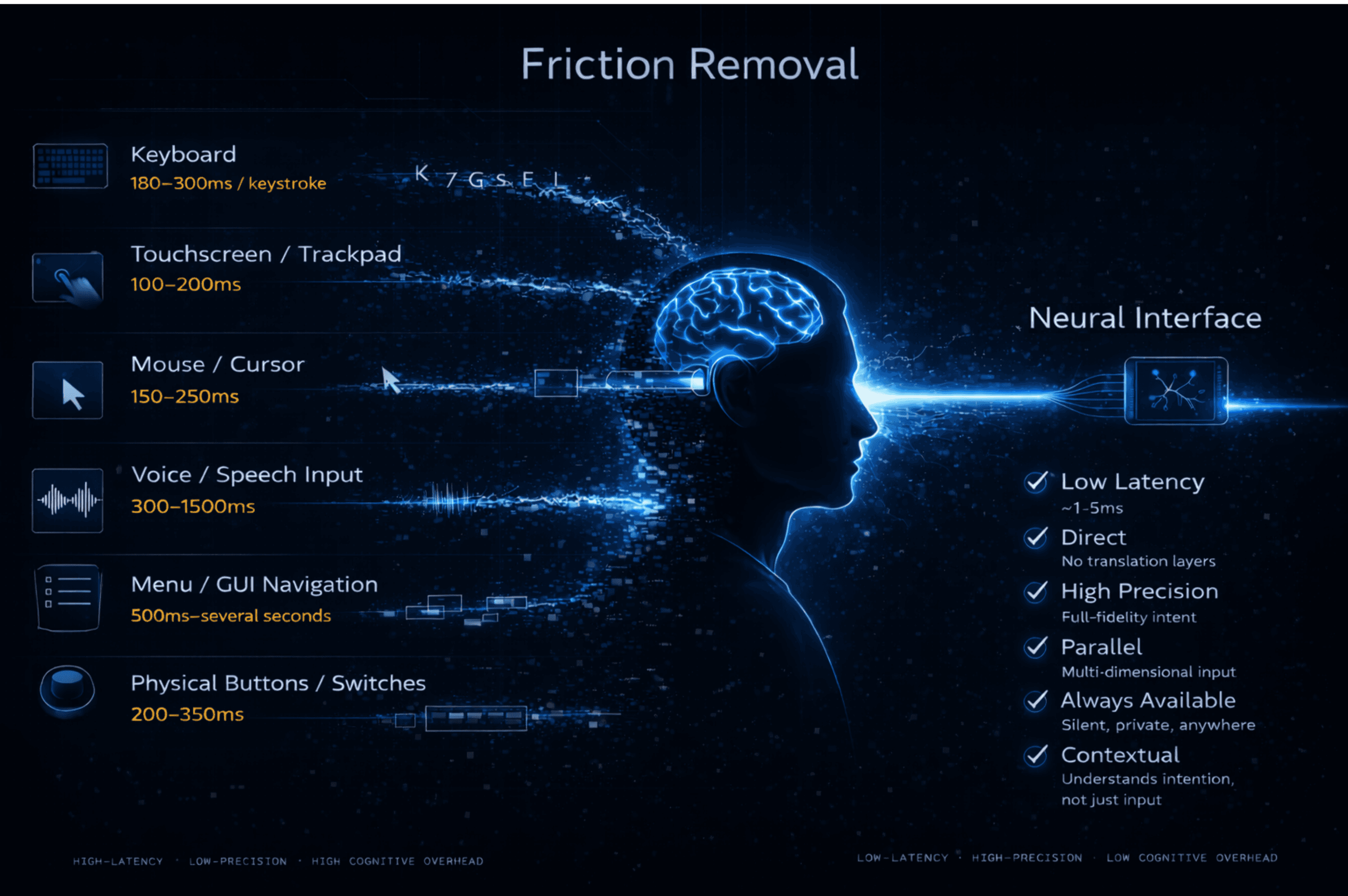
The first is friction removal: BCIs collapse the gap between intent and execution. Currently, our thoughts are translated into physical input via our hands and voices. This introduces delays, precision limits and interface translation overhead. With BCIs, we can directly control digital and physical systems with our thoughts alone. This removes current interface constraints entirely and enables faster, parallel and more efficient interaction with technology.
The second is bidirectionality: human-machine interaction will shift from one-way control to closed-loop interaction. Neural interfaces allow technology to both read from and write to the nervous system, enabling continuous feedback loops. With BCIs, digital systems can adapt in real time to cognitive states, reducing cognitive overload. Beyond brain-only BCIs, bidirectional prosthetics can interface with the peripheral nervous system to incorporate sensory feedback and restore more precise perception. Human-machine interaction will evolve from discrete commands into an adaptive dialogue.
The third is bandwidth expansion. Our human cognition is structurally high-dimensional - the interfaces we use to connect to our devices are not. Inherently low-bandwidth modalities, such as physical buttons or 2D screens, introduce a structural mismatch in human-machine interaction. BCIs will enable our digital systems to decode complex cognitive processes such as intent, intuition and subconscious dynamics.
Together, they define a single trajectory: turning technology from something we operate to something we inhabit.
Beyond Touch - from Interface to Intent
BCIs will collapse the physical interface bottleneck, removing the friction that constrains every human-machine interaction today. Currently, we interact with technology by translating our thoughts into sequential input via our hands and voices. This interaction is fundamentally constrained by the degrees of freedom our bodies can mechanically produce and by the translation overhead each step produces. A hand can press, swipe or pinch; a voice can speak one word at a time. Before any of that happens, thought must become motor intention, motor intention must become muscle activation, and only then does a digital system respond. Each step adds delay, imprecision and cognitive overhead. BCIs bypass this entirely. A direct brain-computer interface reads across numerous channels simultaneously, compressing the loop from intent to effect to only tens of milliseconds - the constraints between intent and execution collapse. Humans will directly govern digital and physical systems with their thoughts alone.
This shift fundamentally changes the way we interact with everyday technologies. Today, composing a document requires typing each word sequentially, navigating menus, switching between applications. Tomorrow, BCIs will let users generate, edit and structure content simultaneously as a continuous stream of thought. The science already proves it: in 2023, labs at Stanford University and UCSF decoded continuous speech directly from paralysed patients' neural signals at 62 and 78 words per minute - reconstructed in real time from thought alone, without a single word being spoken[6]. Apple has already recognised the potential: the company officially named brain signals as a native input category alongside touch, voice and typing. Synchron has already proved the concept: in 2025, based on Apple’s BCI HID protocol, an ALS patient publicly demonstrated navigating an iPad, opening apps and composing messages using thought alone[7]. BCIs will enable us to control multiple software tools at once, pilot swarms of drones and command robotic systems in concert[8]. As a result - beyond convenience - we’ll see a step-change in productivity, as the time and cognitive effort required to translate intent into action are effectively eliminated. An intention is no longer the start of an action chain but the action itself.
This transformation reflects a broader and longer-term trajectory in human-machine interaction: a steady progression towards greater intimacy between humans and digital systems (see The Delphi Podcast - Jon Egan: On the Road to a Digital Species). Early technologies required rigid, external input: mechanical buttons, keyboards, distant screens. Over time, these layers progressively collapsed. Physical buttons that controlled our cars, home appliances and phones became touchscreens. Just recently, AI moved our communication with software from noisy screens to a simple chatbox. Instead of navigating menus, users simply ask ChatGPT to summarise a document or generate code. Input and output have both progressively evolved from simple signals to natural conversations. BCIs extend this trajectory to its logical endpoint: direct control of digital systems through our thoughts alone.
This shift enables a qualitatively different mode of human-machine interaction. By translating thought directly into digital action, neural interfaces collapse the latency and cognitive overhead that are introduced by today's physical intermediaries. The mental effort once spent navigating interfaces is redirected towards the task itself. We move from interaction to integration, from friction to flow.
From Command to Dialogue - Closed-loop HMI
The second opportunity is bidirectionality. Our interactions with digital systems today are mainly governed by directional control. Current human-machine interfaces (HMIs) are purely reactive: they translate human intent into digital commands without the ability to adapt their behaviour beyond predefined inputs. By contrast, neural interfaces introduce a fundamentally different architecture: dynamic closed-loop systems that can both decode and stimulate neural activity - a form of read/write system for the human brain. Human-machine interaction will evolve from discrete commands into an ongoing adaptive dialogue.
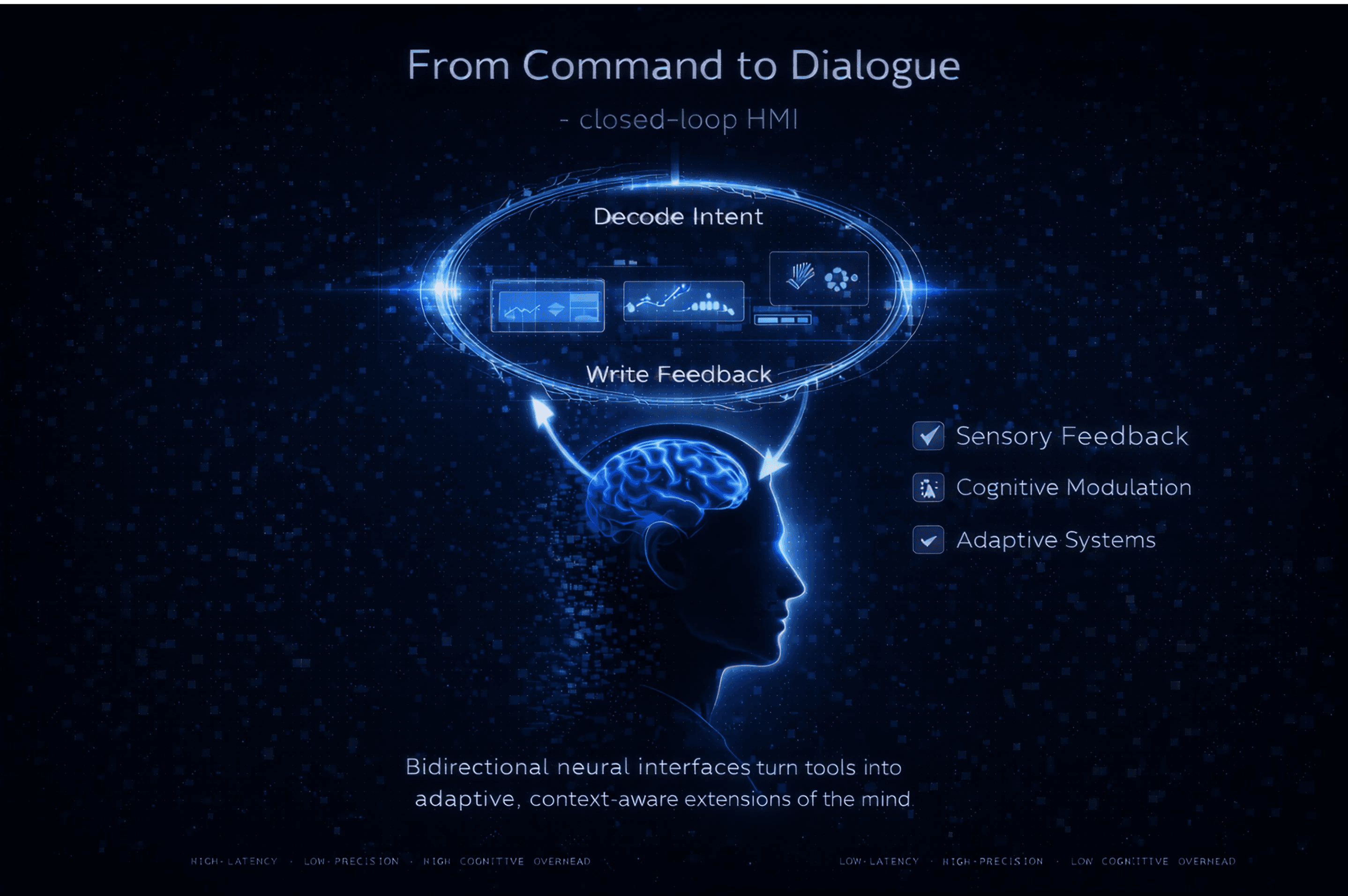
Bidirectional neural interfaces can deliver sensory feedback, modulate cognitive states or adapt stimulation parameters in real time. A neurotech-enabled prosthetic lets an amputee not just move their arm again, but actually sense it - feeling touch and warmth. A system can detect cognitive overload during a task and dynamically adjust the information presented or delay non-essential inputs in real time. Today, closed-loop sleep enhancement devices, like the ones already introduced by BrainCo and Elemind, can already improve sleep by adapting stimulation parameters to measured brain states. Medtronic's Percept PC goes further still - a commercially approved adaptive DBS system that reads Parkinson’s patients’ neural activity in real time and adjusts stimulation to when and how much it is needed, rather than firing on a static schedule. The technology is already in patients today, already reimbursed, already more precise and preferred by patients[9].
Bidirectional neural interfaces allow technology to function as an adaptive, context-aware extension of our mind. When we operate technology today, it responds to our commands, but not to our state. A bidirectional interface does both. It reads cognitive load, detects fatigue, senses intent and writes back, adjusting and compensating in real time. This continuous exchange is what transforms a tool into something closer to a limb. Just as proprioception[10] makes our hands feel like ours, the closed loop makes the interface feel integrated. Bidirectionality turns neural interfaces into genuine extensions of our mind.
The Bandwidth Hypothesis - fundamental physics of HMI
Current human-machine interfaces - such as text-based keyboards and physical buttons - are structurally low-bandwidth: linear, discrete and constrained by screens and manual input. By contrast, our own cognitive processes are parallel, continuous and high-dimensional. Our cognitive architecture encodes intention, perception and adaptation in ways that traditional interfaces can’t. This mismatch creates a structural bottleneck between what we think and what we can express. Solving this mismatch defines the third fundamental opportunity for BCIs - we call it the Bandwidth Hypothesis.
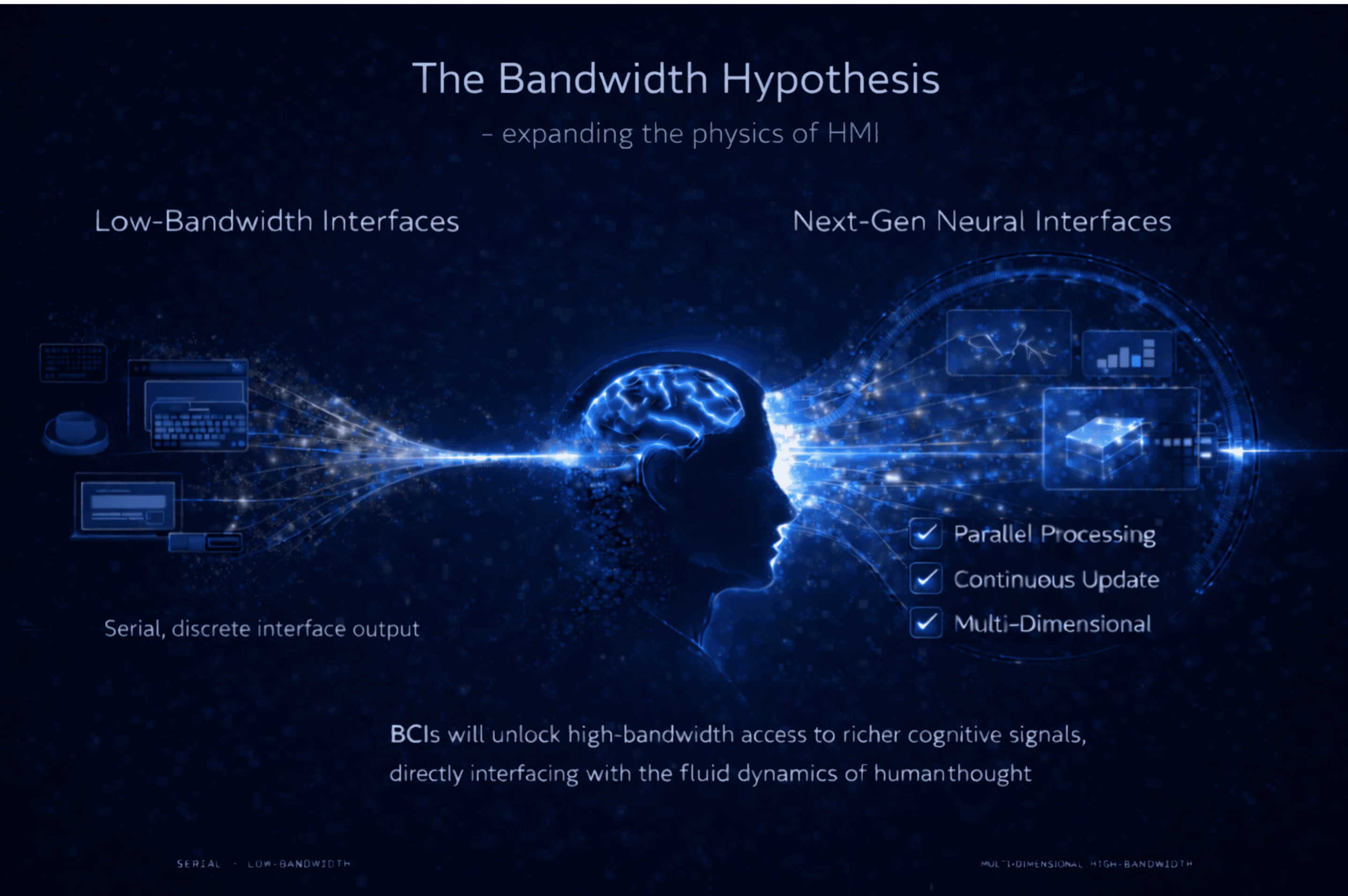
Rich multi-dimensional neural dynamics are forced through serial, low-bandwidth interfaces. Our digital systems merely react to cognitive processes that have been translated into sequential inputs: a clicked button, a typed query, a spoken command. However, not all cognition surfaces as deliberate, conscious intent. When writing, we don’t think in keystrokes and explicit movements of our hands and fingers. We think in sentences, abstract ideas, images. In the background, a cascade of complex cortical and subcortical processes translate intent into action. From decision-making in the prefrontal cortex to actual execution in the motor cortex, before the sensory cortex provides feedback on placement, touch and visual reaction. Our brains continuously translate abstractions into fluid motion to type out our thoughts, while the next idea is already forming in our minds.
Our subconscious processes, such as pattern recognition, intuitive inference or anticipatory decision-making, operate well below the threshold of our explicit awareness. With our current low-bandwidth interfaces, we are unable to translate such processes into the digital. The next decade in human-machine interaction will be defined by the fundamental removal of this bottleneck. BCIs will unlock access to richer cognitive signals - capturing intent, intuition, subconscious processing, mental imagery. Building on their 2023 study, Stanford crossed a more fundamental threshold in 2025 by decoding inner speech - not what a patient tried to say, but what they silently thought before deciding to speak[11].
Instead of waiting for fully translated instructions, BCIs can access and act on cognitive states as soon as they emerge. The interface will become anticipatory - acting proactively on cognitive states before they are consciously articulated. A knowledge worker will be able to explore a dataset, generate hypotheses and refine outputs simultaneously, without switching between tools or explicitly structuring each step. A designer will be able to come up with a design and manipulate a 3D environment while in parallel iterating on form, material and function. A single operator will coordinate multiple machines or agents at once.
Digital systems that interface directly with the brain can evolve beyond the sequential command structures that currently define human-machine interaction. BCIs will turn our digital technology into high-bandwidth extensions of human thought.
From Vision to Reality
Taken together, friction removal, bidirectionality and the bandwidth hypothesis define not just a technological opportunity but a structural shift in how humans will relate to machines. This is not a distant vision. Apple has formally recognised brain signals as a native input category. A paralysed patient is composing messages on an iPad using thought alone. Adaptive DBS systems are already implanted in patients and outperforming their predecessors. What we describe as the future of human-machine interaction is, in fact, in measurable ways, already the present. Technology that was theoretical yesterday is clinical today; what is clinical today will be wearable tomorrow.
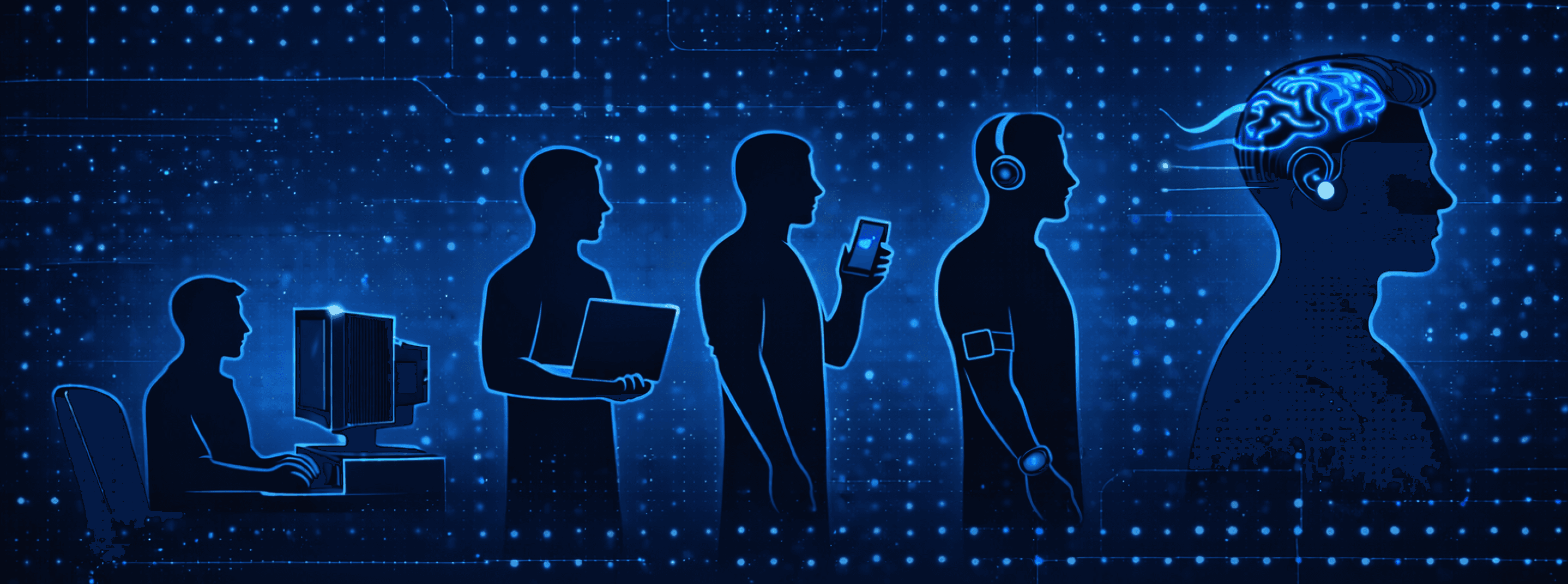
The Integration Paradigm - from external tools to cognitive extensions
The implications of neural interfacing extend beyond how efficiently we operate technology - they reach into how we relate to it altogether. Today's interfaces introduce a constant sense of alienation and fragmentation. Constant switching between context windows and devices for simple tasks; irrelevant notifications interrupting focused work. Our devices have become ubiquitous in our daily lives, but are still fundamentally external to us. BCIs offer a path to resolve this tension. By embedding human-system interaction directly at the level of thought, we can turn technology from something external we operate into something we inhabit - a form of cognitive extension.
With AI systems, we are already seeing today how users actively seek this transition. Instead of serving as external systems that we interact with, we are turning Claude and ChatGPT, through persistent memory and context, into personalised collaborators. Emails can be drafted in our own tone, based on past conversations. Job applications can be prepared proactively as our work history becomes known. The next step is ambient AI: systems that are deeply integrated into our personal digital ecosystems and actively participating in our decision-making processes. With products such as OpenClaw and a growing wave of AI-native wearables, we can already observe how this new paradigm of seamless human-system integration is beginning to materialise. With access to our personal messages and calendars, ambient AI systems can plan our daily lives proactively - drafting emails, setting up meetings, reducing travel planning to a simple "yes" or "no". This isn’t niche behaviour. Users aren’t just tolerating greater human-machine intimacy; they are actively building towards it. BCIs don't introduce a new desire, but fulfil one that is already structurally present in how people relate to technology today.
We can understand this as the culmination of a broader technological arc. Fuelled by impressive innovation in materials, manufacturing and processing power, computing has moved from stationary PCs to portable laptops to ever-present smartphones and wearable devices. Each step has made technology more accessible and seamlessly integrated into our lives. Now, BCIs represent the next - and potentially final - step in this progression, where technology is no longer a device we carry, but a system we integrate with.
While this vision may appear unsettling and the adoption challenging, it also presents a compelling alternative to the status quo. Rather than amplifying distraction and fragmentation, with BCIs we'll be able to turn towards a mode of interaction that is quieter, more natural and more closely aligned with our thoughts. Instead of typing and clicking through menus, composing a message becomes a continuous stream of thought. We see this integrated future not as one of dehumanisation, but as one of synthesis that will enable us to combine the strengths of human intuition with the capabilities of digital systems. The inefficient friction and noise of today's interfaces will become artefacts of our digital past.
We believe the move towards direct neural control is an inevitable structural shift. Similar transitions can be observed looking back. The move from command line to graphical user interface (GUI) opened up a completely new world of opportunity for software applications. The GUI ended up forming the interface foundation of today's digital world. The transition from physical buttons to touchscreens reshaped consumer and commercial electronics in a similar way, removing barriers and opening fundamentally new modes of application for electronic systems. Each of these transitions shared a common pattern: what first appeared as a niche capability became, within a decade, the default mode of interaction. The underlying human preference for less friction and more intimacy with technology never changed - the interface just finally caught up. Neural interfaces won’t just follow a similar adoption curve in consumer electronics, but also define new forms of human-machine interaction. Applications of electronic systems will arise that are unimaginable today - thought-driven design, brain-to-brain communication, instant learning. This shift will be fundamental - impacting any high-value application where the interface advantage justifies integration costs.
Why now? - three converging trends
We outlined earlier how BCIs will fundamentally transform the way we interact with technology and why that transformation is no longer a question of scientific feasibility but of engineering execution. For most of neurotech's history, that distinction didn't matter: the science consistently outpaced the engineering. Compelling results in research environments couldn't translate beyond the lab. That hurdle is about to be overcome. Three converging trends have emerged in the past 3-5 years that are structurally reshaping what is buildable, what is affordable and what is deployable in neural interfacing.
Automated Manufacturing and the Age of Abundant Production
Global manufacturing capacity, particularly in China, has driven sophisticated hardware component costs down by roughly an order of magnitude over the past decade. What once required custom fabrication, institutional research funding or Fortune 500 capital can now be sourced from contract manufacturers at consumer price points. Young teams of researchers and entrepreneurs with minimal funding can now deliver on device visions at significantly lower entry barriers than before[12].
This trend isn’t theoretical or about to have an impact; we can already see significant cost reduction in neurotech hardware today: OpenBCI sells research-grade EEG (electroencephalography) systems to consumers at $250-$500. The same hardware was traditionally priced at $20,000-$150,000 and confined to research and clinical teams. That’s a price drop of more than 100x, with no meaningful reduction in performance, as validated by more than 900 peer-reviewed studies on consumer EEG systems in BCI development and clinical applications[13]. Young teams with virtually no funding now have access to research-grade hardware, which significantly reduces barriers to frontier innovation at scale. The same pattern holds across adjacent hardware categories. Myoelectric prosthetic hands, for instance, translate neuromotor signals in the muscles into prosthetic movement. Incumbent devices are priced between $40,000 and $100,000; PSYONIC applies novel manufacturing methods to bring its Ability Hand to $15,000–$20,000 - a quarter of the incumbent price[14].
Such trends matter enormously for research- and cost-heavy fields like neurotech. The barrier to entry is no longer building a $X00 million medtech pilot production line - it is designing a device that leverages existing manufacturing capabilities. With research-grade neural interfaces, startups can now hit price points of $200 - $2,000, depending on invasiveness, where consumer adoption becomes realistic outside pure medical necessity.
On-device AI and the Edge Computing Revolution
Today, the compute required for real-time neural decoding - continuous processing of hundreds of electrode channels, pattern classification, command generation - fits into a wearable, even implantable, form factor. Recently, heavy R&D investment in machine learning compute hardware led to significant progress across a range of architectures purpose-built for low-power, high-efficiency inference. Innovations such as neuromorphic and in-memory computing, spiking neural network accelerators and dedicated BCI signal-processing ASICs (application-specific integrated circuits) are all moving from research prototypes to commercial silicon[15]. London-based MintNeuro exemplifies this shift: the team is building ultra-low-power miniature chips, purpose-built for on-chip neural signal acquisition and processing - BCI-specific silicon designed from the ground up for implantable form factors[16]. Combined with the ongoing edge computing revolution over the past decade, a wide variety of AI applications can now run at a fraction of the energy consumed by general-purpose computing platforms.
This is exactly the power budget and data processing capability that wearable and implantable neural devices demand.
Columbia Engineering's BISC, published in December 2025, makes this concrete: a single silicon chip as thin as a human hair integrating 65,536 electrodes and delivering 100 Mbps wireless bandwidth - “at least 100 times higher than any other wireless BCI currently available”. The team has already spun out Kampto Neurotech to commercialise their tech[15]. With neural recording hardware, we are moving from "lab-grade" to "consumer-scale".
Software has followed a similar path. Given that raw neural signals are extraordinarily noisy, extracting useful information required extensive offline processing for decades. On-device neural signal classification was only possible within isolated environments and specialised hardware consuming watts of power. That is no longer the case. Machine learning models turn raw biological noise into deterministic digital commands with latencies measured in the tens of milliseconds[17]. The same BISC system demonstrated real-time AI decoding of complex intentions directly from high-bandwidth neural signals15. Large-scale neural data can already be processed instantaneously - decoding neural processes with milliwatts of power and unmatched signal-to-noise ratios and accuracy.
Advanced Materials and the Materials Innovation Wave
The bioelectronic interface problem has been the rate-limiting step in neurotechnology for decades. Materials degrade. Interfaces remain electrochemically constrained. Immune responses cause inflammation. More broadly, the body fundamentally rejects implants at every step, causing signal quality to deteriorate already after a few months of use[18].
Innovation in advanced bioelectronic materials offers the key solution: highly conductive, biocompatible and biohybrid polymers have been rigorously developed over the past decade and have already moved from lab to clinical trials, enabling low-latency systems that can easily embed into soft neural tissue and act bidirectionally[19].
Most notably, PEDOT:PSS - a conductive polymer combining electronic and ionic conductivity with tissue-like mechanical properties - has emerged as the electrode coating of choice for high-channel-count neural interfaces. While conventional metal electrodes trigger neuroinflammation, PEDOT:PSS suppresses the foreign-body response by matching the softness of brain tissue. Neuralink, for instance, applies PEDOT:PSS coatings to its flexible electrode threads, reducing impedance significantly compared to iridium oxide[20] As a result, the signal fidelity required is achieved across thousands of simultaneous channels.
Graphene takes this further. INBRAIN Neuroelectronics - holding FDA Breakthrough Device Designation for Parkinson's disease - performed the world's first human graphene-based BCI procedure in September 2024. Interim results from the first four patients confirmed no device-related adverse events. The graphene used delivered neural fidelity described by the CEO as unachievable with traditional materials[21].
Biohybrid polymers represent the most radical departure. Rather than engineering around the body's rejection of synthetic implants, they dissolve the distinction entirely. Science Corporation is developing a biohybrid probe that embeds stem cell-derived neurons directly into electronics, which are then engrafted into the brain where they form native synaptic connections - effectively becoming part of the neural tissue itself[22].
These material properties aren’t incrementally better. They are categorically different from previous electrode technologies. The challenge is no longer material durability and compatibility but manufacturing at scale. All the while, frontier innovations in non-invasive neurotechnologies - such as stimulation with ultrasound, infrared light or electromagnetic waves - are removing material constraints entirely. Focused ultrasound has already demonstrated the ability to modulate specific deep brain structures in living humans that were previously inaccessible without surgery[23].
Today, stimulation of deep brain regions requires multiple complex surgeries and electrodes implanted directly into the brain. Achieving the same from outside the skull is starting to become a reality and puts neural modulation within reach of the mass market - surgery-less, reversible, as easy to adopt as a wristwatch. The material constraint problem is being dissolved from two directions at once - better implantable materials and the removal of the implant requirement entirely.
These three converging trends aren’t arriving sequentially. They are converging today to create an opportunity for neurotech that has not been seen before. The science has been compelling for decades - now the engineering is catching up. Quietly accelerating all of it is the AI-fuelled explosion of research in natural and artificial intelligence. The trillions deployed into the AI buildout over the past decade have funded fundamental research into biological intelligence and neuroscience. The returns are real: more accurate signal processing algorithms, deeper understanding of neural coding and more sophisticated brain-computer translation layers. Neural foundation models can be trained across different hardware types and user populations to enable highly personalised decoding. This relationship isn’t just complementary: AI is the decoding engine that realises the bandwidth advantages of direct neural interfacing. This convergence is already being priced into capital markets. Understanding where that capital is flowing - and why - is the central question.
The Neurotech Market Opportunity
Neural interfaces have become a foundational layer of the clinical medtech market since their commercialisation as early as the 1960s. For most of the past decades, neurotech innovation and commercialisation were driven and owned by a small number of distinct and specialised medtech companies. The trajectory was linear and clinical: relevant, reimbursable, but firmly categorised as medtech. Innovation was slow-moving, hospital-gated and governed by long regulatory timelines.
This is the $65B market opportunity that conventional neurotech investors aim for in 2035. The number is right, but the frame is wrong. This market already exists - it is not the one being built. Investors who are underwriting neurotech as a medical technology are aiming for the wrong exit. We need to start thinking differently: neurotech won’t just form the next generation of medical devices; it will act as the foundational layer for the next HMI paradigm - and we need to underwrite the market as such. The converging tech trends outlined earlier, combined with the recent AI research explosion, have brought us to an inflection point. Neurotechnology is transitioning from a medtech vertical into the rapidly evolving broader tech market. Here, engineering innovation and commercialisation are defined by platform network effects, data compounding and rapid iteration cycles. This shift is structurally reflected by global neurotech risk capital markets: VC deployment reached $4.8 billion in 2025, up from just $662.6 million in 2022 - a more than seven-fold increase in capital deployed in three years[24].
The surge in capital interest isn’t coming from a single thesis. Sovereign wealth funds[25], defence agencies[26], consumer electronics strategics[27], clinical medtech incumbents[28] and pure-play technology VCs[24] are all deploying capital into the same space, each drawn by a different facet of the opportunity. The clinical value, the platform potential, the hardware moats, the data assets, the national security implications, or just the pure speculation in a market driven by frontier science. Neurotech is fundamentally interdisciplinary, sitting at the intersection of materials science, semiconductor engineering, clinical medicine, software and AI simultaneously. But the same structural forces that make neurotech compelling also make it treacherous to invest in without discipline. Category-defining infrastructure and well-funded science projects are hard to differentiate at first glance.
To ground our investments at Delphi, we have outlined three lenses through which we evaluate the neurotech opportunity - three pillars underpinning our investment thesis. They are neither a complete taxonomy of the space, nor a mechanical checklist. A company that fits doesn’t automatically receive our backing, and one that fits none of them isn’t automatically disqualified. They also aren’t mutually exclusive investment categories: a company could be a Moonshot in its early stages, attract Halo Effect dynamics with an extraordinary founder and ultimately establish itself as a dominant platform player with a compounding data advantage. What the pillars do is pinpoint, with precision, where we believe underwritable value creation exists over a fund life, and where our specific expertise, network and conviction give us an edge.
Pillar I: The Moonshot - Frontier Science
Neurotechnology has already reached broad commercialisation in healthcare and consumer markets. However, leading-edge innovation is still fundamentally governed by frontier science. With Moonshot investments, meaningful uncertainty on product and commercialisation still exists. However, scientific thought leaders can be category-defining, and if a realistic pathway to market is visible, a frontier science project becomes an investment opportunity.
We handle these investments with significant caution. While institutional investors might consider such bets “too early”, moonshot investments are drawn directly from venture’s core logic: when the downside is capped at the investment and the upside is category-defining, the bet should be sized accordingly and conviction held through the noise. We partner with scientific thought leaders to subject moonshot projects to rigorous due diligence. Building deep domain-specific and scientific relationships will allow us to meticulously understand the gravity and potential of each project. The test is simple: if the team succeeds, will it redefine what is possible in human-machine interaction and beyond, or will it merely improve on existing approaches?
While scientific founders are the foundational layer for successful moonshot ventures, extraordinary scientists rarely translate to extraordinary founders. Scientific founders govern their endeavours like a lab: parallel exploration, open timelines, creative latitude. That is precisely the operating mode that produces frontier discoveries, but at the same time it’s a pattern that has caused a number of well-funded neurotech spinouts to stall between proof-of-concept and Series A. While we do understand that early commercial orientation tends to constrain scientific innovation and leading-edge progress, the strongest scientific founding teams still have a clear grasp of the broader market. They can articulate a vision that extends beyond scientific ambition into commercial viability - and a credible plan to execute it. Tom Oxley's work building Synchron from a neurovascular research project into a company with an FDA Breakthrough Device designation and a clear clinical commercialisation roadmap illustrates what that bridge looks like in practice. We seek founding teams that have demonstrated this ability to connect deep scientific expertise with product-oriented thinking.
Pillar II: The Halo Effect - Momentum & Capital Gravity
The Halo investment case is built on a structural observation about how capital, talent and regulatory goodwill in early-stage deep tech tend to correlate. This case doesn’t render the company’s technological progress and vision insignificant - however, when a credible, high-profile founder or strategic backer attaches themselves to a neurotech company, the downstream effects - on hiring, media sentiment, government relations, follow-on funding - are measurable. Here, we underwrite the founders’ ability to execute, effectively de-risking the technical timeline and broadening the investment case long-term and beyond a single product.
Elon Musk’s role in founding Neuralink is the defining example of this investment. Neuralink was able to recruit a neuroscience and engineering team that would have been nearly impossible to assemble otherwise. The company received regulatory access and ended up defining the global BCI vision, replicating what Tesla had been able to achieve for electric vehicles. Neuralink attracted a level of public and political awareness that no amount of marketing spend could have replicated. The Halo preceded the product by years, if not decades. In Neuralink’s case, our thesis is simple: with the Halo acting as a multiplier, not the product, Neuralink represents a compelling high-conviction investment for Delphi Ventures.
We do recognise, however, that the Halo investment framework carries significant risk and requires an extensive amount of diligence to distinguish genuine Halo from manufactured image. What is the involvement of the associated figure? How much does a Halo personality distract from insufficient technical capability? Are they a simple branding figurehead or do they actually bring relevant expertise to the table? Furthermore, a Halo figure bears the risk of distraction or reputational contagion.
The Halo itself must be genuine and structurally advantageous on top of the company clearing our standard threshold - specific application, defensible technical differentiation, realistic capital plan and go-to-market. We monitor this actively in portfolio companies and are explicit with founders during diligence about expectations. The Halo Effect is a durable investment thesis when the Halo manifests foundational value and translates into institutional infrastructure. It is a dangerous one when it substitutes for that infrastructure.
Pillar III: Infrastructure Foundation & Platform Flywheel
BCIs are inherently complex and interdisciplinary. The next advancements in neurotech will be defined by the fundamental infrastructure governing access to neural data. That access has two dimensions.
The first is physical: hardware that reliably and safely interfaces with the brain and that records activity at sufficient resolution. This dimension is governed by frontier material science, bioelectronics and engineering at micro-scale. Finding the right balance of signal fidelity, biocompatibility, longevity and form factor is essential. Companies such as Neuralink, Blackrock Neurotech and Synchron have defined this domain in the past decade, each pursuing different interfacing modalities with varying invasiveness, signal fidelity and scalability.
The second dimension is interpretive. Raw neural signals are notoriously noisy, highly individual and difficult to generalise. Access to neural data means distinguishing signal from noise consistently across hardware types and user populations. This is where software plays the foundational role and where recent developments in highly efficient, large-scale machine learning-based data processing come into play. While the hardware captures the neural signals at the interface, the defining infrastructure layer of the BCI market will be the AI that understands them. At Delphi Ventures, we invested in one key player leading the charge at the base layer, Synaptrix Labs. Their NeuroDiffusion AI platform is trained across multiple devices and user populations to deliver EEG signal processing at a level of accuracy that we could previously only observe on purpose-built clinical hardware. Their Atlas headset is being tested in real-world conditions today, translating complex motor cortex EEG signals into precise wheelchair control.
But while the fundamentals represent the base case, platform dynamics is where the exit velocity comes from. In technology, the most successful companies are rarely those that build the single best application. They are the ones that define the foundation on which all applications run. The company that gets the fundamentals right will be able to open its hardware and software to third-party projects. At that point, the application ecosystem begins to build itself. The hardware becomes the distribution layer, the OS becomes the standard and the API becomes the interface through which modern neurotech compounds. If the foundation is strong enough, developers, clinicians and device-makers will build on top of it, turning the technology into a platform. A data flywheel further reinforces this over time - better products attract more users, more users produce more data and in turn better models, which lead to better products. The data flywheel builds the moat.
Taken together, the Infrastructure/Platform pillar is structured around both imperatives: backing the companies solving the hard technical problems that neurotech cannot progress without and recognising that those same companies, if they succeed, are positioned to define the operating architecture of the next computing paradigm.
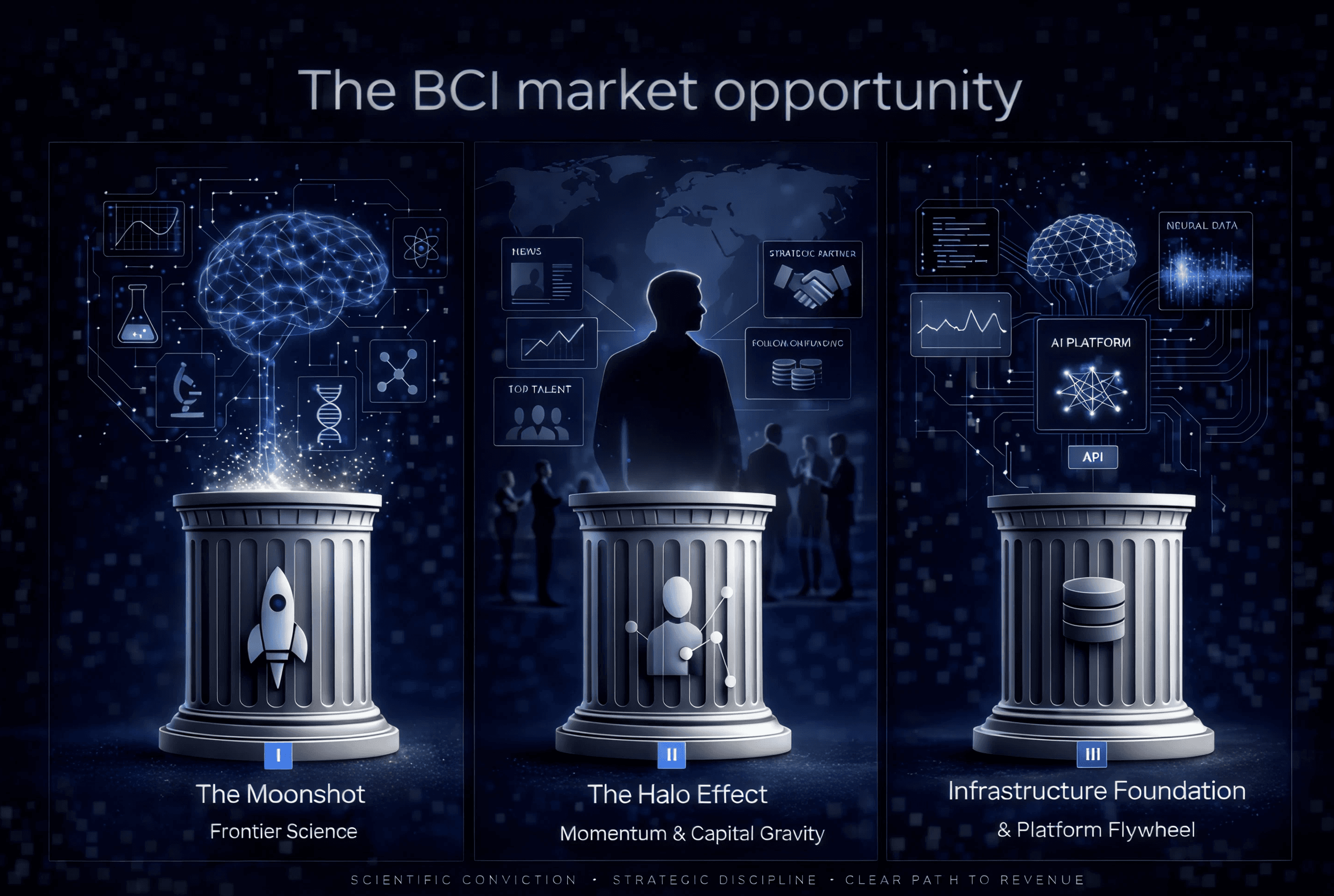
Across all three pillars, we expect one criterion: a clear and near-term path to revenue. Neurotechnology is a highly science-first market. Scientific ambition without a credible plan to generate revenue isn’t an investment - it’s a research grant. The founding teams that succeed will need to be both technically visionary and commercially sharp. They need to be able to build technology that becomes essential at every layer of the neurotech stack. The founders we back are rooted in scientific conviction. The companies they build are engineered for commercial scale.
Scope & Focus - neurotech beyond neural interfacing
We do recognise that neurotech as a field is far broader than neural interfacing alone, and we do understand that the scientific and commercial potential beyond it is real. Neuroscience- and biotech-aligned verticals, such as CNS[29] pharma, psychedelics research or brain drug delivery, as well as medical neurotechnologies carry their very own outstanding investment upside. We do consider every project on its own merits.
Our core neurotech investment thesis, however, is more precise. It revolves around the interface paradigm - the intersection of the human nervous system and our digital technologies, enabled by the electrochemical nature of our nervous system. At Delphi Ventures, we believe this is where the most consequential value can be created over the next decade. Partnering with founders, this is also where we can add the most genuine value: our network, scientific grounding and operating experience centre around the engineering and technology side of the field. We back the founders redefining the frontier of where neuroscience meets compute.
Risks and Headwinds
Neurotech is one of the most exciting investment opportunities of the decade. It is also one of the most complex. Sitting at the intersection of medical devices, AI and electronics, neural interfaces cover multiple regulatory frameworks, unresolved ethical questions and frontier engineering challenges simultaneously. These interdisciplinary forces make neurotech compelling but at the same time intricate to invest in without discipline. We have identified three headwinds that are structural enough to define which companies succeed and which don't. We sharpen our investment approach by confronting them honestly and by partnering with founders to navigate them.
On Cognitive Liberty
The lab-to-market translation problem in deeptech has had a long history of compelling science that never left the lab. The pattern of well-funded spin-outs stalling between proof-of-concept and Series A isn’t the exception but the default. Most neurotech companies die when trying to translate research results into durable, scalable systems. Regulatory timelines stretch; biocompatibility fails at scale; production processes that work in a university cleanroom rarely survive contact with contract manufacturing. We don't believe the engineering trends outlined in this thesis eliminate this risk. Instead, they reduce it and raise the bar for what we define as credible and capable founders. The projects we back will still face this translation - and we evaluate the founding teams as much on their ability to navigate it as on the quality of their underlying science.
The Translation Gap
With read and write access to the mind, deployment of neurotech raises questions that no previous technology has had to answer. Social media monetises attention; smartphones monetise location. Neural interfaces have access to something entirely different from previous technologies: unfiltered signals of human thought, including what we choose not to say or not to do. Society is only beginning to reckon with what that really means, and regulatory frameworks are being drafted today. The concept of “cognitive liberty” is an ethical issue that Western societies have rarely discussed on a large scale. The adoption curve for consumer neural interfaces - particularly invasive ones - will not follow a standard technology curve. It will instead be defined by whether the industry builds trust before it loses it. We treat ethical foundations and data governance as first-order concerns in every portfolio company, not afterthoughts. We back founders who understand that the right to neural privacy is essential to a product’s architecture, not simply a compliance question.
The Timing Problem
The “investment timing” argument cuts both ways. The same early positioning that creates arbitrage value risks being wrong about the timeline by years. Neurotech has been five years away from mass market adoption for the past two decades. However, previous waves of neurotech optimism were built on scientific promise. Our conviction is built on observable engineering trends: hardware costs that have already fallen by an order of magnitude, edge computing that already fits in an implant, materials that are already in clinical trials. That convergence is measurable today. The risk we see isn’t whether neural interfaces become the dominant HMI paradigm, but whether the companies building that foundation today survive long enough to own it, and we structure our portfolio accordingly.
None of these headwinds is an argument against investing in neurotech. They are a justification to invest with precision and scientific expertise. The lab-to-market problem separates scientists from entrepreneurs. The cognitive liberty question distinguishes platforms built on trust from those that aren't. The timing risk separates investors with genuine domain conviction from those that simply follow momentum. The field will inevitably produce category-defining companies. Within this thesis we define the right framework to identify real potential before the market does.
On Market Momentum & Timing
The clinical market for neural interfaces is already showing early signs of structural maturity. Reimbursement pathways are being established; M&A activity is accelerating as incumbents acquire validated technology rather than building it themselves[30]. In many ways, the medtech layer of neurotech has done its job: it has proved the science, trained regulators, established manufacturing standards. Within the next 2-5 years, we’ll see a range of neurotechnology-native medtech companies gaining clinical approval and pushing market momentum further. They’ll demonstrate that neural interfaces can be built, approved and adopted at scale.
At the same time, we are seeing more AI-native neurotech startups emerge as the technology prepares to reach broader markets[31]. Neural interfacing isn’t a bet on a single technology or company. It is a bet on a structural shift in how humans relate to machines. One we believe is as fundamental as the move from command line to touchscreen and considerably more consequential. The science has been compelling for decades; what has changed is the engineering. The three pillars in this thesis are our framework for investing in that shift with precision: backing the scientific founders who will define what becomes possible, the talent and capital attractors who will pull the ecosystem forward and the infrastructure builders who will own the foundation that everything else runs on. We are early because we see an opportunity to invest in this cohort at pre-momentum valuations. The technology is being proved at scale right now; the first platforms are being built and the window between early enough to capture foundational positions and late enough that valuations reflect the opportunity is beginning to close. The foundational layer of the next computing paradigm is being built - and we intend to back the founders who define it.
Nature, High-performance Brain-to-Text Communication via Handwriting (May 2021). Journal of Neural Engineering, Speech Motor Cortex Enables BCI Cursor Control and Click (May 2025)
Precedence Research, Neurotechnology Market Size, Share & Growth Rate 2034 (January 2025). Towards Healthcare, Neurotechnology Market Grows at 13.23% CAGR by 2034 (November 2025). Future Market Insights, Neurotech Devices Market Size & Forecast 2025-2035 (August 2025). InsightAce Analytic, Neurotech Devices Market Research Study 2026 to 2035 (February 2026)
Future Market Insights, Neurotech Devices Market Size & Forecast 2025-2035 (August 2025). InsightAce Analytic, Neurotech Devices Market Research Study 2026 to 2035 (February 2026). Future Market Insights, Spinal Cord Stimulators Market Size & Growth 2025 to 2035 (June 2025). SNS Insider, Deep Brain Stimulation Devices Market Projected to Hit USD 4.43 Billion by 2035 (March 2026). Expert Market Research, Transcranial Magnetic Stimulator Market Size Analysis 2035 (2025). Towards Healthcare, Cochlear Implant Market to Grow at 9.54% CAGR till 2035 (March 2026). Precedence Research, Brain Computer Interface Market Size to Hit USD 13.86 Billion by 2035 (January 2026)
Business Wire, INBRAIN Neuroelectronics and Merck KGaA, Darmstadt, Germany Collaborate to Develop the Next Generation of Bioelectronic Therapies (July 2021). Merck, Merck KGaA, Darmstadt, Germany and Inbrain Neuroelectronics Collaborate to Develop the Next Generation of Bioelectronic Therapies (July 2021)
NeuroFounders, How Coherence Neuro Is Developing a BCI to Fight Brain Tumors (October 2025)
Nature, A High-Performance Neuroprosthesis for Speech Decoding and Avatar Control (August 2023). Nature, A High-Performance Speech Neuroprosthesis (August 2023)
BusinessWire / Synchron, Synchron Debuts First Thought-Controlled iPad Experience Using Apple's New BCI Human Interface Device Protocol (August 4, 2025). BusinessWire / Synchron, Synchron To Achieve First Native Brain-Computer Interface Integration with iPhone, iPad and Apple Vision Pro (May 13, 2025)
Scientific Data (Nature), Continuous Sensorimotor Rhythm-Based Brain–Computer Interface Control Dataset (April 2021). A Low-Complexity Brain–Computer Interface for High-Complexity Robot Swarm Control (May 2022)
Nature - npj Parkinson's Disease, Chronic Adaptive Deep Brain Stimulation for Parkinson's Disease: Clinical Outcomes and Programming Strategies (August 2025). JAMA Neurology, Long-Term Personalized Adaptive Deep Brain Stimulation in Parkinson Disease: A Nonrandomized Clinical Trial (November 2025)
The body's internal sense of its own position and movement; the mechanism by which we know where our limbs are without looking at them.
Cell, Inner Speech in Motor Cortex and Implications for Speech Neuroprostheses (August 2025)
McClean Report, Microcontroller Unit Shipments Surge but Falling Prices Sap Sales Growth (August 2015). FactMR, MEMS Sensor Market Size & Share: Industry Growth 2034 (2024). MIT Technology Review, Inside Shenzhen's Race to Outdo Silicon Valley (December 2018)
International Journal of Medical Informatics, Stress monitoring using low-cost electroencephalogram devices: A systematic literature review (June 2025). Emotiv, EEG Machine Price: What to Know Before You Buy (February 2026). PLoS ONE, A scoping review on the use of consumer-grade EEG devices for research (March 2024)
GIES College of Business, iVenture alum lands $1 million Shark Tank investment for PSYONIC and Ability Hand (February 2024)
Stanford Institute for Human-Centered AI, Artificial Intelligence Index Report 2025 (April 2025). Nature Communications, The Road to Commercial Success for Neuromorphic Technologies (April 2025). Columbia Engineering, A Wireless, High-Bandwidth Brain-Computer Interface on a Single Silicon Chip (BISC) (December 2025). Semiconductor Engineering, Is In-Memory Compute Still Alive? (December 2024). Nature Electronics, A Wireless Subdural-Contained Brain-Computer Interface with 65,536 Electrodes and 1,024 Channels (December 2025). Science Daily, Scientists reveal a tiny brain chip that streams thoughts in real time (December 2025)
Imperial College London News, MintNeuro: redefining neurological interventions with bioelectronic implants (December 2022). Startups Magazine, Pioneering scalable semiconductor technology for next-gen neural implants (July 2025)
Briefings in Bioinformatics, Oxford Academic, Deep Learning Approaches for Neural Decoding Across Architectures and Recording Modalities (March 2021). Nano-Micro Letters, Springer Nature, Non-Invasive Brain-Computer Interfaces: Converging Frontiers in Neural Signal Decoding and Flexible Bioelectronics Integration (January 2026)
ACS Chemical Neuroscience, Brain Tissue Responses to Neural Implants Impact Signal Sensitivity and Intervention Strategies (January 2015). PubMed / Journal of Neural Engineering, Implanted Neural Electrodes Cause Chronic, Local Inflammation that is Correlated with Local Neurodegeneration (2009)
Nature Communications, Bio-Inspired Electronics: Soft, Biohybrid, and "Living" Neural Interfaces (February 2025). Advanced Electronic Materials, Current Developments and Challenges in the Field of Biohybrid Neural Interfaces: A Scoping Review (October 2025). Applied Sciences / MDPI, Flexible Micro-Neural Interface Devices: Advances in Materials Integration and Scalable Manufacturing Technologies (December 2025).
Journal of Medical Internet Research, An Integrated Brain-Machine Interface Platform With Thousands of Channels (July 2019)
BusinessWire, World's First Human Graphene-Based Brain Computer Interface Procedure (September 2024). PCB Barcelona, INBRAIN Neuroelectronics announces promising results from the first human study of its graphene-based brain-computer interface (October 2025)
Science Corporation, Biohybrid neural interfaces: an old idea enabling a completely new space of possibilities (November 2024). bioRxiv, Optogenetic Stimulation of a Cortical Biohybrid Implant Guides Goal Directed Behavior (November 2024)
Nature Communications, Non-Invasive Ultrasonic Neuromodulation of the Human Nucleus Accumbens Impacts Reward Sensitivity (November 2025)
Neurotech Futures / Substack, 2024 Neurotech Funding Snapshot: $2.3 Billion Across 129 Deals (March 2025). Neurotech Futures / Substack, 2025 Neurotech Funding Snapshot: $4.8 Billion Across 140 Deals (January 2026). PitchBook, Neuralink Implantation Marks Milestone for Startups in $8B Neurotechnology Vertical (January 2024)
TechCrunch, Elon Musk's Neuralink Closes a $650M Series E (June 2025)
DARPA.mil, Next-Generation Nonsurgical Neurotechnology (N3) Program (ongoing). Journal of Neuroscience Methods, DARPA-funded efforts in the development of novel brain-computer interface technologies (April 2015)
BusinessWire via Synchron, Synchron to Achieve First Native Brain-Computer Interface Integration with iPhone, iPad and Apple Vision Pro (May 2025). Snap Newsroom, Welcome NextMind (March 2022)
MedTech Dive, Medtronic Inks Deal to Build Brain-Computer Interface into Surgical System (January 2026). MassDevice, The top 10 neurotech stories of the year so far (October 2024)
Central Nervous System: the brain and spinal cord, the body's primary command and control architecture
Life Science Intelligence, Medtech M&A: Power Moves in 2024 Set the Course for 2025 (December 2024). Deloitte.com, Three Key Trends Likely to Shape Medtech in 2026 (January 2026). Neurotech Reports, CMS Policy on Transcutaneous Auricular Vagus Nerve Stimulation (taVNS) (2024–2025)
Centre for Future Generations, Neurotech Consumer Market Atlas: How the Sector is Making Moves into the Mainstream (June 2025). BiopharmaTrend / Where Tech Meets Bio (Substack), 2025 Neurotech Review: BCIs, Brain Delivery, Organoids & Neuro-AI Move Closer to Clinic (January 2026)