Escape Velocity For The Final Frontier
|
Piers Kicks
Since we first looked up, the sky has been a ceiling priced in dollars-per-kilogram. That price is now in freefall, and a falling cost curve is the quiet engine beneath every industrial revolution — steam, steel, transistors, bandwidth. Launch cost is next, and the industries waiting on the far side of its collapse will be unrecognisable.
“Two possibilities exist: either we are alone in the Universe or we are not. Both are equally terrifying.” - Arthur C. Clarke
Every industrial revolution is catalysed by a price collapse in a single input. Steam. Steel. Transistors. Bandwidth. The price of leaving Earth is about to undergo its most aggressive compression ever. Since the dawn of humanity we have looked up in awe at the burning night sky, one of the few truly universal experiences we share with our ancestors stretching millions of years across time. Amidst the turbulence of the modern era, I believe mastery of our cosmic environment is uniquely capable of propelling us toward abundance, resilience, and unity.
Today, reusable rockets are collapsing the cost of reaching orbit by orders of magnitude, and the sci-fi of yesteryear is beginning to manifest as industrial activity in orbit and on the Moon. What exists on the other side of this wave will be unrecognisable. Most people think of space as a niche, when in reality it is already a ~$626 billion industry. Our model suggests a credible path to $10 trillion annual revenues in the coming decades. It underpins the bleeding edge of modern life: a constellation of atomic clocks synchronising global markets to the nanosecond, orbital eyes tracking ghost ships across the open ocean, and an extraterrestrial mesh drawing the world's most remote communities into the heartbeat of the modern web. In myriad ways you, dear reader, rely heavily on space.
This report explores the coming age of space entrepreneurship through a single mechanism: launch cost. This is the metric around which all else revolves. Unlike any other input, a 10x fall does not only make existing businesses cheaper, it enables previously impossible ones. In the same way that some of the best founders in the world are already building under the assumption that AGI awaits, we believe the same is true of keen observers of the trends outlined in this report. We open with the status quo as 2026 finds it, then examine five price thresholds along with the qualitatively new classes of business each enables. From there, we explore how SpaceX could become the most important company ever, the obstacles that could break the thesis, and what it means for where we invest.
My hope in writing this is not only to elucidate the marvellous acceleration of this new landscape, but to evoke some sense of curiosity for what lies beyond. The 21st century has set the stage for humanity’s next steps into the cosmos. Driven by an insatiable demand for energy in an ever more sophisticated civilisation, this harsh environment may well hold some of the answers we seek. If we are to spread the light of consciousness beyond our pale blue dot, the window to do so appears to be opening. It may not stay open forever.
TL;DR
The price of leaving Earth is collapsing on a defined curve. Each threshold changes what can be built, who the customer is, and where venture-scale value accrues.
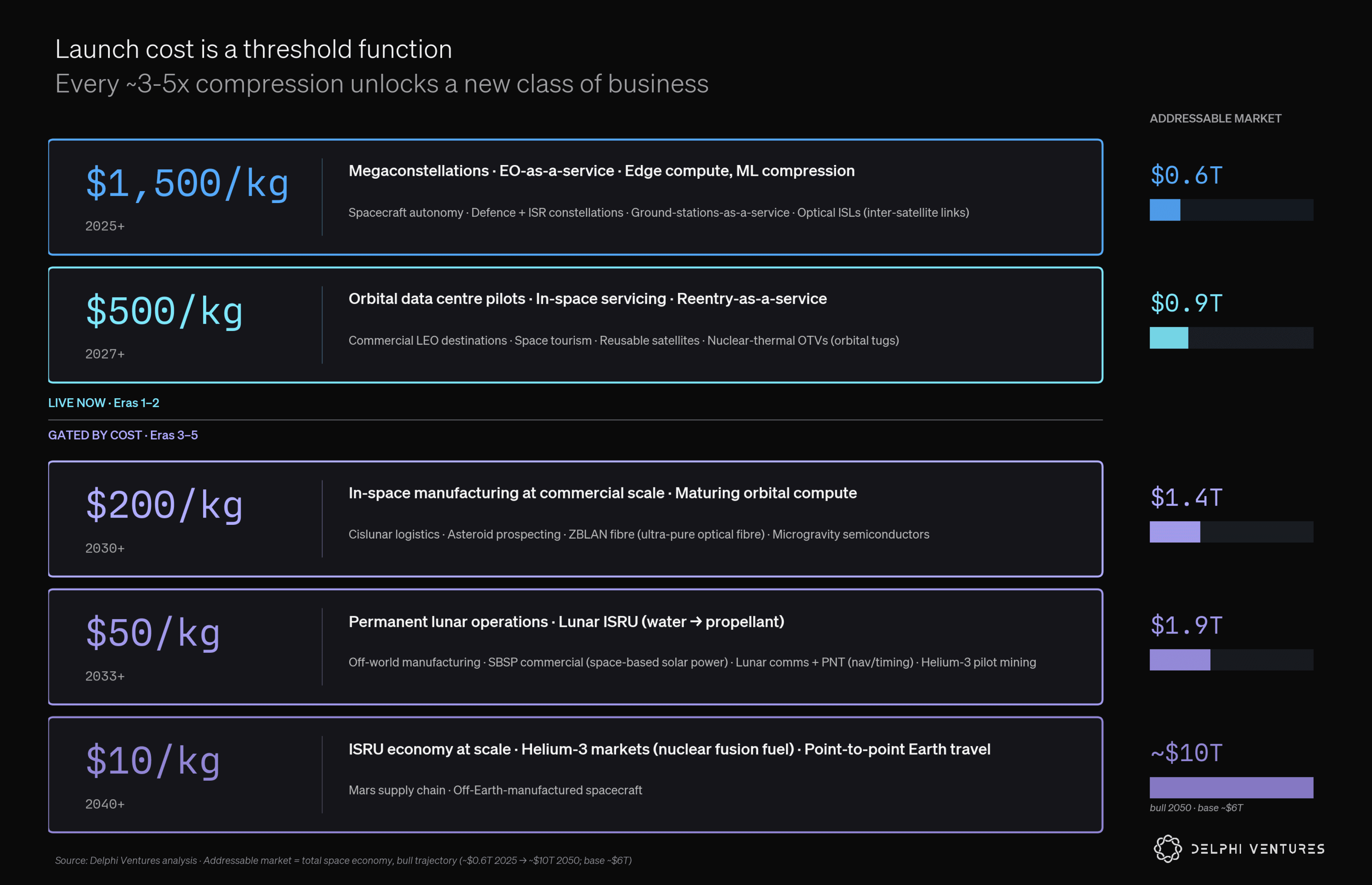
Each era enables entire industries. $1,500/kg gave us megaconstellations (thousands of satellites flying as one network) and Earth observation (selling imagery and data about the planet). $500/kg opens orbital compute and commercial space stations. $200/kg opens microgravity manufacturing at scale. $50/kg unlocks a lunar economy. $10/kg underpins the Mars supply chain.
The SpaceX IPO is the macro validation event. This is perhaps the most important company of the 21st century, and will command humanity’s attention for decades well beyond near-term price action.
A founder cohort is about to be minted. A liquidity event of this scale unleashes 500+ senior SpaceX employees with founding-team capital and world-class pedigree. We expect the next 10 years to yield amazing opportunities.
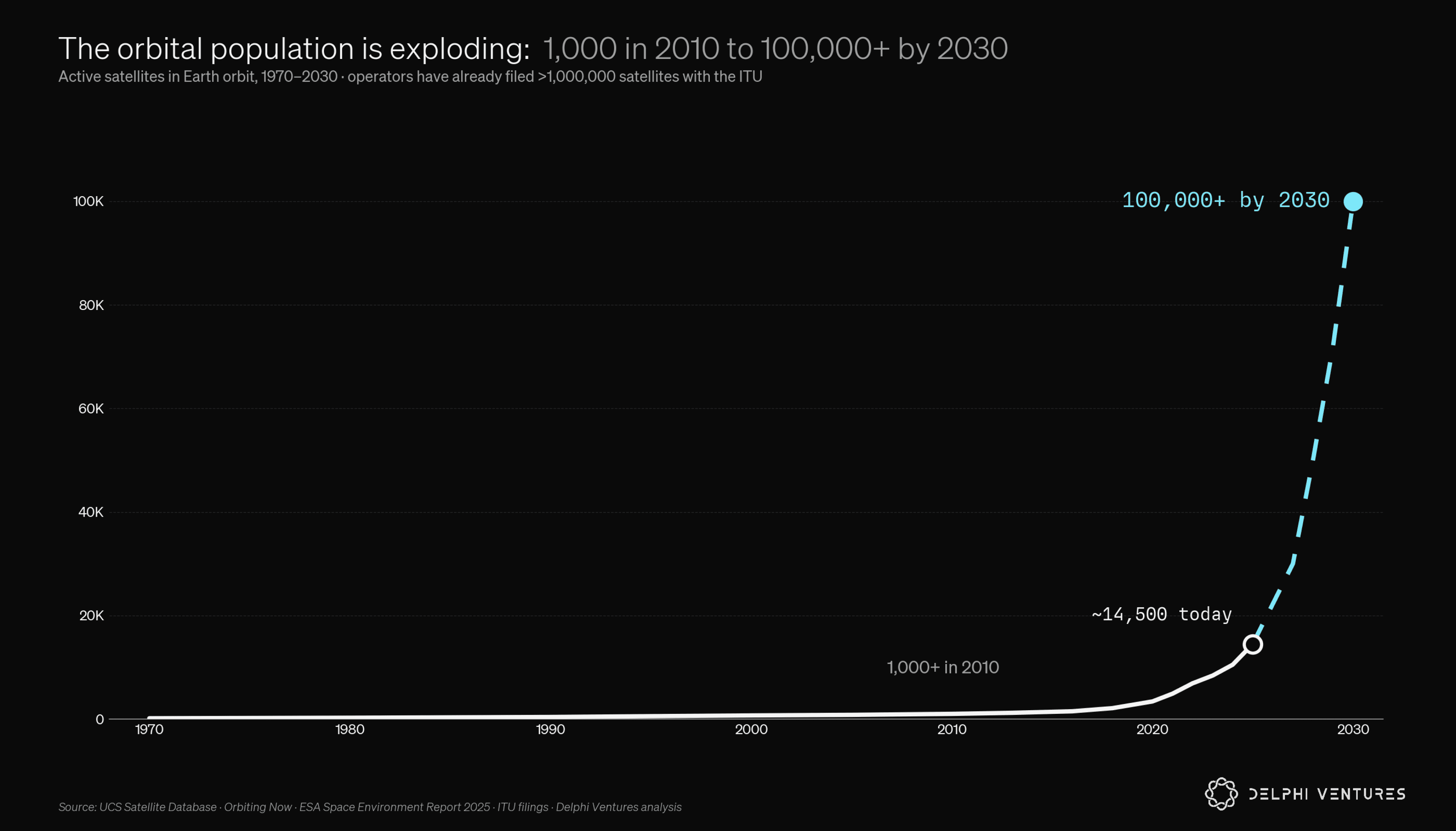
The satellitte population is ballooning. From 14,500 today, we expect well over 100K by 2030 and into the millions by the end of the next decade. The range of applications is dizzying.
The alpha sits in the bottlenecks. Cheaper launch does not make every space business work; it moves the binding constraint. To us, the most interesting founders in 2026 are the ones building for tomorrow’s market and thinking through creative solutions to downstream problems. The best entrepreneurs are already building for cost realities that do not yet exist.
What would change our mind: Kessler syndrome (a snowballing orbital collision wrecking infrastructure), the cost curve stalling higher than expected, regulatory freeze, or demand failing to show. None kills the thesis outright; each can move the timeline far enough to matter for venture returns.
In hindsight, it will be obvious that the price per kilogram to orbit was one of the most important numbers of the century: the input that allowed the final frontier to reach escape velocity.
Where we stand in 2026
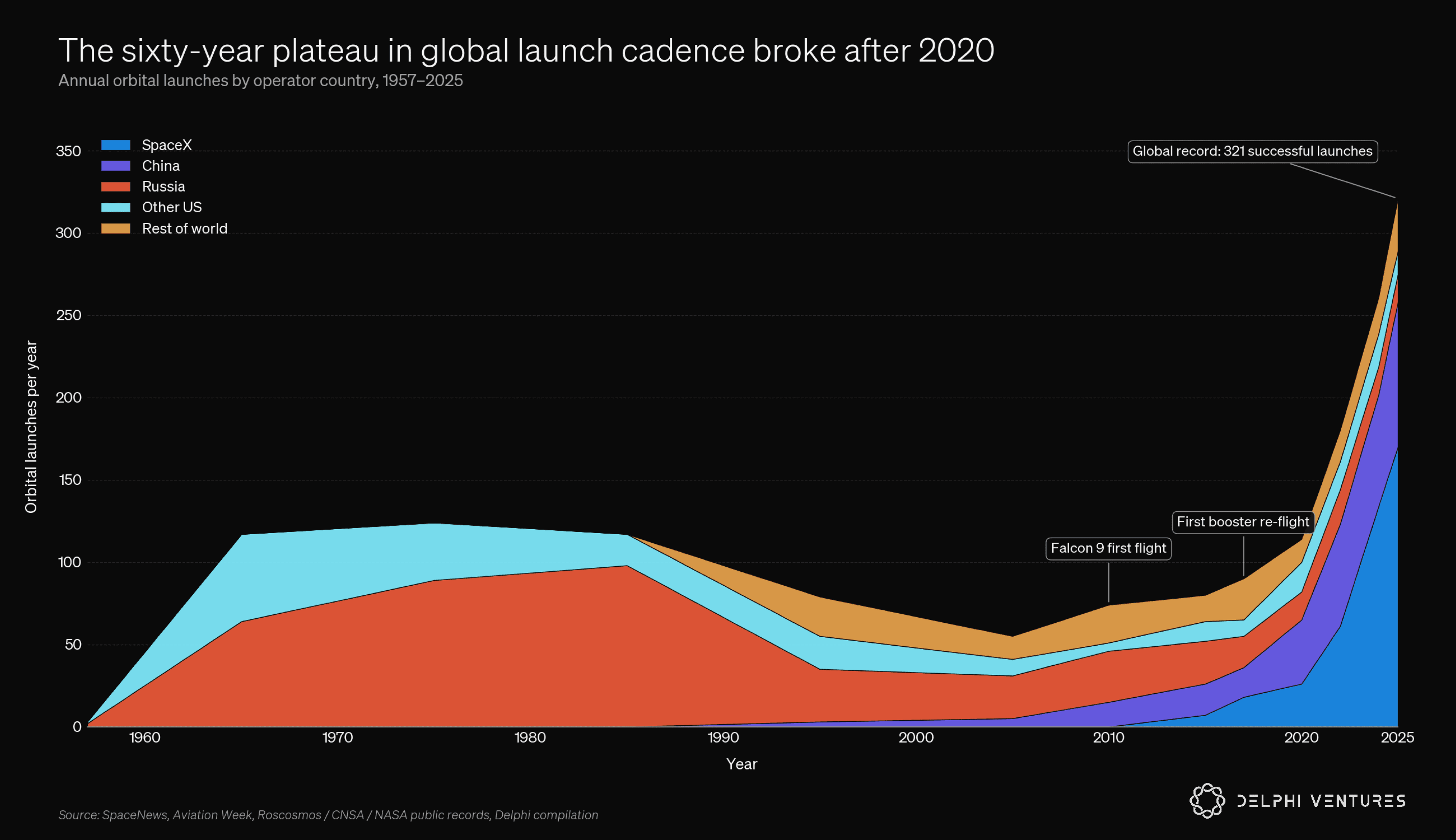
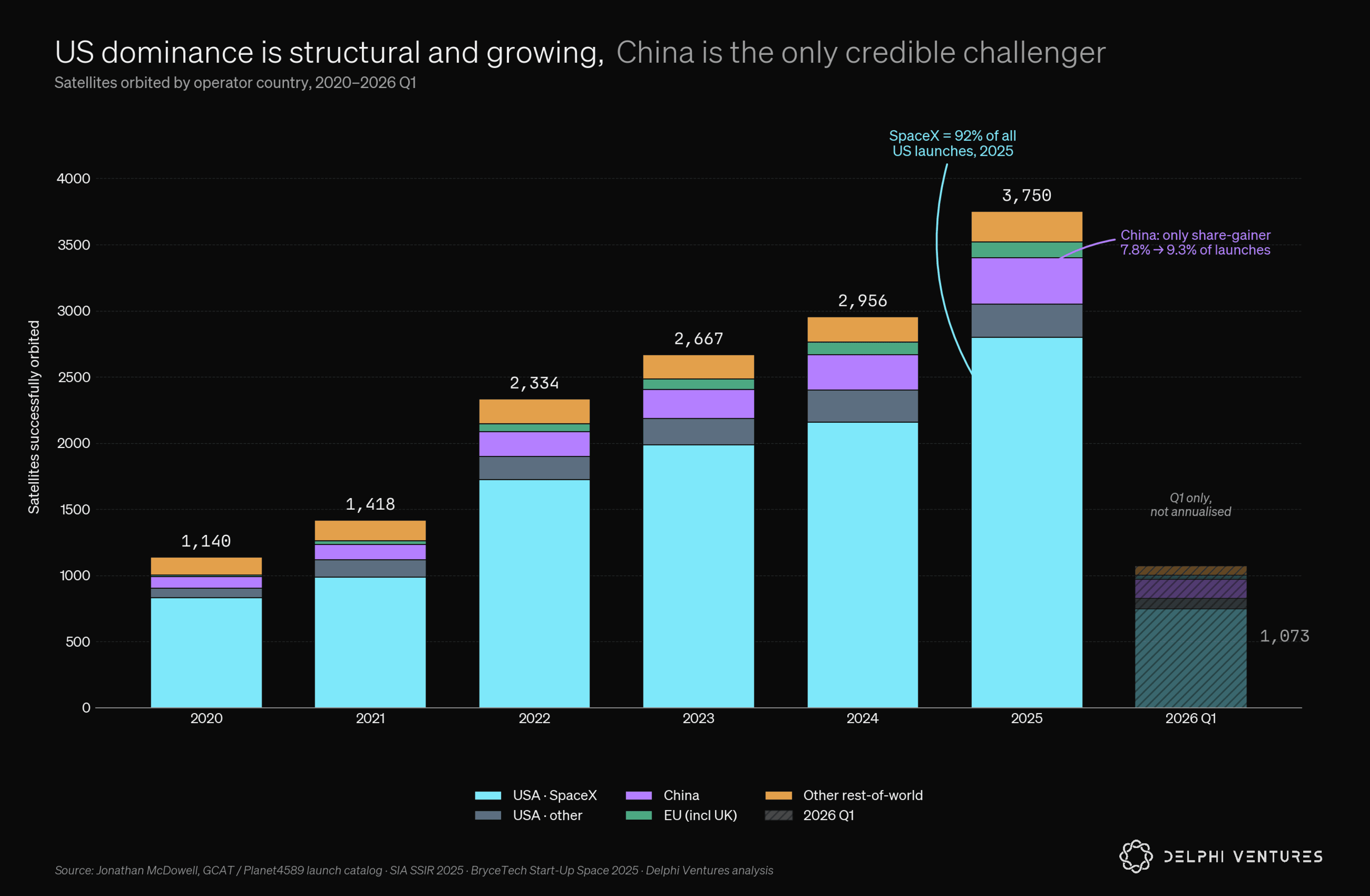
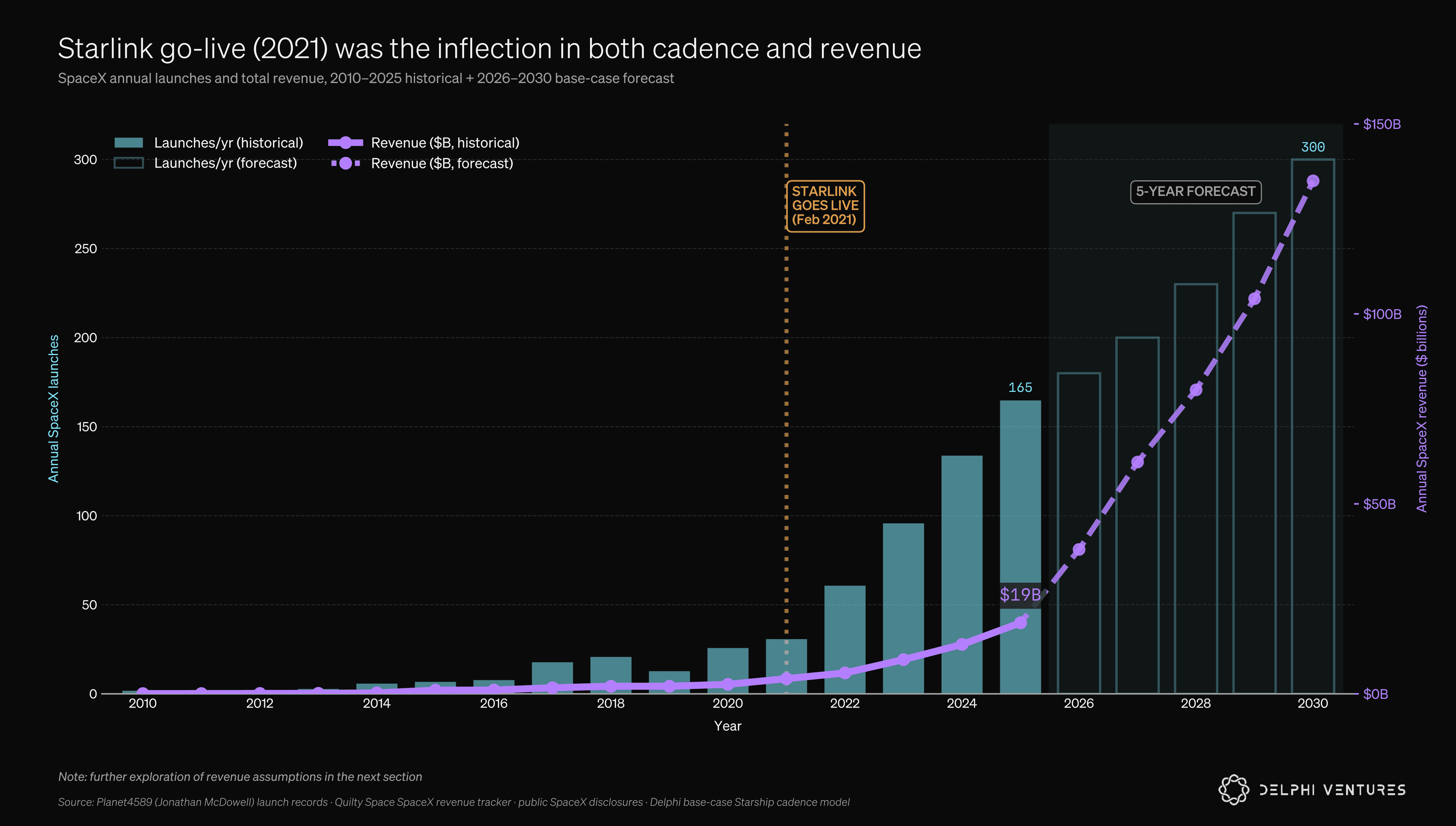
One company has bent reality. In 2016 SpaceX flew 8 orbital missions. In 2025 it flew 165: a twentyfold rise in under a decade, more launches than the entire rest of the world combined, and by payload mass more than the rest of the planet put together for six years straight. Through Starlink it now operates almost 75% of all manoeuvrable satellites in orbit, the largest constellation ever assembled.
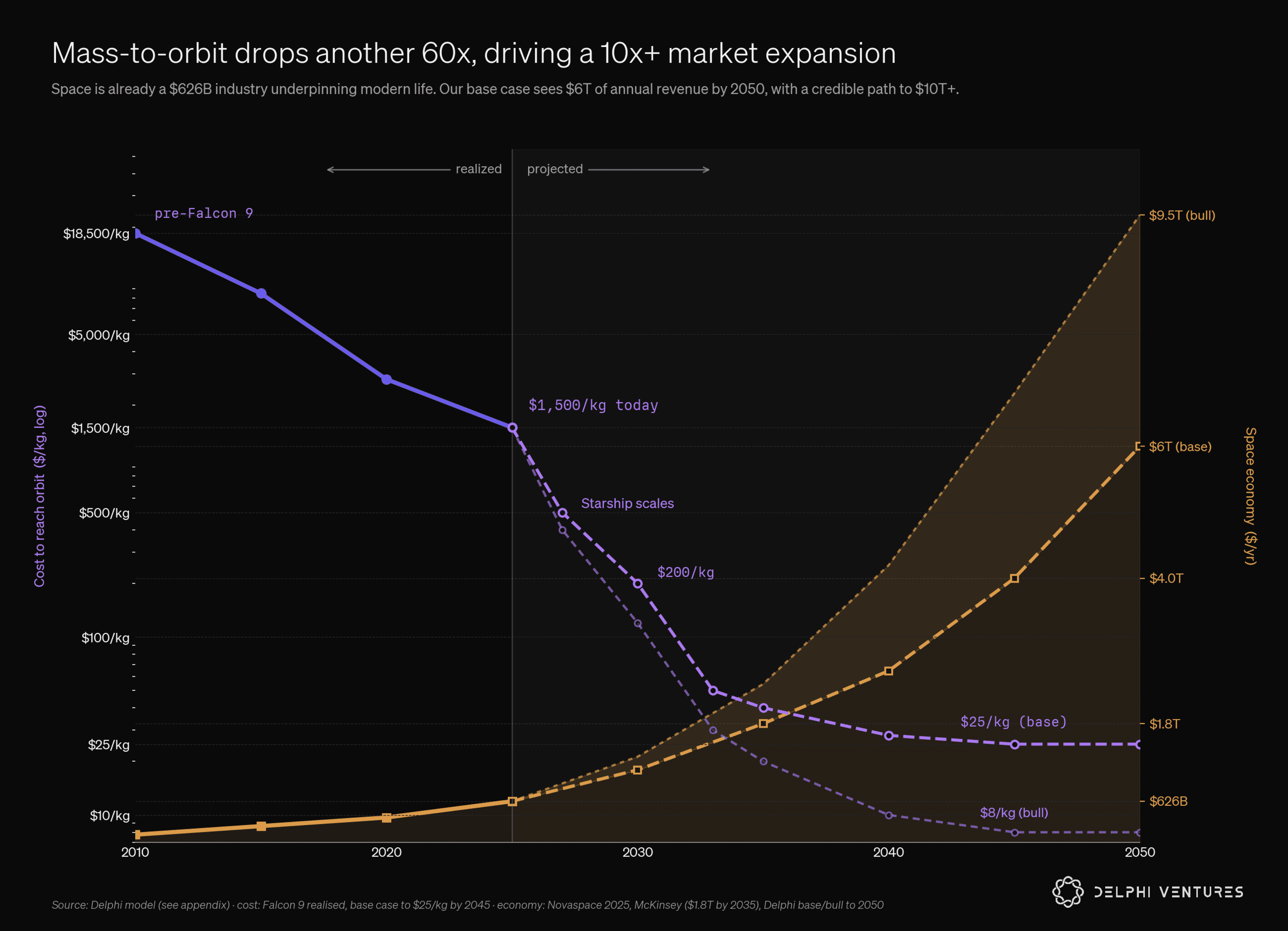
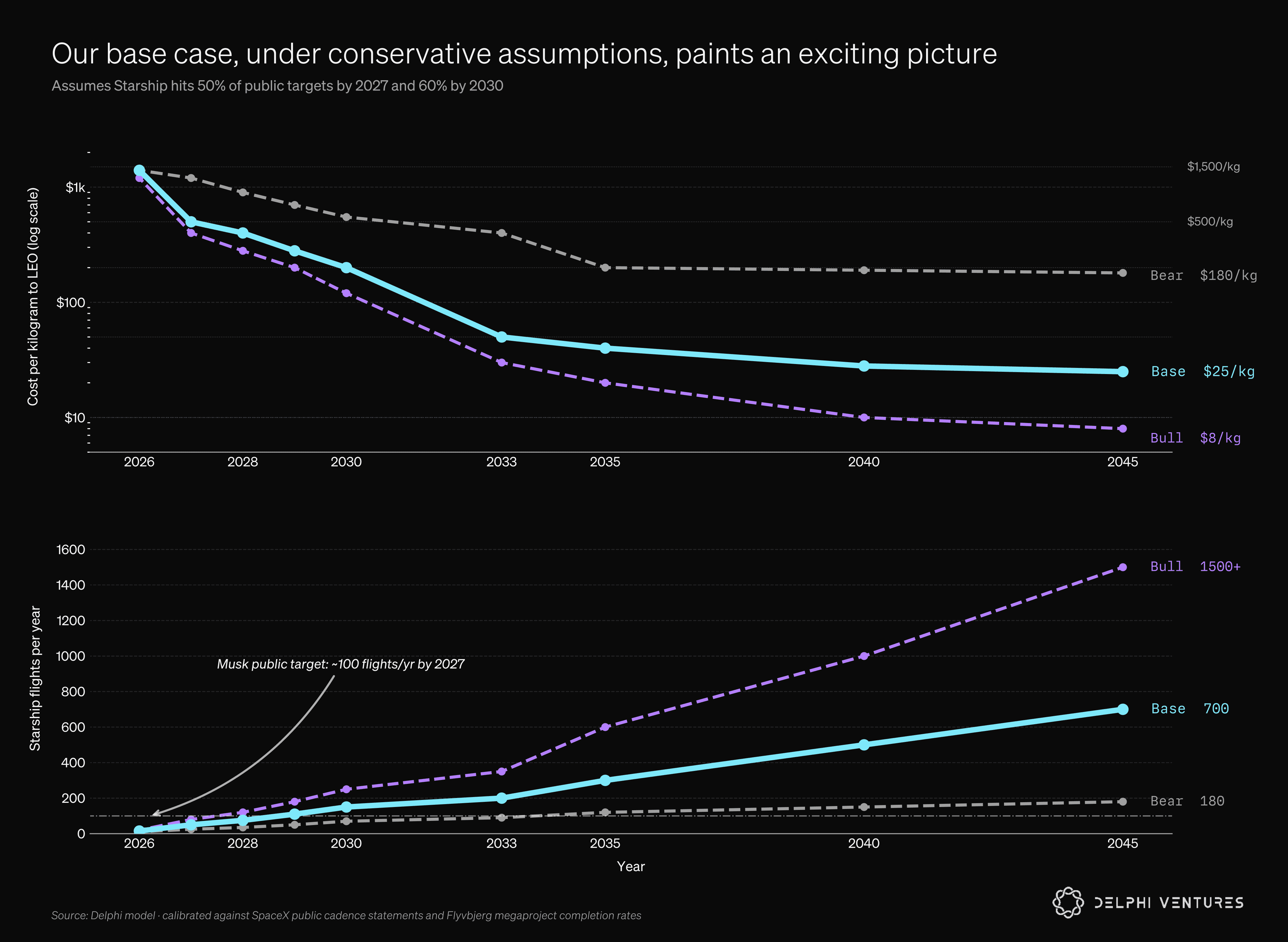
The cost of reaching orbit, which barely moved for the first sixty years of the space age, has fallen more than tenfold in fifteen years, and on our base case shows another 60x compression by 2045.
What makes the coming decade categorically different from the last is not any single breakthrough but a convergence, each force pulling the others forward:
Reusability is now routine. Falcon 9 boosters are certified for 40 flights, with one already past 33. Starship has demonstrated almost all of the critical pieces of full reuse, and works towards same-day turnarounds on their fleet.
The manufacturing machine awakes. Across Starfactory and Gigabay, SpaceX isn't just building rockets; they are building a machine that builds the machine, aiming to churn out up to 1,000 Starships a year. They are turning rocket science into an assembly line.
Demand is arriving to meet the supply. Putting data centres in orbit read as science fiction in 2019 and is now funded. @Starcloud_ ($2.2B), @CowboySpaceCorp ($2B) and SpaceX itself are exploring the build out in response to terrestrial power constraints.
Capital has followed. 2025 was a record ~$12.4B of venture funding into space tech, up 48% year on year, and Q1 2026 was the strongest quarter yet at ~$8B.
The Moon has reopened. The US’ @NASAArtemis is funded into the mid-$90Bs seeking humans on the moon by 2028 and a lunar nuclear reactor by 2030, a record cohort of private landers flew and landed on the moon in 2025, and China’s ILRS targets a crewed South Pole presence in the 2030s. The Moon is no longer NASA’s alone.
The global space economy reached a record ~$626B in 2025 and is projected to cross $1.8T by 2035 (McKinsey). Roughly 78% of it is now commercial and rising. Space has crossed from a government-led industry with commercial participation to a commercial-led industry with a government backstop. A third of the sector’s commercial revenue is national-security work, the industry’s anchor tenant. The 2022 to 2024 SPAC chill flushed out the weakest players; what remains is a concentrated bench of credible operators, financed by capital that looks like cloud infrastructure in 2014, a category proven but not yet commoditised.
With the James Webb Space Telescope peering backwards in time to the dawn of the universe and the Artemis programme returning humanity’s attention to the Moon, the curious among us are once more drawn to the mystery of space. The coming decade will unleash a level of wonder about our place among the stars not seen since Apollo. As Carl Sagan once said:
“Our remote descendants, safely arranged on many worlds throughout the Solar System and beyond, will be unified by their common heritage, by their regard for their home planet, and by the knowledge that, whatever other life may be, the only humans in all the Universe come from Earth.”
The $1,500/kg Era (2025–2027): Industrial Rocket Capacity
We are in the $1,500/kg era right now. That is Falcon 9’s internal cost for a kilogram of payload to LEO. The published rideshare rate sits at $350,000 for fifty kilograms, a ~80% margin the company retains to fund the next vehicle. As new competitors (Blue Origin, Rocket Lab) emerge, this compresses.
For the first time in the history of the sector, the price a serious operator pays is low enough that an orbital business plan can be underwritten off a concrete risk profile. This is the era where a generalist VC can write a cheque and be wrong only about a specific company, not about the category.
Megaconstellations are no longer a thesis; they are live infrastructure. @Starlink fields more than ten thousand active satellites, comprising 75% of every active manoeuvrable spacecraft in orbit, with over 10 million subscribers.
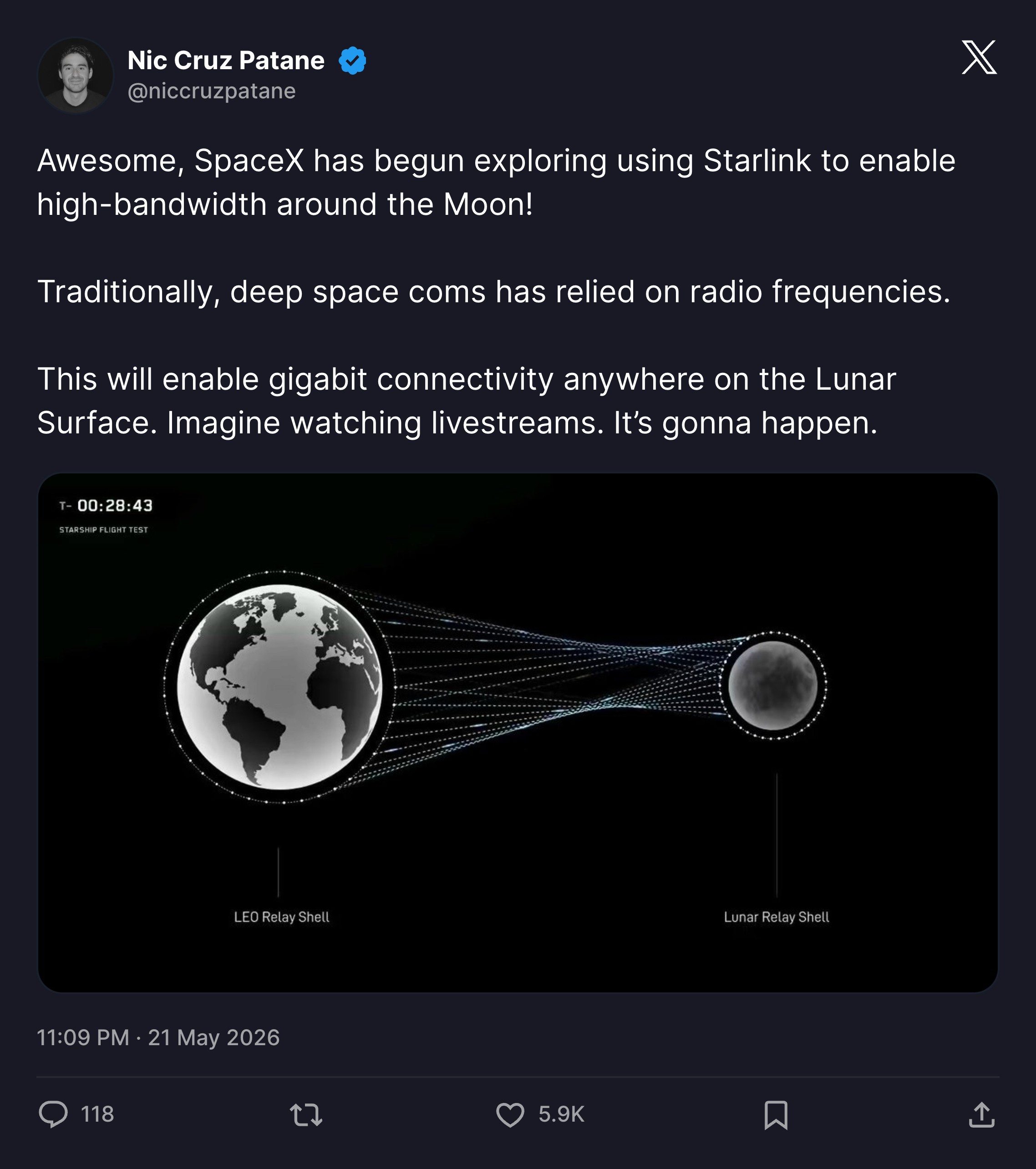
Its network now processes ~600 Tbps of bandwidth. At any given second of the day, the entire human race collectively consumes around 3,000 Terabits of data. That means Starlink's network capacity is already mathematically equivalent to carrying up to 20% of the entire planet's real-time internet traffic simultaneously. The network is expected to grow into multi-petabytes of capacity next year. Amazon Leo (formerly Project Kuiper) is mid-deployment; China’s Guowang and Qianfan are accelerating.
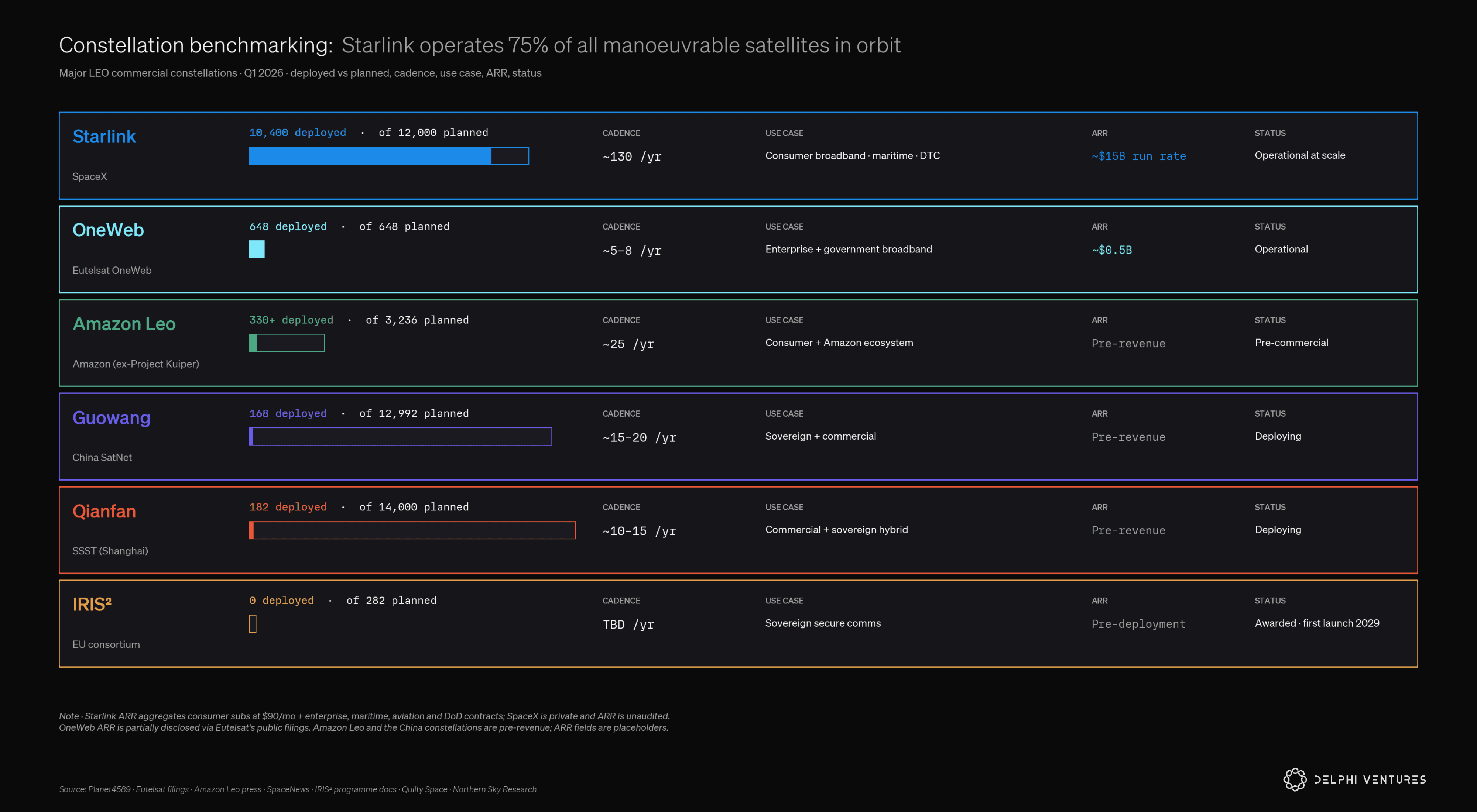
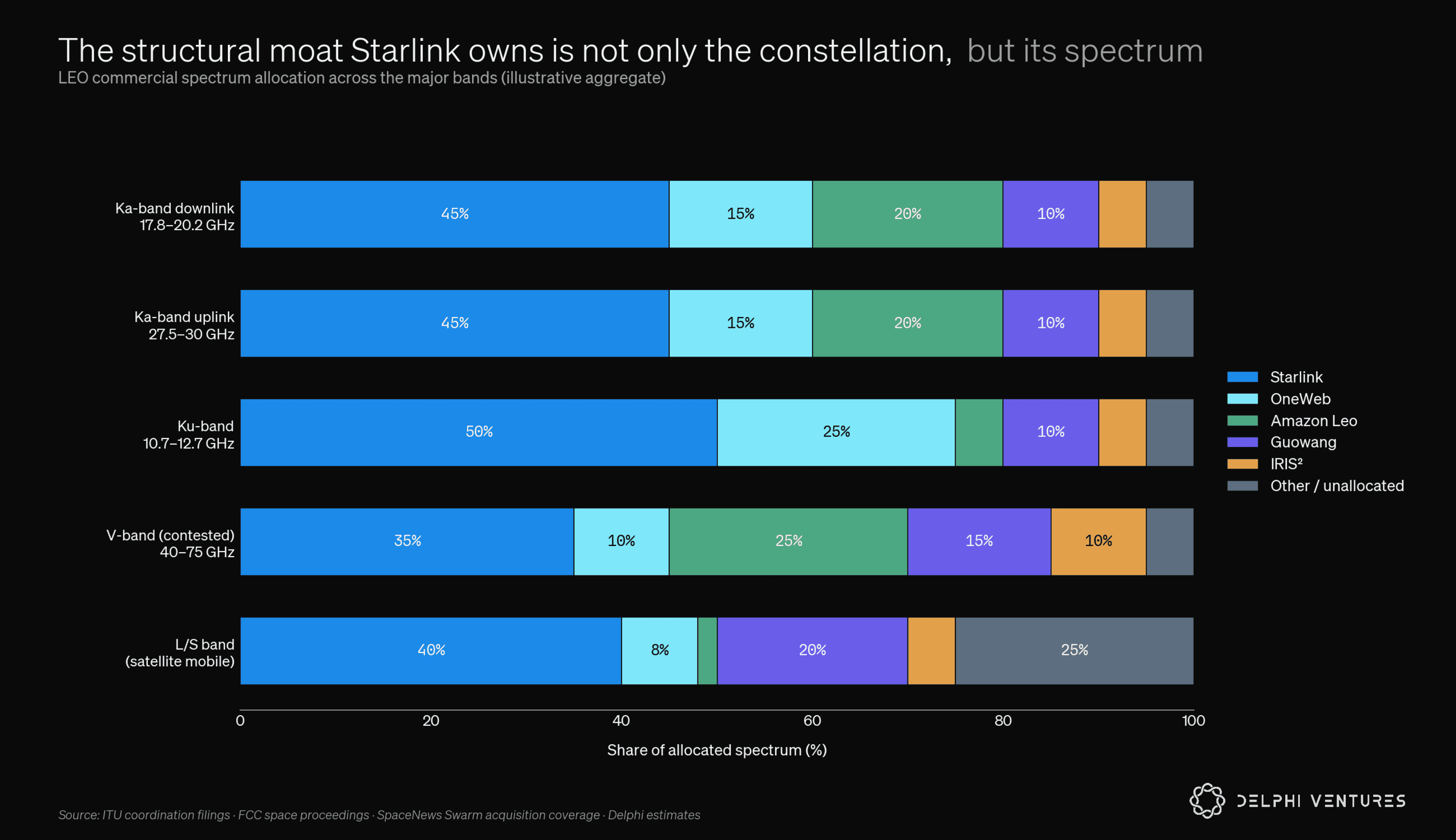
Spectrum is an asset class of its own. This refers to the radio frequencies a satellite is licensed to broadcast on, and is a critical aspect of operations. SpaceX’s ~$524M acquisition of Swarm was a VHF-rights play, not an operating-business one. A 10,000-satellite constellation with insufficient downlink spectrum delivers less total throughput than a 2,000-satellite constellation with grandfathered Ka-band rights. The issuance of new spectrum is tightening, so it’s likely these dominant players will ossify. Regulators are increasingly enforcing strict "use-it-or-lose-it" milestone deadlines to prevent spectrum warehousing, leaving newer entrants with zero margin for operational error. Look no further than Amazon Leo, is at risk of demotion on spectral priority by the FCC as it's likely failing to meet its strict July 2026 constellation-deployment deadline. They were supposed to have 50% of the 3,236 planned live by this date, and instead have just 330 active following major setbacks.
Earth observation as a service taught enterprises that fresh imagery has API value. Planet Labs did that for the optical layer; ICEYE leads in synthetic aperture radar. The differentiator has moved from the pixel to the inference: on-orbit edge ML now compresses a ten-terabyte daily downlink into a ten-gigabyte signal before it touches the ground, which alters both unit economics and customer mix.
A growing application layer sits on top, taking imagery as feedstock and producing decisions. @KoBold_Metals (backed by Gates, Bezos, Altman; valued at ~$3B at its last priced round) uses satellite imagery alongside geophysical data to identify mineral deposits, having discovered the Mingomba copper deposit in Zambia that projects 300,000 tonnes of annual production by 2030. Teams like Hubble unlock global IoT infrastructure through a Bluetooth-connected satellite network. These are not space companies in the legacy sense; they are application-layer firms whose product would not exist without the underlying satellite layer being cheap. Expect the pattern to repeat across mining, energy, insurance, defence intelligence, and catching sanctions-busting oil tankers in the ocean.
Spacecraft autonomy as a service is the newest of the four and the one we expect to be most underpriced by generalist investors over the next twenty-four months. A constellation at Starlink scale contains more spacecraft than any operations team can meaningfully fly. EraDrive’s $5.3M oversubscribed seed in December 2025 was a clear example: AI-powered vision that lets spacecraft navigate, operate, and collaborate without a ground controller in the loop. Whoever builds it first occupies the position ROS holds in robotics today: a de-facto standard that every downstream operator builds against, and the durable edge goes to whichever SDK developers actually standardise on.
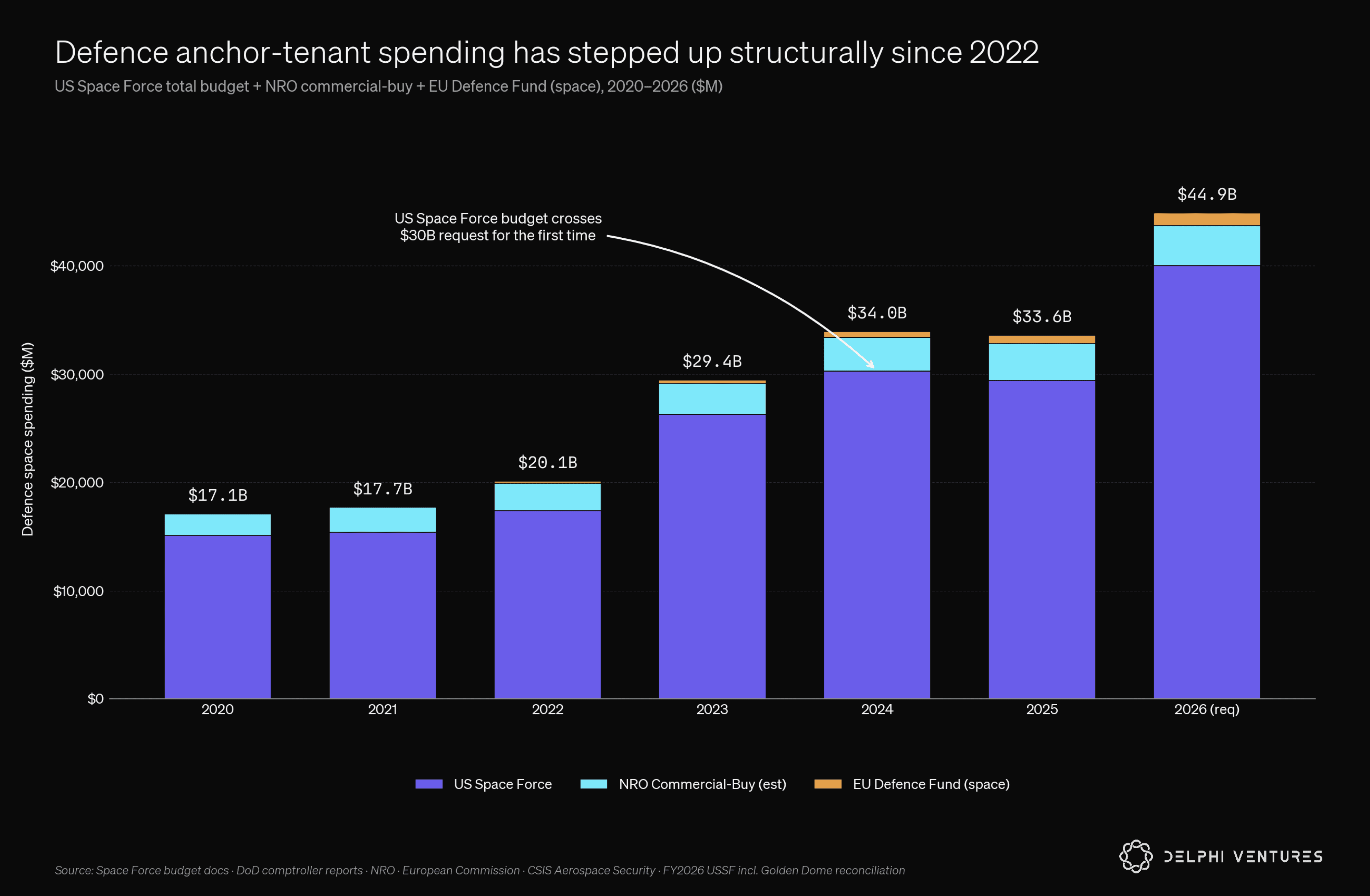
The defence lane is a significant engine. Approximately 30–40% of revenue underneath the commercial veneer of this sector is classified or quasi-classified national-security work. For geographies such as the EU, procurement remains a material pain point due to cumbersome bureaucratic processes, and reform is required if they are to become competitive in the global arena. (For full spectrum, ground-segment, and defence detail see appendix).
The sci-fi fringe of 2026 includes @reflectorbital, selling on-demand sunlight from orbital mirrors to terrestrial solar farms; Lonestar, escrowing disaster-recovery data in orbit; AstroForge, who lost their first asteroid probe in space; and Celestis, who are working on space burials. A small cohort is still pitching orbital advertising (cry) which remains mercifully unfunded.
In the $1,500/kg era, the money is in bits delivered through atoms: imagery, connectivity, signals, edge compute, and the autonomy stack on which all four scale. The atoms-in-space businesses come next.
The $500/kg Era (2027–2030): Maturing Orbital Infrastructure
The $500/kg era is the first in which the physical economy of space starts to emerge. At $1,500/kg the orbital business case is information; below $500/kg, it is also matter. Life-extension (topping up a satellite's fuel in orbit so it flies for longer ), orbital habitation, reentry as a commercial service, and on-orbit servicing each hit a customer-economics inflection somewhere in this band.
Starship operational, with cadence still ramping, is what gets us here, with New Glenn (despite minorsetbacks), Rocket Lab Neutron, and Stoke Space Nova as the supporting cast. The competitive structure shifts from “SpaceX and the rest” to “SpaceX, two credible heavy-lift entrants, and a layer of medium-lift specialists." Margin compression is the predictable consequence that will help keep driving costs down; and cadence growth is the important one.
Orbital data centres. This is the largest catalyst for industry revenues observed. We expect at least one of the major tech companies to commit first-party orbital compute infrastructure rather than buy it as a service and SpaceX itself to scale up efforts to serve xAI’s needs. The power-cost asymmetries of space increasingly favour orbit .
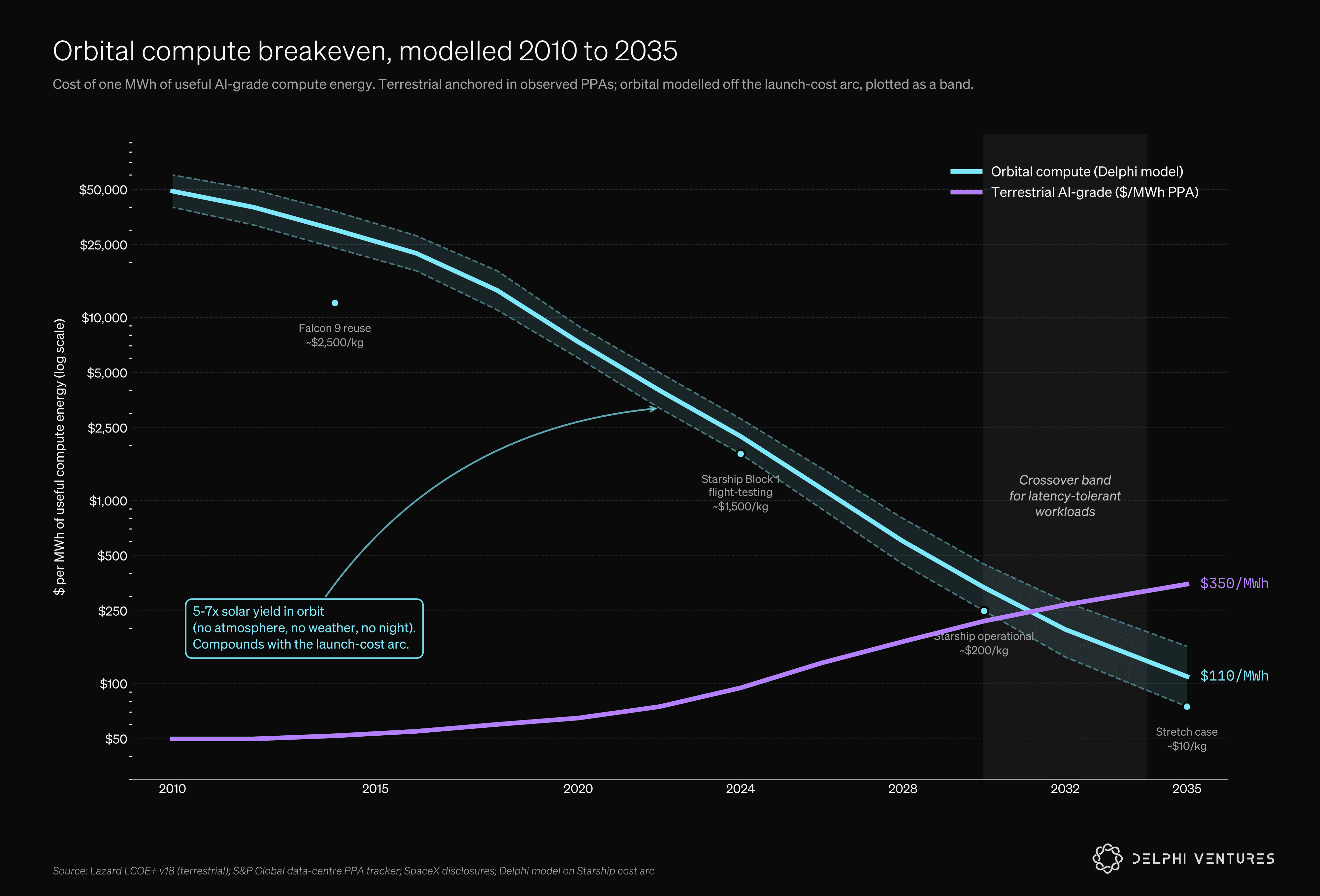
Despite debate around the technical feasibility of scaling this, it's clear that the Sun is the answer. Every few milliseconds it outputs more energy than our species has consumed across all of history. If we could fully capture one second of it, Earth would be powered for half a million years. Since beaming energy through our atmosphere is inefficient (70% loss), converting it to tokens in orbit and transmitting it as valuable bits seems like a logical endgame. It is clear that a truly advanced civilization will require this capacity at some stage, so I welcome this catalyst. Let the abundance mindset into your life.
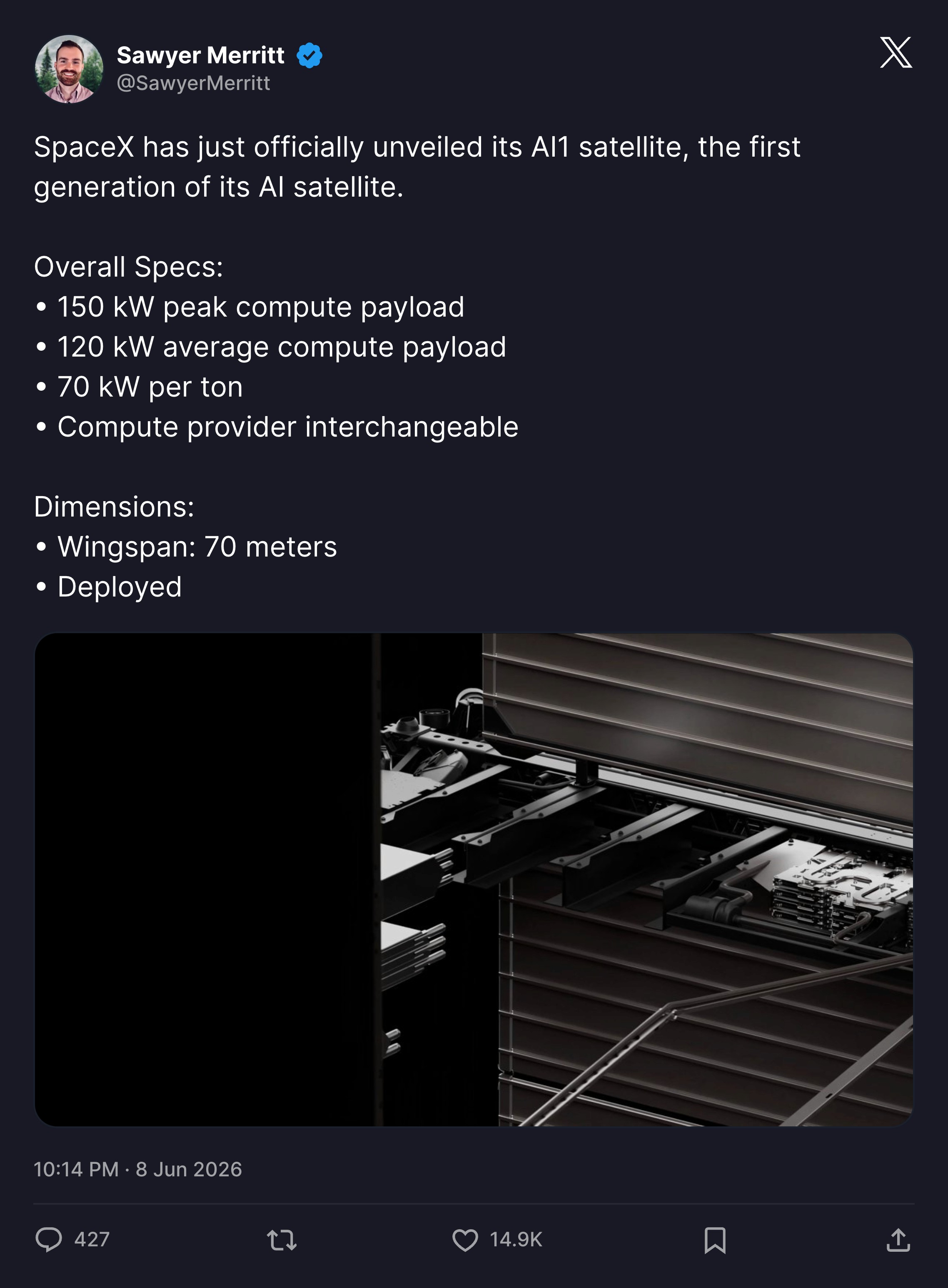
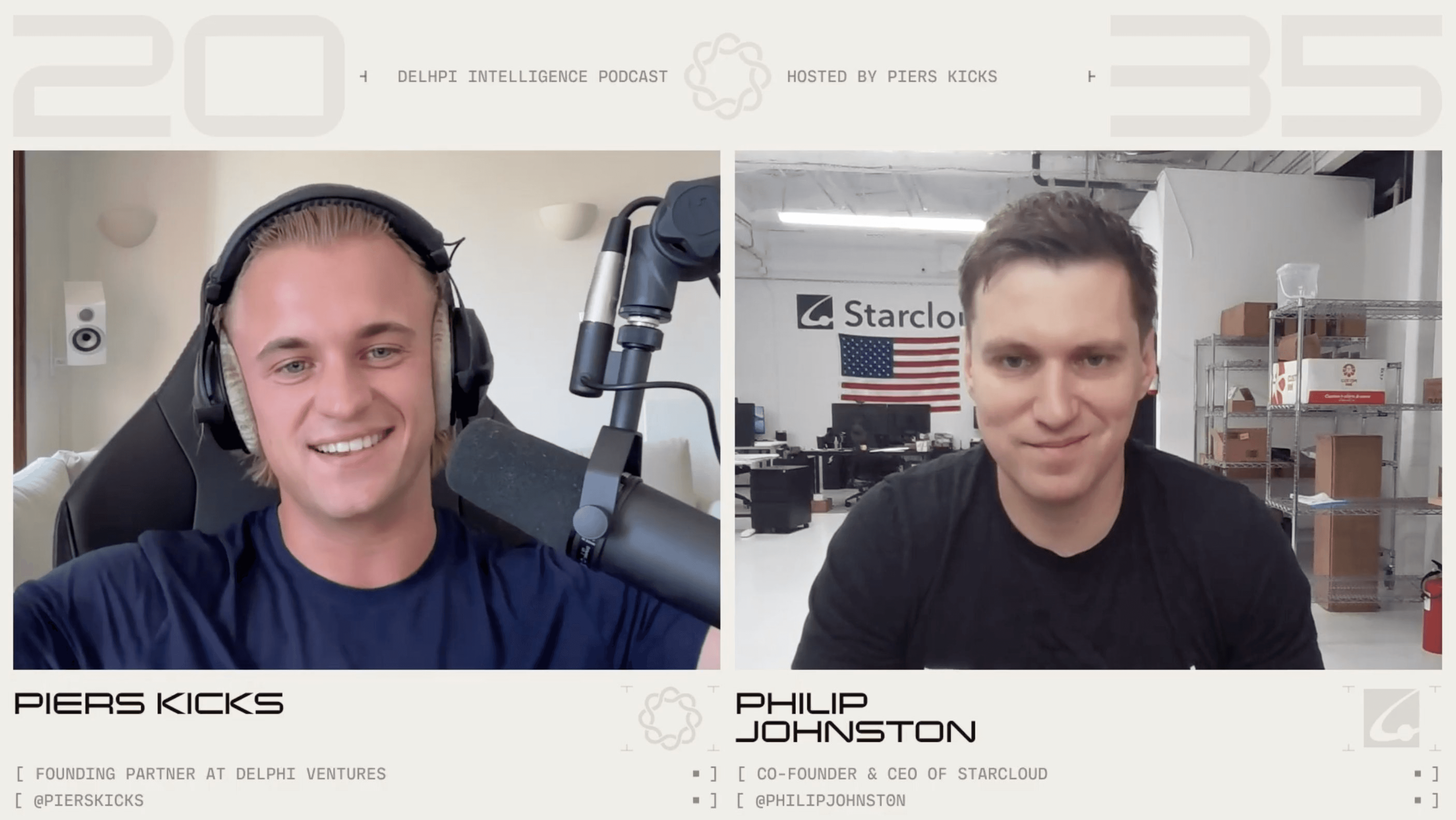
Between Starcloud and Cowboy Space, the 2027–2030 pilot-to-production crossover is the critical juncture for establishing a broad ecosystem. I still haven’t heard a good answer to how we shield tens of billions of dollars of equipment from the next Carrington Event. See our interview with the Starcloud CEO@PhilipJohnstonhere.
In-space servicing and refuelling at scale. Orbit Fab proves the viability of this infrastructure; Starfish Space moves from technology-demonstration revenue to recurring servicing contracts. The gating constraint is standards: a shared fuelling-port specification across Western primes is the precondition for the market clearing.
Robotic labour is the enabler of industrial work in space. GITAI is building arms for on-orbit servicing and construction and has already flown demonstration hardware; Rocket Lab is pulling Motiv Space Systems in-house as its robotics arm; and seed-stage entrants like Icarus Robotics are betting embodied AI can take on the cargo handling and maintenance that today consumes scarce astronaut time. The bet is that heavy industry in orbit will be done by machines, supervised by people. Our fragile organic form is woefully unsuited to space.
Commercial LEO destinations. Vast Space launches Haven-1 in early 2027 and is the front-runner for the post-ISS era with Haven-2. ISS retirement in 2030 is the forcing function. By 2030, between two and four privately operated stations will be in orbit, with the survivors having locked in NASA-anchor revenue and beginning to attract pharmaceutical, semiconductor, and tourism workloads. The appendix names the four serious bidders for NASA’s Commercial LEO Destinations (CLD) programme, the successor framework to the ISS.
Reentry as a commercial service. This is one of the components Delphi cares most about in this era. You cannot have an in-space manufacturing without a reentry thesis. Varda Space Industries demonstrated the round-trip with its Winnebago capsule and has run multiple successful reentries to its Utah recovery zone. Inversion Space is preparing its Arc lifting-body vehicle for first flight in 2026. SpaceX just received FAA approval for Starfall, its basic reentry pallet. The unit economics that matter here are not launch-cost; they are downmass cadence: how quickly you can bring things back from orbit, not just send them up. By 2030, Reentry-as-a-Service transforms downmass from an exotic, one-off mission profile into a standardised, recurring-revenue utility line. More in the appendix.
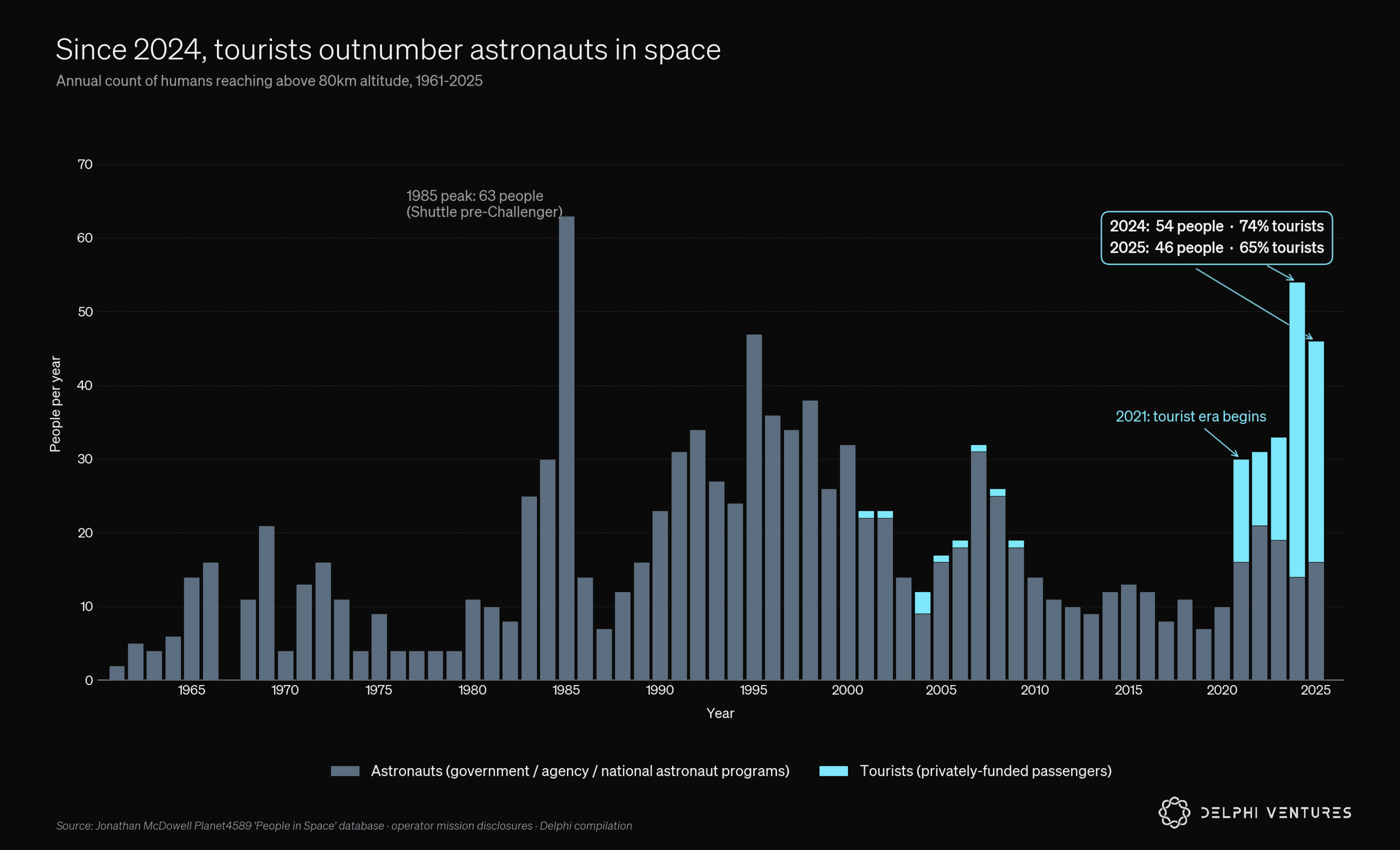
Space tourism at scale (orbital flights). Axiom private-astronaut missions (~$55M a ticket) becoming routine, plus the first dedicated SpaceX free-flyer tourist mission, combine to produce 100+ passengers per year by 2030. Small in revenue share, but it keeps attention on the heavens above. We expect this to fall to the $1-5M/seat range over the next decade, and $50-100k for suborbital flights.
The structural shift: At $1,500/kg the buyer of launch was almost always also the operator. At $500/kg the launch and operations layers cleanly separate, the way airlines do not build their own aircraft. The company flying the payload stops needing to be the company that launches it. It mirrors the semiconductor industry between 1985 and 2005: TSMC’s foundry model commoditised silicon manufacturing, and differentiation moved to fabless designers who never owned a fab. SpaceX is becoming the TSMC of launch: deliberately overbuilt manufacturing capacity, deliberately commoditised pricing for external customers, and the value capture moves up the stack to the operators who design the payloads and own the customer relationships.
The $500/kg era is when our orbital infrastructure begins to mature. In-space servicing is robust, and early manufacturing pilots begin to mean the trip down matters as much as the trip up.
The $200/kg Era (2030–2033): Space Begins Production
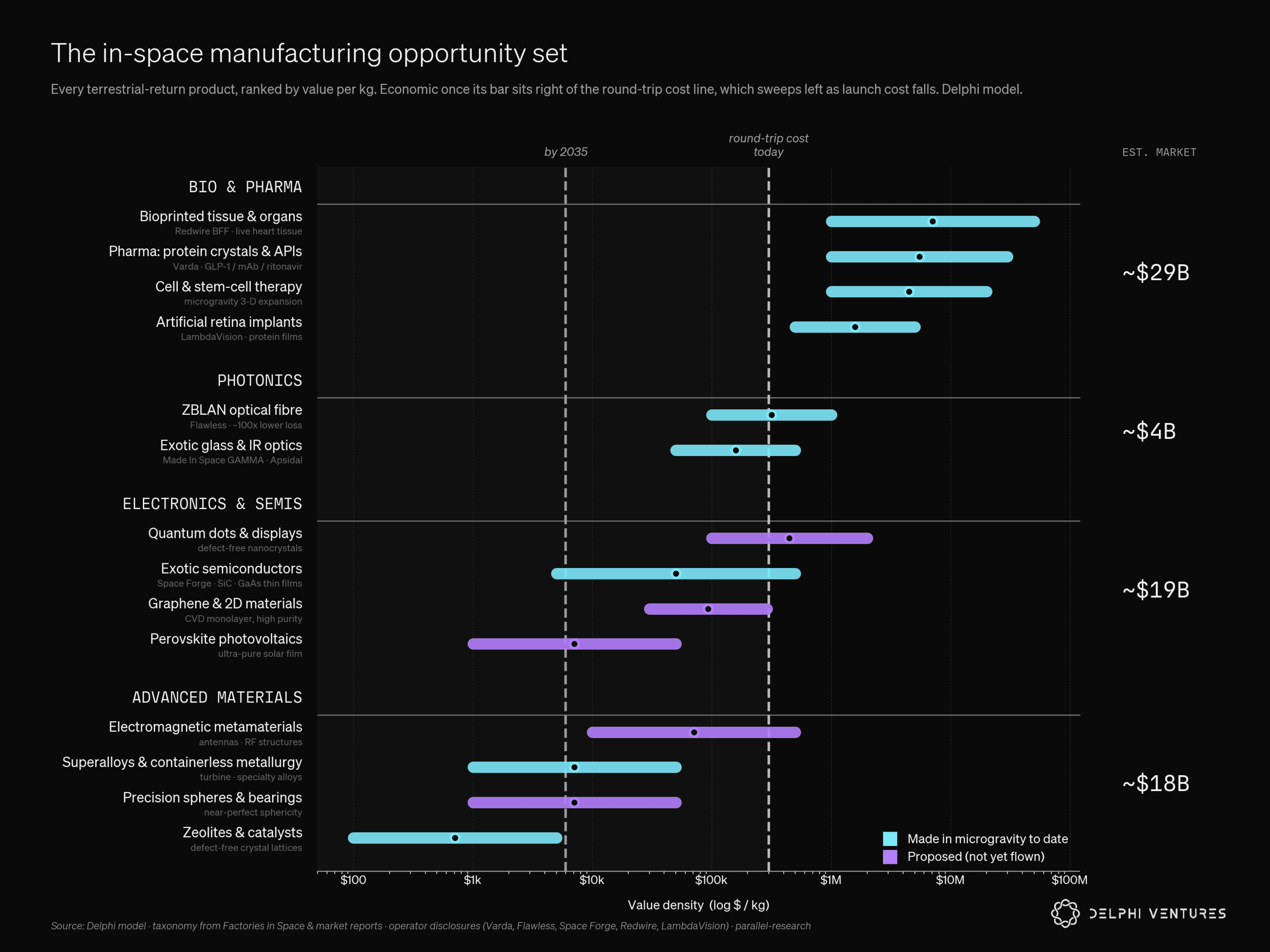
At $200/kg the calculus reverses. This is the era in which in-space manufacturing crosses the breakeven threshold for at least three product categories. The reentry layer built out in the previous era is now core infrastructure. The total addressable market for in-space manufactured goods sold back to Earth crosses $10B annually for the first time.
In-space manufacturing. Varda is the leader in making medicine in space, flying robotic mini-labs into orbit and bringing them back in its Winnebago capsule fleet, focused on drugs that gravity ruins on Earth: complex proteins for cancer therapies, fragile custom chemical combinations, and pills whose molecular shapes only form perfectly in zero gravity. Mass Balance is building SpaceFold: a new biology model that leverages microgravity behaviours to patch the blindspots (disordered proteins) of AlphaFold. This allows for rapid protoyping on Earth to use scarce space time to maximal effect. For materials, Hyperion is scaling up as a UK entrant going after off-world production of exotic materials. Space Forge has generated the first plasma aboard ForgeStar-1, the precursor step to semiconductor-grade production in microgravity.
Crucially, the hardware required for all of these is tightly coupled to the materials manufactured, so a lot of engineering goes into form factor here. The market structure resembles early biotech: a handful of pure-play producers, a much larger field of vertical-specific applications, and gross margins inflated by the inability of any terrestrial substitute to replicate the product.
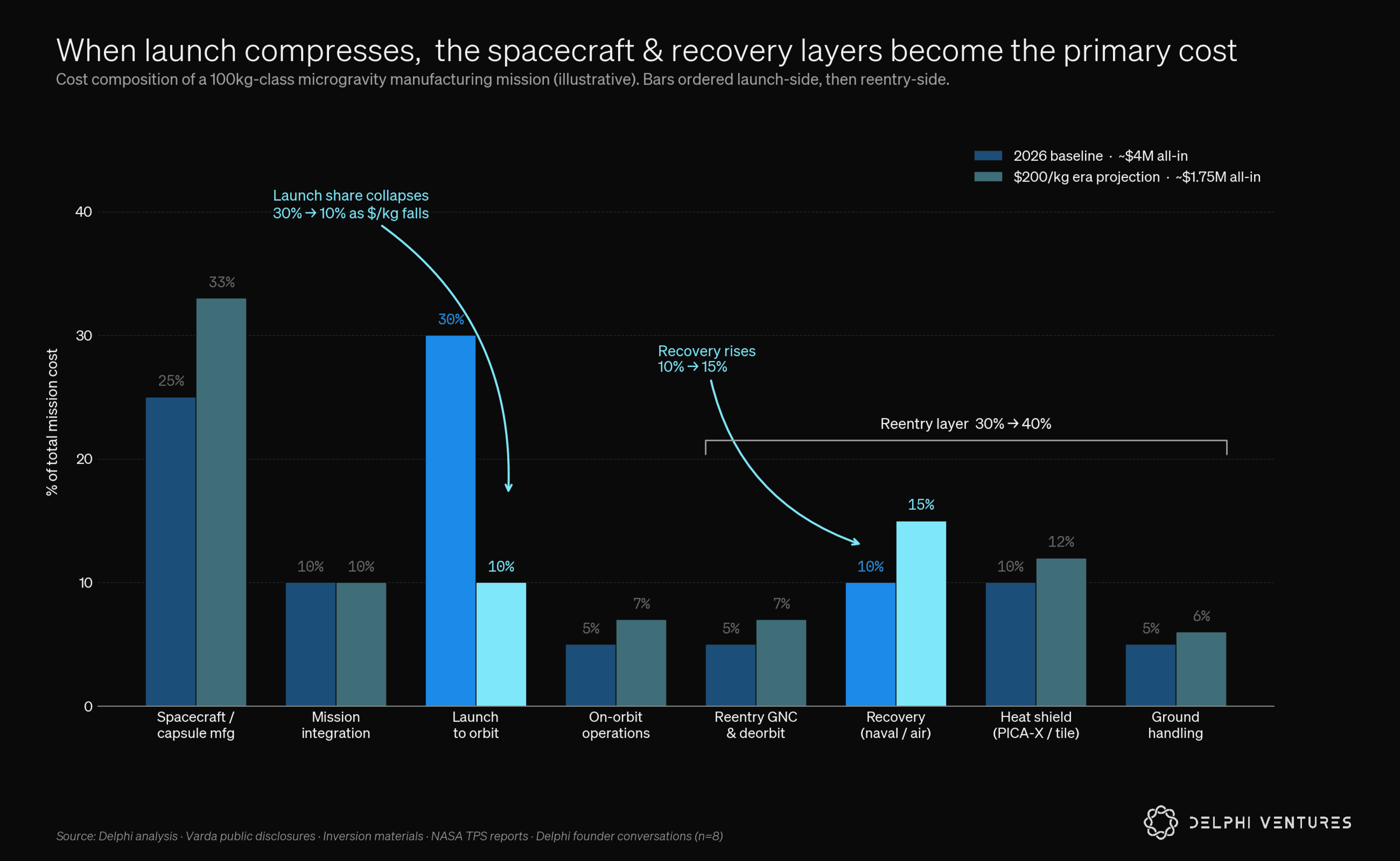
Reentry as half the value chain. By 2030 the reentry layer is the equal partner to the orbital manufacturing thesis. A kilogram returned to Earth from a $200/kg launch costs roughly twice the launch number once you fold in recovery, heat shield, and ground handling, implying a round-trip cost of ~$600/kg. The reentry operators become the FedEx of the orbital economy, and the spatial concentration of recovery zones becomes a strategic question.
The lunar economy begins to look like an ongoing logistics route rather than a series of one-off missions, with Impulse Space running regular kick-stage missions between LEO and cislunar space. This is a small dedicated propulsion bus that delivers a payload from a low-cost rideshare launch position to a high-energy destination orbit, much like a last-mile delivery van picking up cargo from a distribution hub.
The NASA Lunar Gateway is operational, with Artemis missions building significant momentum. Space-based solar power (SBSP) sees more pilots, though as mentioned earlier it is far more likely that orbital compute and manufacturing will consume the marginal kilowatt-hour in orbit before anyone bothers beaming it down at significant efficiency loss. Both SBSP and early asteroid-prospecting are considered in this era and explored in the appendix.
The $200/kg era is when the economic value framework shifts. Instead of space being a “cost center” where we launch things that generate data but ultimately die, it becomes a commercial factory that exports high-margin, physical goods back to the global economy.
The $50/kg Era (2033–2040): Industrial Lunar Foundations
The $50/kg era is the era in which real estate on the Moon begins to look a lot less speculative. Lunar surface operations move from sporadic scientific missions to a continuous logistics tempo that resembles the early phase of Antarctic research-station infrastructure: government-anchored, increasingly commercial, and internationally contested.
The composition of the lunar regolith presents an opportunity for establishing a proper industrial base, 40–45% by weight is oxygen. In-situ resource utilisation (ISRU) becomes a major focus. Once we process regolith at scale, a world of opportunity awaits: propellant, breathable atmosphere, water for life support, sintered habitats, solar-array substrates, and ultimately the structural metals for off-Earth manufacturing.
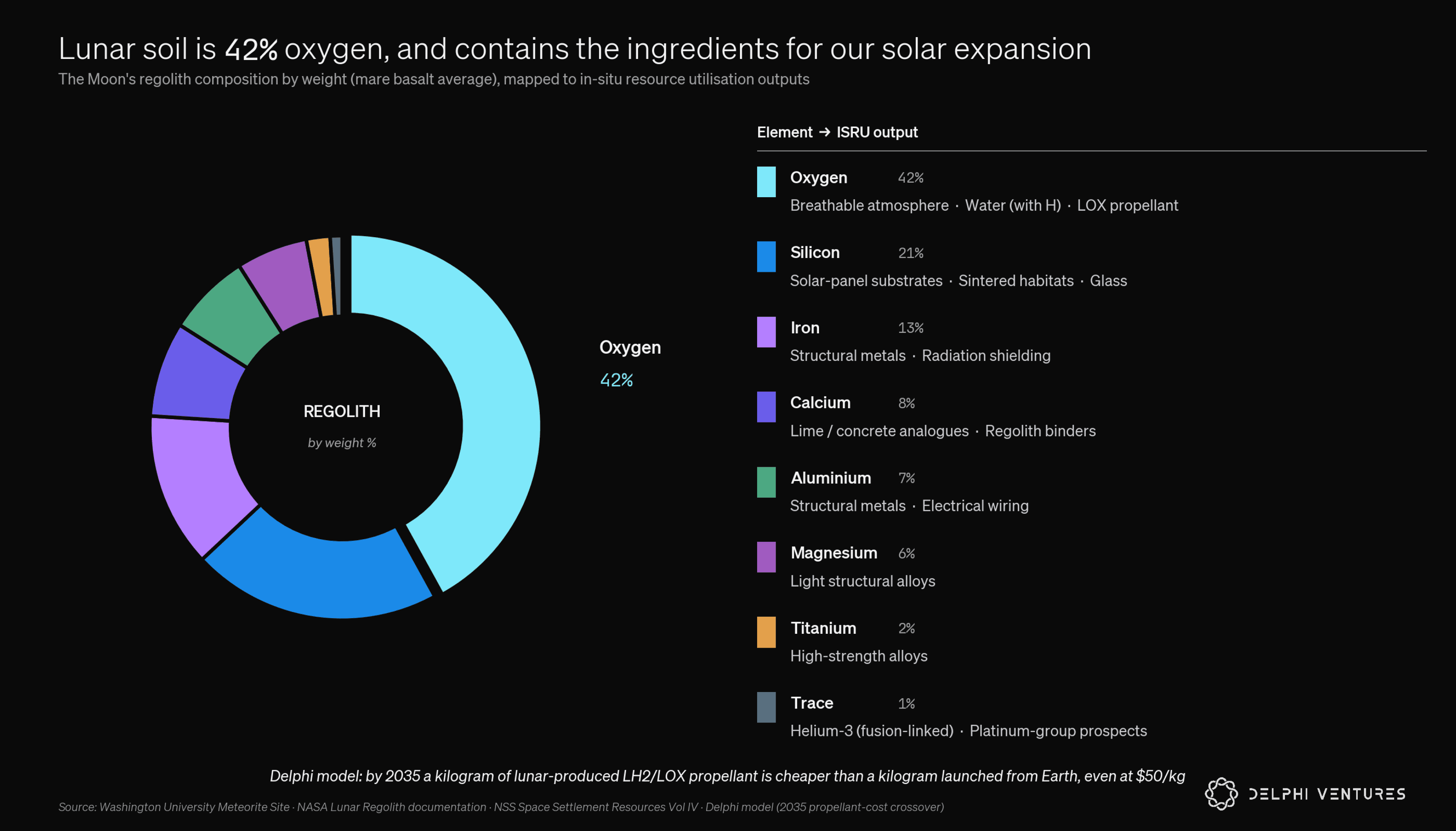
Water extraction at the South Pole, primarily for in-situ propellant, becomes the first economically self-sustaining ISRU loop if cadence, energy, storage, and local demand all arrive together. By 2035, a kilogram of LH2/LOX (used for propellant) produced on the lunar surface could be cheaper than a kilogram launched from Earth even at $50/kg. That would be the first time in human history that any commodity made more economic sense to produce off-world than to ship from home.
The back half of this window opens no new threshold, it is the maturation stretch. Launch grinds from $50/kg toward its $25/kg, and the industries the earlier thresholds unlocked either prove demand beyond government cheques and compound, or they stall. This is the stretch where a central question of this report is answered: will durable non-government demand materialise? We expect the first commercial customers to be the LEO stations and orbital factories built in the previous era: they are already in space, so propellant and materials lifted from the Moon beat hauling them up from Earth. Terrestrial demand for lunar resources comes later, if at all. (Full lunar-surface stack, landers, rovers, comms/PNT, ISRU, hotels: appendix.)
The $10/kg Era (2040+): Unlocking The Final Frontier
Most of what follows this threshold is speculative, though inevitable in direction. Our base model suggests this could appear in 2050 or later. At $10/kg, mass-to-orbit is not the binding constraint on any space-based business. Four things become possible.
The ISRU economy at scale. Regolith-derived infrastructure on the Moon and Mars: landing pads, solar arrays, habitats, radiation shielding, propellant. In-space construction stops being assembled-from-Earth and becomes built-on-site. The first wholly off-Earth-manufactured spacecraft is built and launched from the lunar surface in this era, foreshadowing the eventual rise of Von Neumann probes.
Helium-3 and the fusion link. If and when fusion arrives at commercial scale, He-3 from lunar regolith becomes a tradable commodity at industrial volume, a market multiple orders of magnitude above its current niche. If fusion does not ship, He-3 stays small, and water and regolith-derived propellant remain the grounded plays either way.
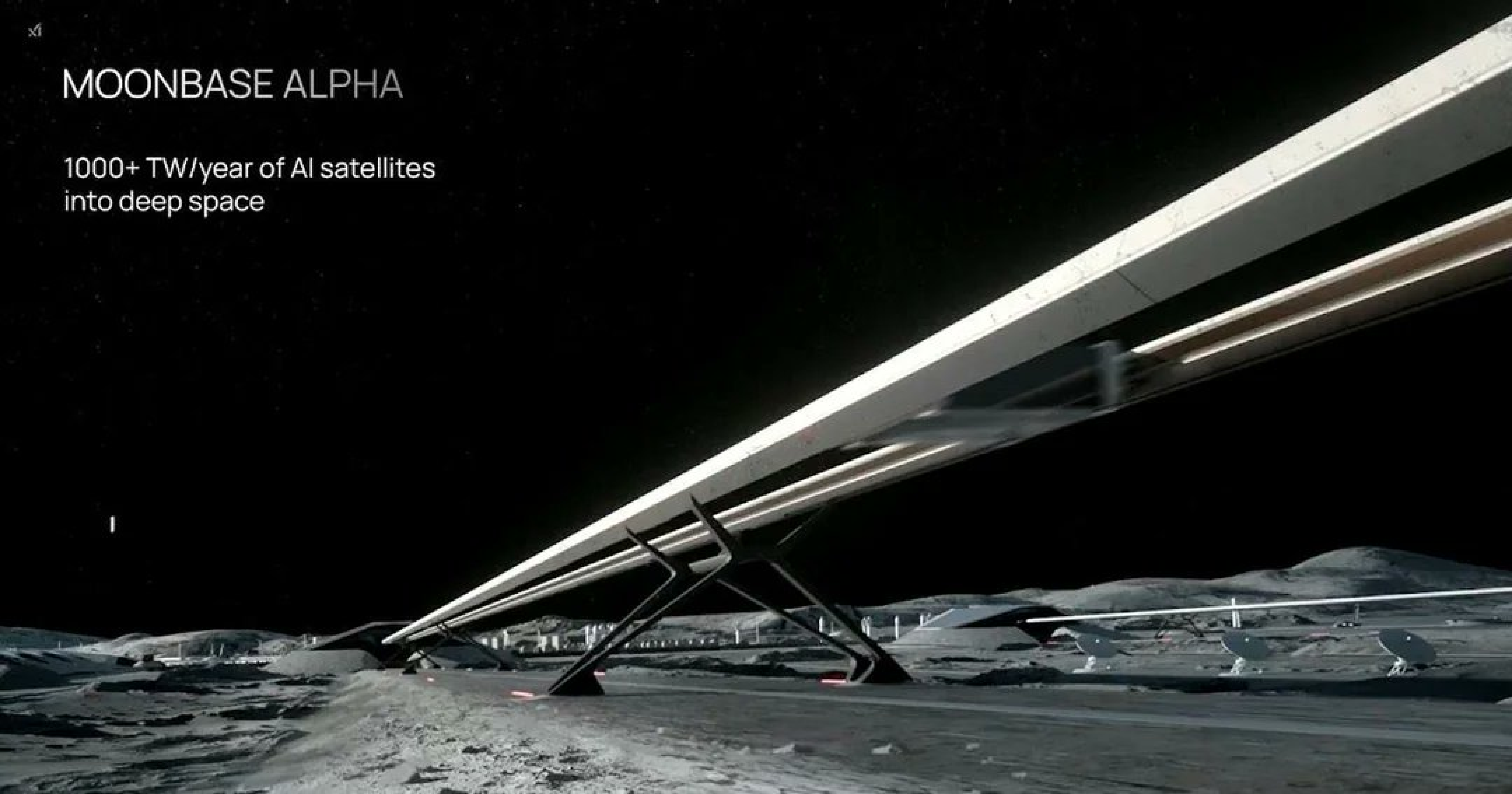
Lunar mass driver. The idea is older than it sounds: Gerard O’Neill and NASA studied lunar mass drivers in the 1970s. Musk is proposing it as the launch backbone for AI infrastructure in space. Enabled by the Moon’s lack of atmosphere and low gravity, a railgun track would accelerate small AI compute satellites into deep space orbit at ~10% of conventional rocket costs. By the mid-2040s, this could convert the Moon into an automated, solar-powered kinetic shipyard, scaling off-world computational capacity toward an eventual “Matrioshka brain” (a hypothetical cluster of compute satellites that wrap around a star to harvest all of its energy).
Point-to-point Earth travel. Starship Earth-to-Earth at $10/kg-class economics produces a London-to-Sydney trip in 45 minutes at a price competitive with first-class aviation. The gating constraints are regulatory, not technical: airspace integration, noise near spaceports, and passenger acceptance. By 2045 we expect a small number of routes to be operational.
The Mars supply chain. Musk’s true calling. The $10/kg era is when “make life multi-planetary” has physical infrastructure behind it: regular cargo cadence to Mars, a working ISRU loop for water and propellant, and the first multi-thousand-person settlement. For the first time in the four-billion-year history of life on this planet, we will have spread the light of consciousness to an alien habitat. Beyond this threshold, humanity becomes meaningful on the Kardashev scale: a civilisation harvesting solar at scale from orbit, fusing Helium-3 from the Moon, and operating outside Earth’s atmosphere: several major steps toward a Type I civilisation.
‘I’d like to die on Mars, just not on impact’ –
The composition of progress at the frontier
The United States remains dominant, anchored on SpaceX, but the architecture underneath is diversifying faster than the headlines suggest. China is growing meaningfully across 20 private launch firms, Europe’s collective stack is cementing, and the longer-tail of active countries like Japan, India, and the UAE have developing ecosystems.
Sixty-seven nations have signed the US-led Artemis Accords while China and Russia assemble the rival ILRS bloc. The nearest historical rhyme is Antarctica: a frontier governed by a thin treaty, contested by flags and field stations. The stations carry dual-use robotics, and the end-game resources are worth trillions. (The full geography, covering China, Europe, Japan, India, UAE, and the sovereignty mechanics, ITAR/EAR/Artemis Accords, is in the appendix.)
Key Obstacles To Our Thesis
1) Kessler-syndrome cascade. The threshold at which new-debris creation outpaces reentry decay is credibly modelled at two to four times the current active-satellite population. Past that threshold, collision events generate debris faster than it deorbits, and LEO becomes progressively unusable for commercial operations across multiple decades. As depicted in the film Gravity, a runaway ablation cascade (arguably my favourite space-related term) could theoretically render space totally unusable. Imagine an ever-growing storm of metal fragments encircling the Earth at 30,000mph. The strongest counter is not “Kessler is fictional” but “the response is faster than the bear assumes”: active debris removal becomes a $200/kg-era market with a real customer in every major constellation operator. The risk is an event in the late 2020s that demonstrates the cascade before the removal economy has scaled: the most underweighted single risk in the sector as 100,000 satellites enter orbit by 2030.
2. The cost curve stalls below 10x compression. Starship’s cadence target is one vehicle every 3–4 days by 2027; some analysis puts the empirical base rate for hitting targets this aggressive below 25%. If Starship maxes out at one vehicle per week or fortnight, the price-per-kg trajectory plateaus in the $200–500/kg band and the lower eras slip a decade. Our base case assumes Starship hits roughly half its public cadence by 2027 and 60% by 2030. Even then, the $500/kg era opens on schedule and the $200/kg era 2–3 years late. The bear requires Starship to fail to hit even half its public targets, which would be the largest single SpaceX miss in the company’s history.
It is worth being precise about how this stalling might manifest. Getting to ~$200/kg is a manufacturing-scale problem, not a physics one: it needs ~10 reuses per vehicle, and there is no new science between here and there. The genuine bottlenecks are execution, not invention. Raptor engine supply is the binding constraint today, so tight that ahead of Flight 12, SpaceX scavenged engines off one booster to rebuild another. Full upper-stage reuse has not yet been demonstrated at scale, the one real remaining execution risk. FAA throughput caps US launches near 146 a year against the thousands the end-state needs, which is why SpaceX is already chasing overseas pads. The economics beyond $200/kg depend on clearing these. The bulk of this report does not.
3. Demand-side no-show and the public valuation reset. The honest concession first: the entire report is supply-side. Every threshold is a statement about what cheaper launch makes possible, not a demonstration that an urgent customer is waiting. We find comfort in two areas, though they do not fully cover the field. The first is that the two largest demand pools are not anticipatory at all: AI inference and dual-use defence are paying customers today, and they underwrite the $1,500/kg and $500/kg eras. The second is the dotcom analogue, where the over-build did not destroy internet-delivered services but pulled them forward.
We would still not be surprised by a meaningful repricing of $1,500/kg-era exemplars inside thirty-six months: From the start of 2025 to early June 2026, Planet Labs is up roughly 1,020%, AST SpaceMobile about 423%, and Rocket Lab about 361%, the run is the market pricing trajectory rather than earnings. The most likely trigger for a repricing is the SpaceX IPO itself, re-anchoring the smaller public names against a $1.75+ comparable. The deeper question remains: for $200/kg-and-beyond, and ISRU in particular, we are underwriting a customer base we cannot yet point to.
4. Regulatory and geopolitical freeze. FAA Part 450 throughput has lagged commercial cadence; environmental challenges to Starbase have produced multi-month delays; the China relationship has fragmented spectrum, supply-chain, and investment regimes. This is the bear case most likely to materialise as a partial outcome. The probability-weighted impact is a 1–2 year delay across the eras post-$500/kg: meaningful for fund-cycle returns, not for the fundamental thesis.
5. Anchor tenant pull-out and founder-concentration risk. The $500/kg-era station thesis depends on hyperscaler or pharma anchor commitments not yet fully contracted; the defence layer on politically contestable budget priors; and the entire cost curve on a single company executing on Starship for a decade straight. Needless to say, Elon is a crown jewel of our species that is integral to this window of cosmic opportunity opening. In writing this, I learned that Musk travels with up to 20 bodyguards and a personal medic amongst which he is code-named “Voyager”. The detail is funded by his vast corporate web, where Tesla’s $4.8m annual contribution is just “a portion of the total cost”. The team even has a rare federal deputization granting his team U.S. Marshal authority. There is no hedge for this. His security is treated as critical infrastructure, but a single-person dependency of this magnitude is not to be taken lightly...
The Undisputed King: SpaceX
Every thesis in this report rests on one company delivering. The five price eras, the cadence model, the reentry layer, orbital compute, lunar logistics: all of it assumes SpaceX. At $1.75T the listing prices SpaceX at ~93x trailing revenue. The question is not whether that is rich. It is whether it is the cheapest entry the public markets will offer, on a business with no historical precedent. Below we explore some of its underlying engines, before taking a look at just how big it might become.
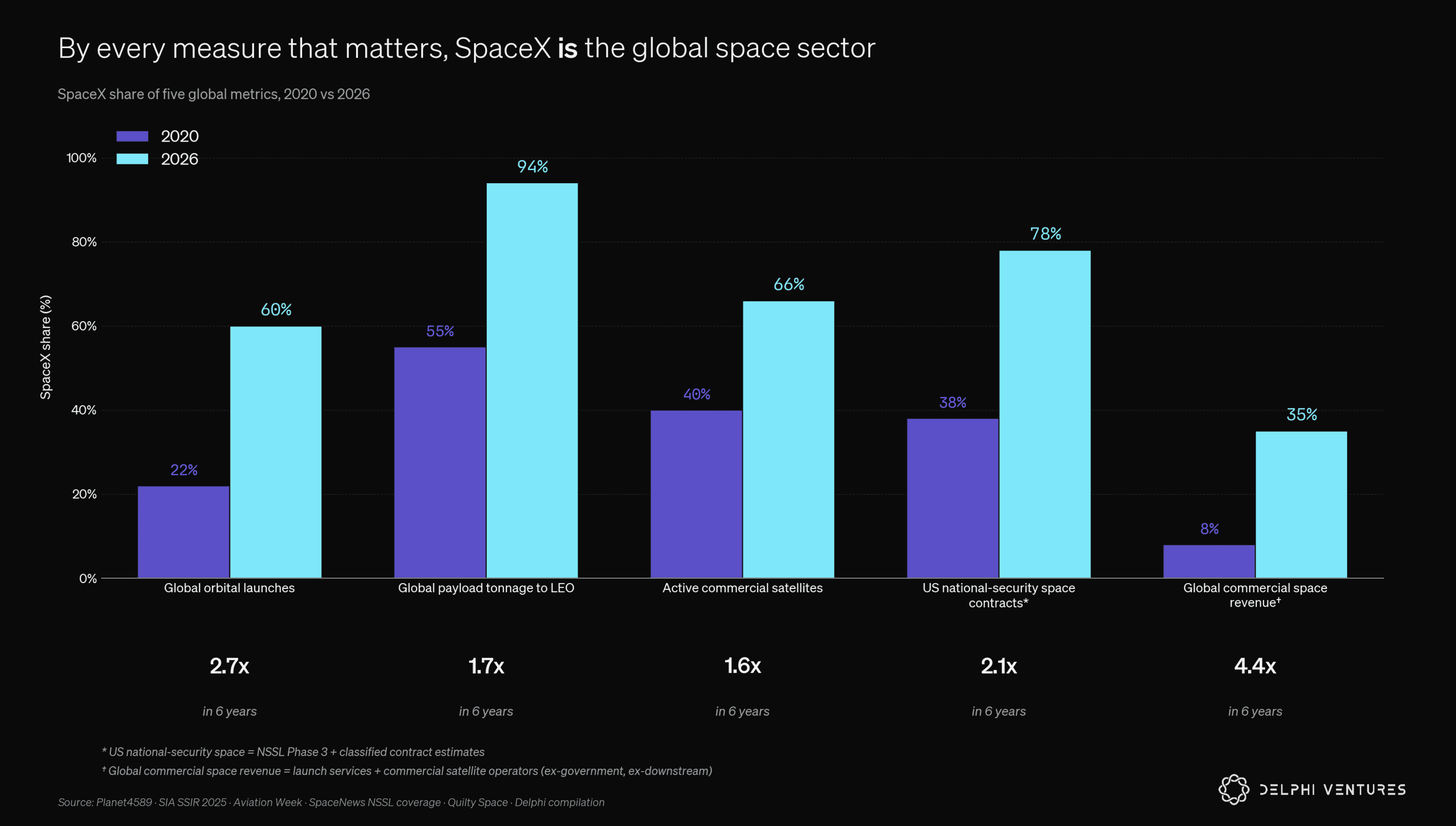
The launch business is the moat, not the cash machine. SpaceX flew 165 orbital launches in 2025, more than the rest of the world combined for the second year running, and by payload mass, more than the rest of the planet put together for six years in a row! At $4.1B of revenue it is a small line relative to Starlink. It is not where the money is, but what enables every other stream. Nobody else can drive matter to orbit at this scale.
Starlink is already a major revenue line. In 2020 Starlink had zero commercial customers. In 2025 it generated $11.4 billion in revenue and $7.2 billion in EBITDA at a 63% margin. Subscribers doubled across the year and crossed 10 million by February 2026. With direct-to-mobile now turning on globally, we estimate substantial further upside. If they are to capture just 100 million global mobile subscribers at $10/month each, that represents a further $12B near-term. Starlink’s first five years of revenue growth sit in the same league as Anthropic and OpenAI.
Defence is now a structural pillar. A $5.9B Pentagon award covers 28 national-security space launches (NSSL) Phase 3. Separate Golden Dome contracts now exceed $6B, a $4.16B missile-tracking layer plus a $2.29B follow-on in May 2026. Starshield is the fastest-growing line in the P&L. This is recurring, sovereign-grade revenue that did not exist on the income statement a few years ago.
SpaceX is now the world’s most advanced compute manufacturer. In March 2026 the group announced Terafab, a chip plant in Texas that Tesla, SpaceX, and Intel are building together. The county tax filing puts the spend at $55 billion for the first phase and up to $119 billion at full scale, targeting more than a terawatt of AI compute a year. Musk’s justification was blunt: “We either build the Terafab, or we don’t have the chips, and we need the chips.”
Then there is Colossus, the 200,000-GPU supercluster SpaceX built in a record-setting time of ~6 months (with half online in just 120 days). Beneath it, a billion dollars of Tesla Megapacks (giant batteries) already buffer its power in the event of grid outages. Industry benchmarks for similar buildouts run 18 to 36 months.
In May 2026 SpaceX leased the full Colossus 1 to its rival Anthropic for Claude training and inference, $1.25 billion a month, about $45B over the term to May 2029. Three weeks later Google signed the same trade, $920 million a month for a further 110,000 GPUs from October 2026. Two contracts, one quarter, $26 billion a year of high-margin compute income switched on against a cluster that cost $3 to 4 billion to build. Google in particular is one of the largest data-centre operators on Earth, and it is renting compute from SpaceX. This is a clear signal of the demand surplus, and gives confidence in the floor of this revenue line. Meanwhile, SpaceX moves its own frontier work to the larger Colossus 2.
So what could SpaceX be worth?
Elon has spoken openly of an endgame: a single entity combining SpaceX, xAI, and Tesla under one roof. Whilst there may be insurmountable governance hurdles to this, deep collaboration is already beginning to unfold. When SpaceX absorbed xAI in February 2026 he called it “the most ambitious vertically-integrated innovation engine on, and off, Earth.” Whilst it may seem like marketing, it is the most literal description of what is being built:
Chip manufacturing
Maximally truth-seeking AI
Macrohard: software user emulation
Selling excess compute to rival labs
A social media platform with monetary rails
A high-throughput global data network
Orbital data centers (and AI satellites)
A permanent base on the Moon
A lunar satellite railgun
Colonizing Mars
What makes this more than a conglomerate is that each pillar lowers the cost of the next. Terafab’s silicon removes the dependence on Nvidia’s allocation and margin, so compute scales on SpaceX’s own supply. That compute trains the models; the models run on the same AI5 silicon inside Optimus; and the robots are what build the next factory, and one day new planetary infrastructure. Tesla’s Megapacks provide power continuity every rival AI builder is grid-constrained to find. Underneath all of it lies launch: cheap reusable lift is the input cost to Starlink (the most advanced megaconstellation ever created), orbital compute, defence, and to Mars. Meanwhile Starlink and the AI scale-up generate the cash that funds further R&D that drives that cost lower still.
No traditional multiple fits a self-reinforcing engine that spans launch, orbital infrastructure, energy, compute, and frontier models that sit on top of all of it along with the networks both digital (X, 500m+ users) and physical (Tesla, 10m+ vehicles, humanoids soon) to distribute it through. That is the real Elon premium. Not a cult of personality, but the compounding optionality of an operator who controls more of the value chain than anyone before him.
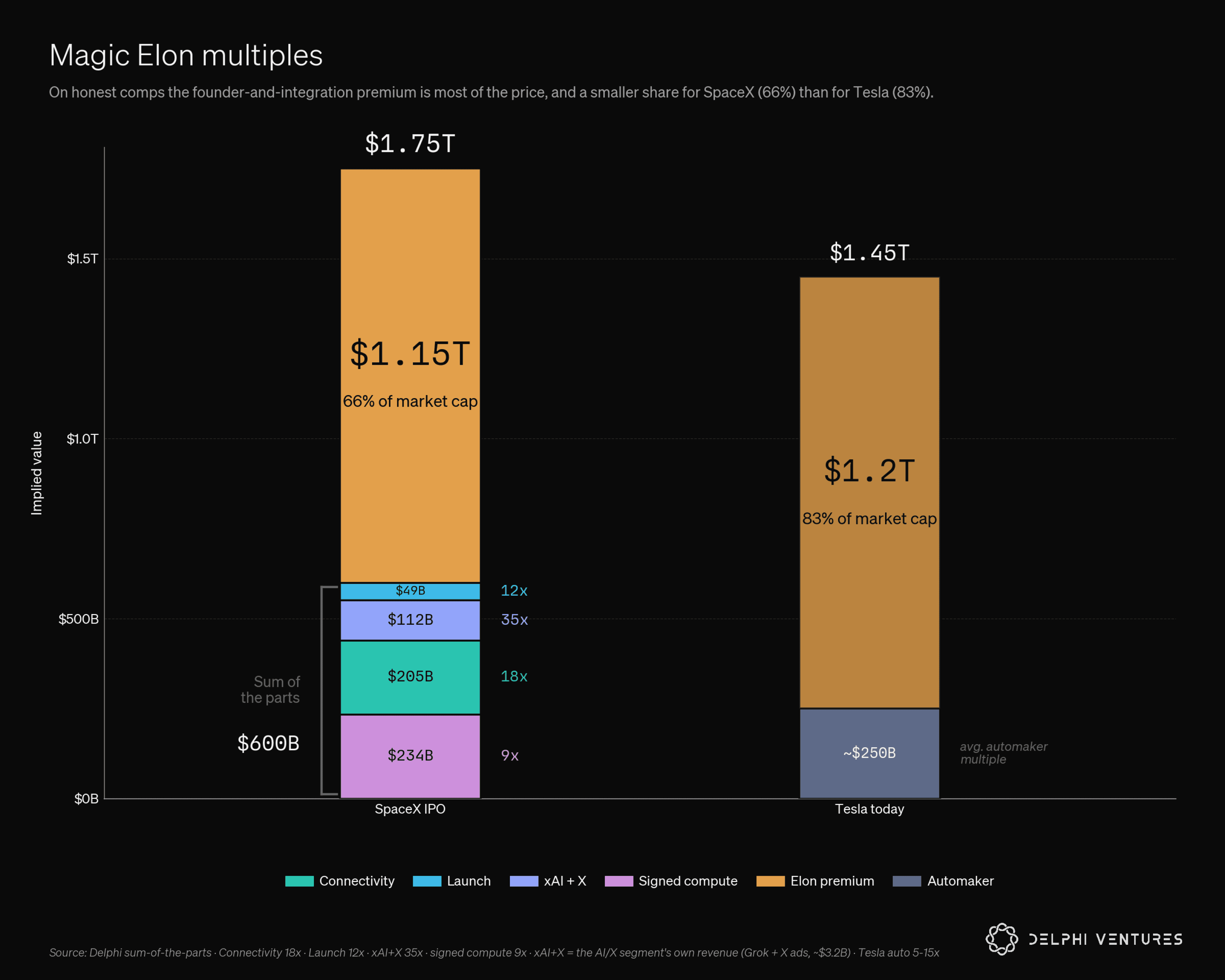
If we break down by revenue bucket and ascribe a fair multiple for each, we get the following numbers. Starlink at 18x, a slight premium to Nvidia for a space-connectivity monopoly growing at 40% on 63% margins; launch at 12x (unglamorous, but huge demand ahead); their in-house AI line at OpenAI’s 35x; the signed compute contracts at 9x (in the same range as the neoclouds, growing fast). The parts come to $600 billion. The listing asks $1.75 trillion. The other ~$1.15 trillion is what the skeptics call the Musk premium and write it off as the market voting on pure faith. With Tesla, the same premium runs to 83%. It is not all hype, as it also embeds humanoid (Optimus) optionality where private leaders such as Figure ($39B), Apptronik ($5.3B), and Robostrategy ($BOT,the public market index) are growing in valuation.
The analogues for SpaceX are not traditional tech companies. They are the firms that owned planet-scale infrastructure during a once-a-century build-out. The East India Company fielded a private army of a quarter of a million men, twice the size of Britain’s own, minted its own currency, levied taxes and ran its own courts: a corporation that had become a sovereign power, accountable to no one but its shareholders. I implore you to wonder what SpaceX might look like by the close of this century.
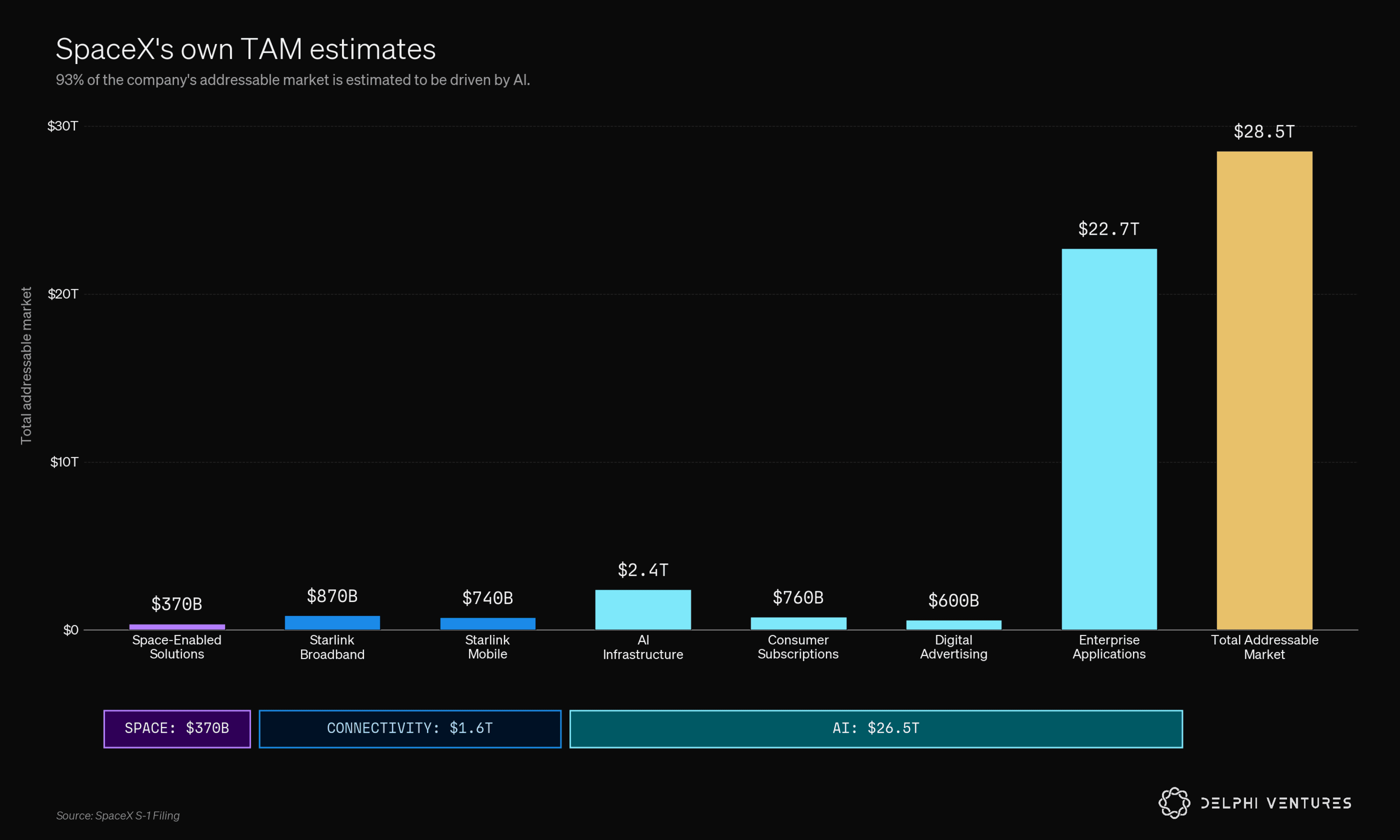
SpaceX has shared some pretty outlandish numbers in their S-1 filing TAM exercise. No company has ever reached $1 trillion in annual revenue. Amazon, at $740B, will likely be first this decade. SpaceX would need a 50x from $18.7B to get there, a climb with no precedent in corporate history, at the revenue scale of a mid-sized economy. The underwriters are already there in spirit: Goldman, running the book, models $474B of revenue by 2030; Morgan Stanley $3.4T by 2040. Both agree the primary driver is AI.
Our expectations
We hold a deliberately lower revenue line. Our base case suggests ~$135B of revenue in 2030 and ~$800B in 2040, below both underwriters, because these are numbers we can defend input by input. The signed compute contracts expire in 2029, and orbital compute at scale is only likely to manifest some time in the 2030s. We pair that conservative line with anticipated multiples the market may actually pay for the monopoly, growth, and optionality we have described above.
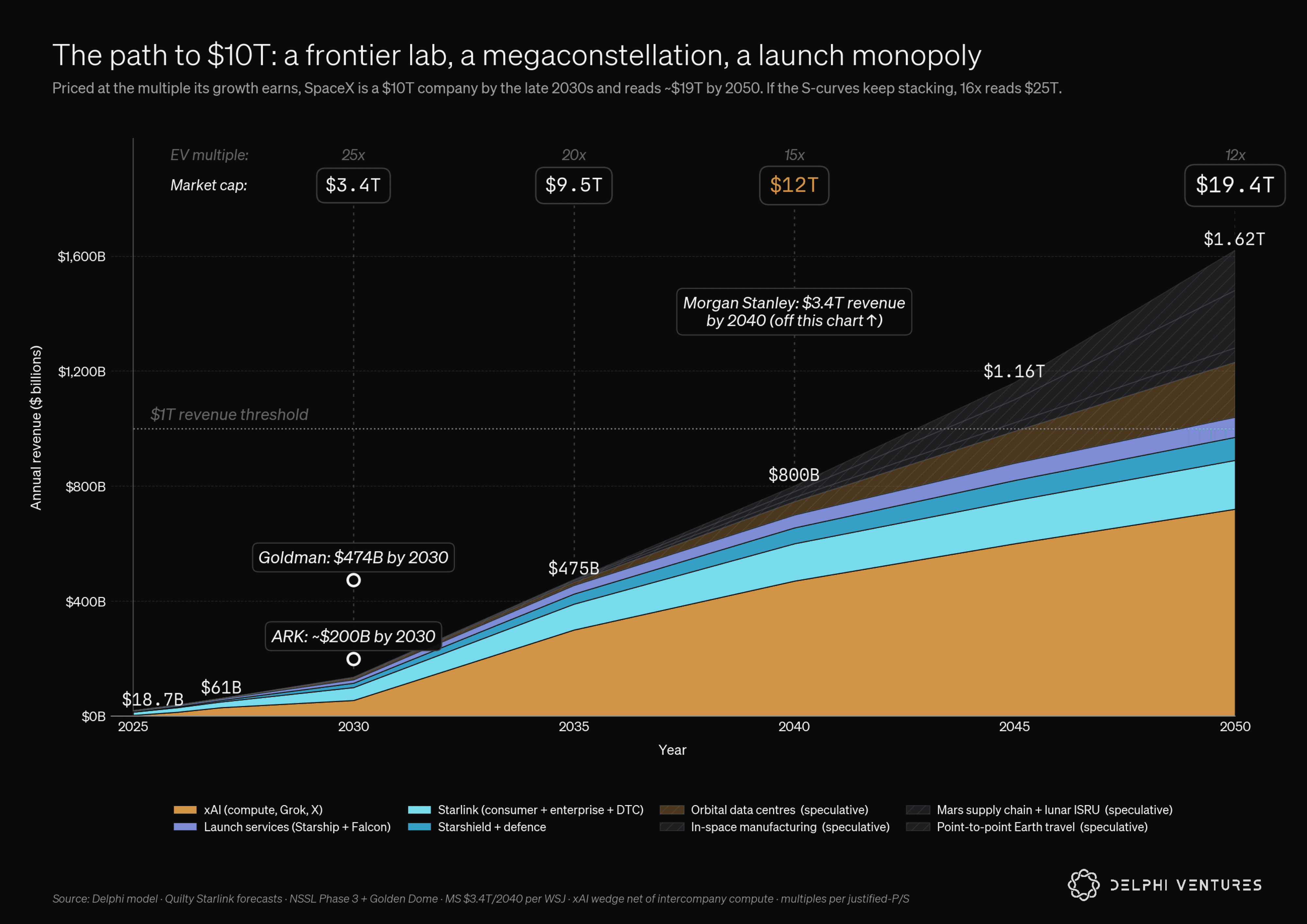
On that basis the model implies $3.4 trillion by 2030 at a 25x multiple, the $10 trillion company by the late 2030s, and ~$19 trillion by 2050, the multiple staying high through the major cost-collapse eras and moderating only as the business matures. The multiple framework is separable from the revenue model, and running the underwriters’ own revenue through ours paints a different picture again: Goldman’s 2030 target implies $11.9 trillion of market cap, and Morgan Stanley’s 2040 revenue number suggests ~$51 trillion.
Every compression assumption says growth fades as the base grows, the way normal companies age. The singular claim about SpaceX’s full vertical stack is that it has more major catalysts ahead than any company in history. If new waves of opportunity mature as the last ones crest, growth can endure. If so, it's long-term steady state multiple could be higher than we suggest.
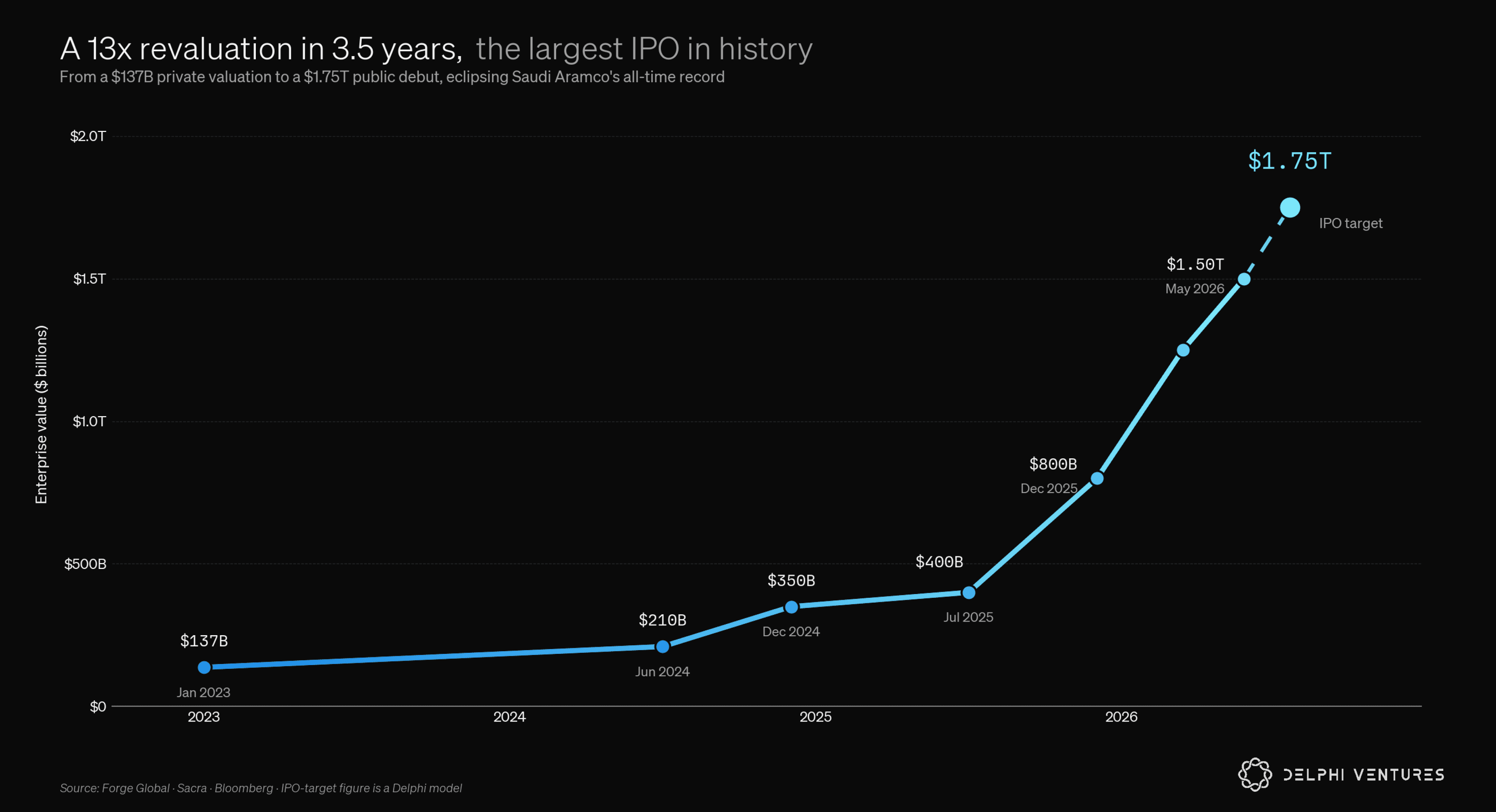
The most counter-intuitive feature of SpaceX’s strategic position is that the company benefits more from a thriving competitive ecosystem than from monopoly capture:
Launch cadence requires demand. Every Vast station, every Varda capsule, every Anduril Tranche order pulls Starship’s marginal cost lower for Starlink’s benefit.
Defence revenue depends on a viable commercial sector. The Pentagon’s commercial-buy model only works while there is a commercial market to buy from; if the rest of the sector dies,
collapses into a sole-source relationship, and sole-source contracts attract price caps, audits, and political scrutiny. A healthy commercial flywheel is what keeps SpaceX’s defence margin politically defensible.
Mars needs a planet’s worth of capital. Even at $10T, SpaceX cannot self-fund a Mars colony alone; it requires every adjacent industry to mature in parallel.
Assuming the key risks we explored don’t happen, how big could space actually get?
Today’s space economy is roughly $626B . The consensus track (McKinsey + WEF) projects $1.8T by 2035 on a 11% CAGR; Morgan Stanley and PwC put $1–2T by 2040. Run their view out to 2050 and you get the base case at ~$6T. Our view skews more towards the bull case of $10T annual revenues by 2050. The bull requires orbital compute to land at scale, plus at least one of the materials science or microgravity-therapeutics accelerants. We put the joint odds at ~15 to 20%. For pharma, Eli Lilly’s tirzepatide franchise alone booked $36.5B of 2025 revenue on a single drug class, with forecasts near $70B by 2030. If microgravity manufacturing makes viable 2–3 GLP-1-class molecules over the next twenty-five years, that category alone equals the majority of today’s entire upstream space economy.
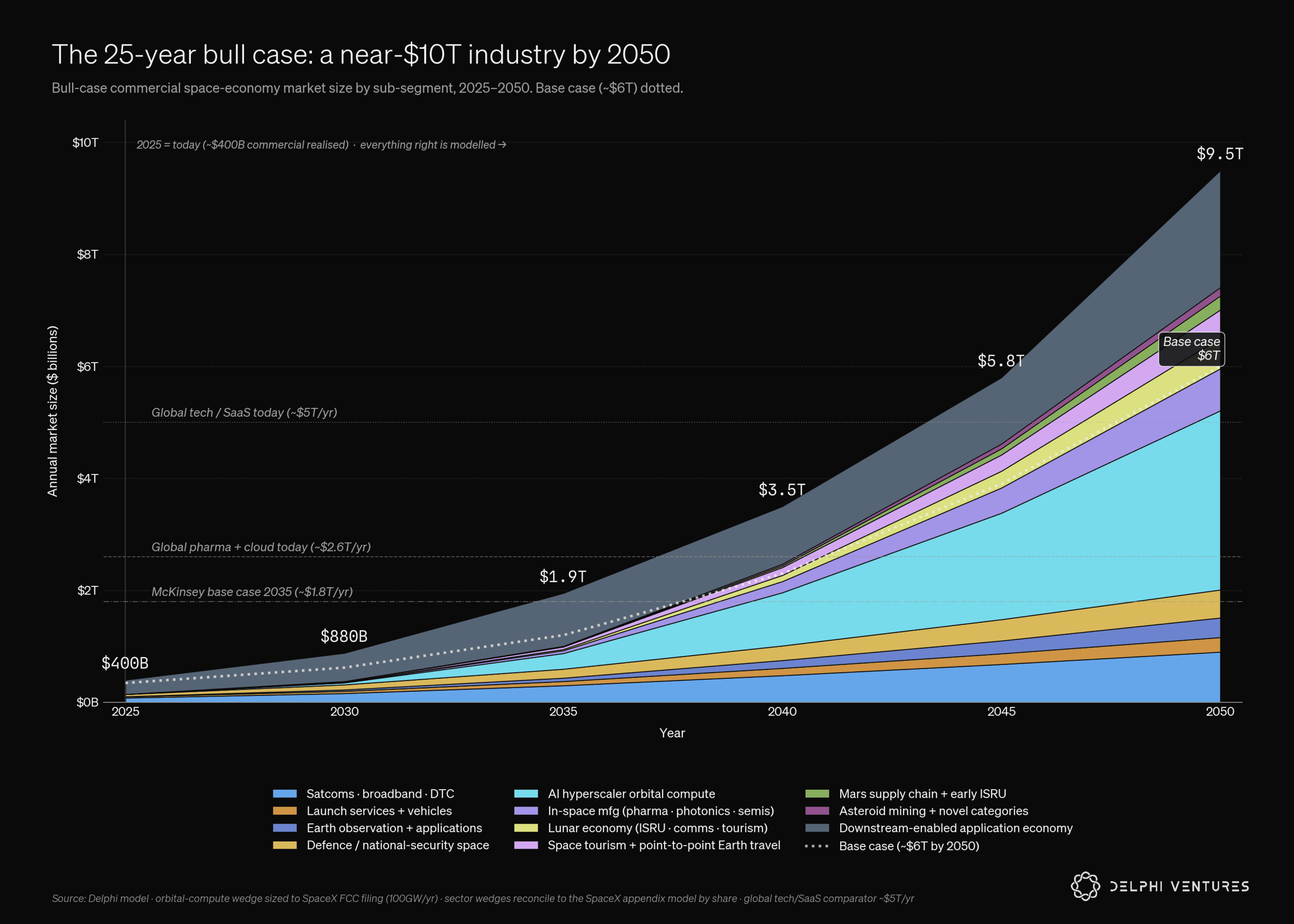
By 2050, the bull-case space economy is nearly twice today’s entire global tech/SaaS industry. It’s worth noting that as of 2026, approximately $5-7T of economic activity is already dependent on space services.
Close
Space is the hardest hardware domain ever attempted, where being 99% right is usually not enough. The venture profile is brutal. Companies take eight to twelve years to reach exit; capital intensity is enormous; engineers build in vacuum-rated cleanrooms, test against an unforgiving physics regime, and wait months for a launch window to discover whether the assumptions made survive reality. Pre-seed to Series A graduation rates are less than half of what they are in software. Most space-themed funds raised between 2019 and 2023 will not return capital. We are under no illusions about this, and believe the asymmetry is worth the brutality when choosing the right founders and cost assumptions. We predominantly invest our own capital, so we are not optimising for quarterly markups or a 24-month story arc. We can be patient.
Believe the cost curve before the market does, and build for the economics that do not exist yet. SpaceX at $1.75T is the beta of that bet; the alpha sits orders of magnitude earlier, in the seed rounds that anticipate new binding constraints. We are backing the founders building novel applications of space-derived data; the teams turning off-world conditions into a factory for drugs and exotic materials the planet physically cannot produce; the autonomy and orchestration layer the Great Web In The Sky runs on; and the fringe ideas that, to most, still sound like fiction.
History shows that capability is not cumulative. Rome built roads the medieval world could not replicate. Polynesian navigators crossed open oceans by star and swell, only for their descendants to lose the routes. We last walked on the Moon in 1972, and have not returned for over 50 years since. We stand on the cusp of a great acceleration of our ambitions as a space-faring species. The ability to leave Earth, our cradle, does not ratchet forward inexorably. It is a delicate flame, and the next ten years will decide whether a new era of space ignites.
"As we leave the Moon at Taurus-Littrow, we leave as we came and, God willing, as we shall return, with peace and hope for all mankind." — Eugene Cernan, Commander of Apollo 17, December 14, 1972
Appendix
A1. Bear/Base/Bull cadence model
The era windows in the body of this report are calibrated against a Base scenario for Starship cadence and unit cost. The report’s thesis does not depend on the Bull case. It does depend on the Base case being broadly right. Each scenario is anchored to SpaceX’s own public targets and back-tested against Bent Flyvbjerg’s empirical work on megaproject completion rates (~25% base rate for ambitious cadence targets in heavy industry).
Anchor inputs. SpaceX’s stated cadence target is one Starship every 3–4 days by 2027 (~100–120 flights/year). Payload to LEO per flight is ~150 tonnes expendable; ~100–120 tonnes operational with full reuse. Internal cost per flight at scale is targeted at <$10M, with Musk’s long-term floor at $1–2M.
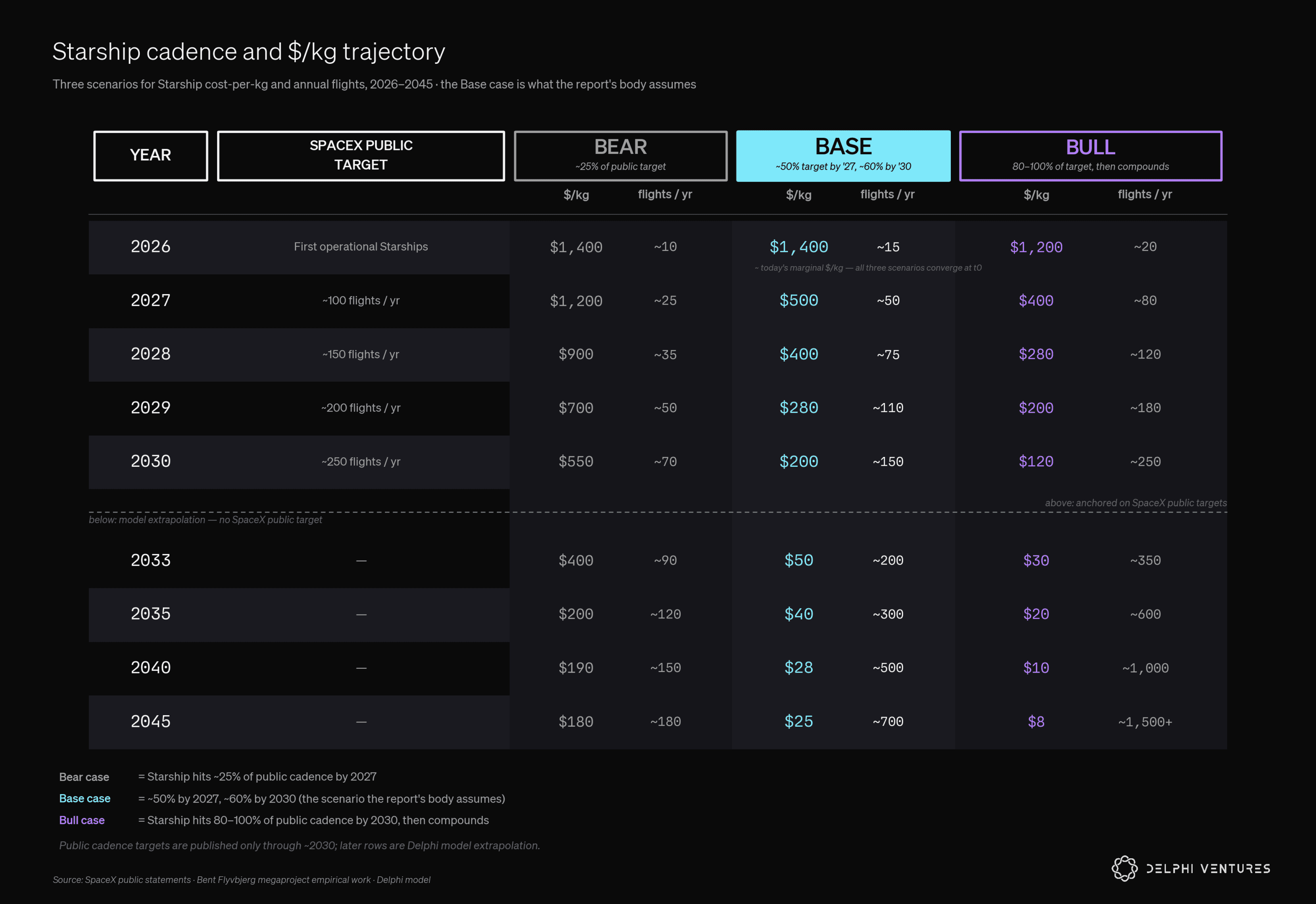
Bear assumes Starship hits ~25% of its public cadence target by 2027 and never closes the gap. $/kg plateaus in the $400–800 band through 2032. The $200/kg era slips to 2034–37; the $50/kg era slips post-2045; the $10/kg era does not arrive in the window of this report.
Base assumes Starship hits 50% of public targets by 2027 and 75% by 2030. The $/kg trajectory matches the era windows used throughout the body. This is the scenario the report’s framing assumes.
Bull assumes Starship hits 80%+ of public targets by 2027 and continues to compound. $/kg compresses one era ahead of the Base schedule: the $50/kg era opens in 2031–32, the $10/kg era plausibly arrives in the mid-2030s.
Sensitivities. The variable that matters most here is per-flight reuse turnaround time, not flight count per launch site. A 24-hour booster turnaround at a single pad outperforms ten pads on a six-week refurbishment cycle. The second is payload utilisation; Starship at 50% mass-utilisation is a $/kg story closer to the Bear than the Base. The third is regulatory throughput (FAA Part 450, environmental challenges).
The model deliberately does not project a price floor below $10/kg in the window of this report.
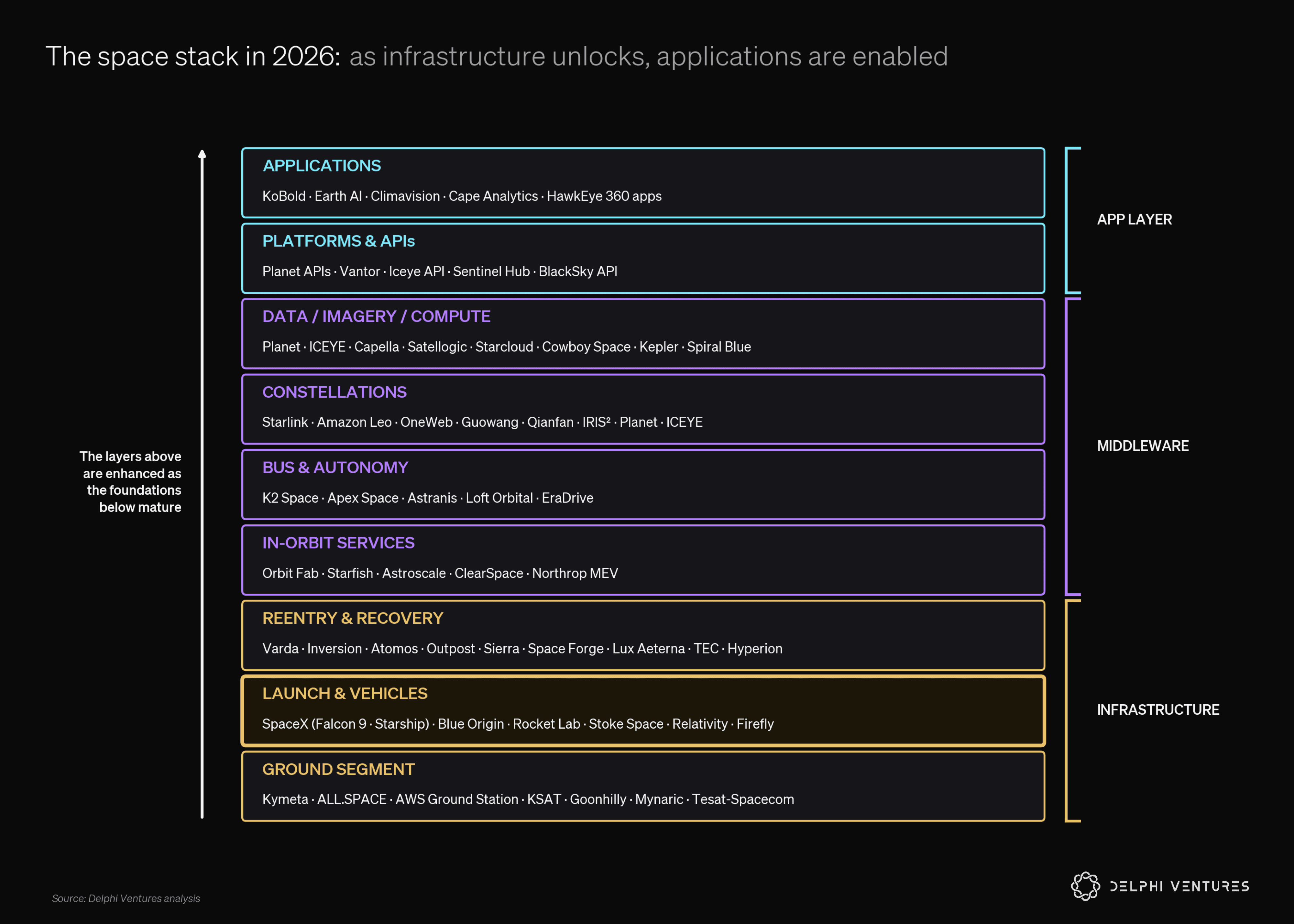
A2. The $1,500/kg era: full rosters
Megaconstellation vertical specialists. K2 Space builds large platform-class buses optimised for defence and ISR payloads where Starlink’s commodity bus is the wrong shape, taking advantage of MEO to do more with fewer satellites. Apex Space ships productised buses (their Aries class) on standardised timelines, treating the spacecraft chassis as a product SKU rather than a custom build. Astranis focuses on small GEO comms satellites for regional broadband. Each is viable on its own terms and more valuable to the overall network than to any single operator.
Earth observation, full roster. Planet Labs and Maxar’s WorldView Legion for the optical layer; ICEYE and Capella in synthetic aperture radar; HawkEye 360 in radio-frequency geolocation; Satellogic in agriculture; Umbra and BlackSky filling the long tail. The differentiator has moved from the pixel to the inference; downlink remains surprisingly scarce, which is why inference, compression and tasking software matter as much as sensor quality.
Application layer, beyond KoBold. Earth AI targets indium, nickel, and palladium with a reported 75% drilling success rate against the industry’s historical <1%; Esper operates in adjacent domains.
On-orbit compute, edge ML. Kepler Communications and Spiral Blue have independently demonstrated payload data reductions north of 99% through edge inference. Starcloud has tested an active off-world H100 today; Cowboy Space Corporation (Aetherflux rebrand, founded by Robinhood co-founder Baiju Bhatt) closed a $275M Series B at a $2B valuation led by Index Ventures, first flight targeted end-2028.
Sci-Fi fringe, full. Reflect Orbital (orbital mirrors selling on-demand sunlight to terrestrial solar farms), Lux Aeterna (reusable satellites with built-in heat shields, first flight Q1 2027 on a SpaceX rocket), plus a quiet cohort working on orbital advertising, on-orbit data physical-security escrow, and space burials.
A3. Spectrum deep-dive
The structural moat Starlink owns is not only its constellation; it is its spectrum allocation. The ITU coordinates global frequency rights for orbital communications, and the windows in which non-geostationary systems could file under favourable rules closed quietly in the early 2020s. Starlink and OneWeb were grandfathered; Amazon Leo and most subsequent entrants face tighter sharing requirements. The FCC-coordinated interference fights between Amazon Leo and Starlink over Ka-band and V-band downlinks preview every future megaconstellation negotiation.
SpaceX’s August 2021 acquisition of Swarm Technologies is the cleanest illustration. Swarm operated a sandwich-sized IoT constellation in the 137-138 MHz and 148-150.05 MHz VHF bands, a spectrum allocation worth far more than the operating business itself. The transaction price was rumoured to be $524m, but the strategic logic was that Swarm came with FCC-licensed VHF rights for non-voice satellite mobile service that SpaceX could roll into Starlink’s direct-to-device roadmap without filing from scratch. The lesson: spectrum is acquired as an asset class of its own, not as a side effect of operations. Expect many serious operators from 2026 onward to run an active spectrum-M&A book.
The satellite count is a manufacturing problem, which SpaceX has solved. The spectrum count is a coordination problem, which persists. Downlink bandwidth is the binding constraint on what every constellation can actually deliver to end users, regardless of how many satellites are in the sky. A 10,000-satellite constellation with insufficient downlink spectrum delivers less total throughput than a 2,000-satellite constellation with grandfathered Ka-band rights. Europe’s IRIS² is partly a sovereign answer, a consortium-led constellation built to claim spectrum ahead of foreign operators. China’s Guowang is the same instinct in reverse, with the state itself filing the claim. The investible angle is the layer underneath: spectrum-aware operations, dynamic frequency management, software-defined radios, and the regulatory-arbitrage operators that help new constellations file under viable bands: Kratos and Aurora Insight in the US, a growing cohort of European specialists.
A4. Ground segment deep-dive
Half the value chain in commercial space sits on the ground. Antenna manufacturing (Kymeta, ALL.SPACE, Isotropic Systems, Cesiumastro); ground-station-as-a-service (AWS Ground Station, KSAT, Goonhilly, Atlas Space Operations, Leaf Space); and the optical-ground-station layer required by laser inter-satellite links (Mynaric, Tesat-Spacecom, Skyloom, BridgeComm, Cailabs).
Optical inter-satellite links are the unsung accelerant of the $1,500/kg era. Starlink works as a mesh because each satellite has four laser terminals routing traffic optically between satellites without touching a ground teleport: a packet originated in Sydney can route through space directly to a receiver in Lagos, bypassing the entire terrestrial cable network. The Mynaric (acquired by Rocket Lab for $155m) and Tesat ($250m annual revenues) duopoly on commercial optical terminals is one of the cleanest oligopolies in the sector, and the US SDA’s Tranche programmes now assume every constellation member runs optical links by 2028.
A5. Defence-lane detail
The Space Development Agency’s tranche architecture and the proliferated NRO constellations have changed what “fast” means inside the DoD. Tranche 0 was awarded at roughly $1.3B; Tranche 1 expanded to $1.8B across multiple primes; Tranche 2 contracts are pacing toward . The Space Force’s FY26 budget request crossed $30B for the first time, with the procurement-of-services portion rising fastest. Anduril, K2 Space, Apex, Varda, Xona Space Systems, True Anomaly: their near-term growth is a function of how quickly SDA can sign Tranche follow-ons, not of launch cost.
By our estimates, supported by CSIS analysis, 30–40% of current revenue underneath the commercial veneer of this sector is classified or quasi-classified national-security work. We arrive at the range by aggregating disclosed Tranche values ($5.5B/yr run-rate by FY26), NRO commercial-buy estimates ($3B/yr), NSSL Phase 3 ($13.7B awarded across launch primes), AFRL classified R&D budgets, and the European Defence Fund’s space track, against total addressable commercial revenue.
The international parallel matters. The European Defence Fund is writing nine-figure cheques into space-defence dual-use. The EU’s ReArm Europe / Readiness 2030 plan commits up to €800 billion in additional defence spending by 2030, a material fraction flowing into sovereign launch, ISR constellations, secure satcoms, and missile-warning. France, Germany, and Italy are each building national space-defence stacks underneath the EU layer.
A6. The $500/kg era: full rosters
In-space servicing and refuelling. Orbit Fab, Starfish Space, Astroscale, Northrop Grumman’s MEV. The gating constraint is a shared fuelling-port specification across Western primes; the SDA-led standardisation effort (CONFERS) is the most underweighted piece of policy news in the sector.
Commercial LEO destinations. Vast Space (Haven-1 in 2026, front-runner with Haven-2), Axiom, Sierra Space’s LIFE habitat and the Starlab consortium (Voyager + Airbus + Mitsubishi), and Blue Origin / Sierra Orbital Reef are the four serious bidders for the NASA CLD program. ISS retirement in 2030 is the forcing function.
Reentry, full roster and economics. Varda (Winnebago capsule, Utah recovery), Inversion Space (Arc lifting body, first flight 2026), Atomos Space, Outpost Technologies, Sierra Space (Dream Chaser, $550M Series C March 2026), Space Forge (UK naval recovery), The Exploration Company (Nyx, European routes), Lux Aeterna (reusable spacecraft with built-in heat shields), and Hyperion (Portuguese waters). Heat-shield economics, historically anchored by ablative materials like PICA-X and AVCOAT, now shifting to SpaceX’s automated ceramic tile manufacturing and Stoke’s actively cooled metallic structures, are a primary driver of refurbishment overhead. Reentry accuracy (narrowing from Apollo’s multi-kilometre splash zones to sub-kilometre target ellipses) determines whether an operator needs a prohibitively expensive naval recovery fleet or can achieve land-based recovery. Atmospheric chemistry from megacadence reentry is a regulatory tail risk: aluminium-oxide loading in the upper atmosphere from deorbiting megaconstellations is a credible 2030s political issue.Space tourism. Axiom private-astronaut missions (~$55m a seat), the first dedicated SpaceX free-flyer tourist mission, and suborbital (Blue Origin New Shepard, Virgin Galactic if solvent) at higher volume but lower revenue per passenger.
A7. The $200/kg era: full rosters
In-space manufacturing. Beyond Varda and Space Forge: Hyperion and Flawless Photonics are scaling ZBLAN-fibre production, enabling 10–100x lower signal loss than terrestrial silica fibre, critical for photonics chips, mid-infrared sensing, and quantum-computing interconnects.
Cislunar logistics. Impulse Space and Quantum Space run regular kick-stage missions between LEO and cislunar space. The NASA Lunar Gateway is operational; Artemis cadence is two-to-three crewed missions per year, with cargo logistics commercially contracted.
Space-based solar power. Caltech’s SSPP demonstrated wireless power transfer in 2023; by the early 2030s Virtus Solis and the Japanese SSPS programme each have multi-megawatt orbital arrays. The strongest counter: orbital compute and manufacturing will consume the marginal kilowatt-hour in orbit before anyone bothers beaming it down. SBSP retains a credible market in off-grid, military, and disaster-response applications where the comparison is against diesel generators, not grid power.
Asteroid prospecting. AstroForge, TransAstra, and Karman+ run prospecting missions to Near Earth Objects. None has commercialised return-to-Earth resources; all have credible models selling prospecting data. Commercial extraction is a $50/kg-era story; prospecting is a $200/kg-era one.
A8. The $50/kg era: lunar surface stack
Landers and rovers.
Intuitive Machines, Firefly, Astrobotic, and ispace operate regular cargo cadence under CLPS-2 follow-ons. Lunar Outpost and Venturi Astrolab provide the rover layer; Blue Origin’s Blue Moon Mark 2 carries heavy cargo for human-rated missions.
Lunar comms and PNT. The ESA Moonlight consortium operates a five-satellite lunar constellation, four for navigation and one for communications; Lockheed’s Crescent Space provides LunaNet-compatible commercial comms.
Resources and ISRU. Water ice at the South Pole is the primary focus, not Helium-3 yet. Interlune has sold forward Helium-3 contracts, including to the US Department of Energy, against first harvest planned for 2029, gated by terrestrial fusion deployment timelines. Silicon makes up 21% of regolith, aluminium 5–14% depending on terrain, with iron, calcium, magnesium, and titanium accounting for most of the remainder.
Off-world hotels. GRU Space and at least one Chinese counterpart operate early lunar surface tourism.
A9. Geography: the composition of progress at the frontier
The United States remains dominant, anchored on SpaceX, but the architecture underneath is diversifying faster than headlines suggest.
China. Not a single state actor but roughly twenty private launch and satellite companies competing inside a state-supported framework.
LandSpace flew the first methane-powered orbital rocket in 2023; Galactic Energy, iSpace, CAS Space, Orienspace, and Deep Blue Aerospace are pacing toward operational reusable launch by 2027–2028. Guowang and Qianfan together target 25,000+ satellites by 2030. China’s ILRS (with Russia) targets a basic South Pole station by 2035. The posture: parity on every layer by 2035, lunar leadership by 2040. The constraint is hardware (export-controlled chips) more than capital.
Europe. ESA, the IRIS² programme, and national agencies (CNES, DLR, ASI, UKSA, Portuguese Space Agency) form the institutional spine. The commercial layer is anchored on ICEYE (Finland), Isar Aerospace (Germany), Skyrora (UK), Latitude (France), Space Forge (UK), Hyperion (UK), and The Exploration Company (Germany/France). The micro-launcher race for sovereign access is a contest between Norway’s Andøya Spaceport, Scotland’s SaxaVord Spaceport, and Portugal’s Santa Maria Island in the Azores. Sovereignty in space, for Europe, increasingly means owning your launch and splash zones, your spectrum, and your supply chain.
Japan. ispace is the lunar lander anchor; Mitsubishi’s H3 and the JAXA SSPS programme are credible; Synspective, Astroscale, ALE, and Pale Blue are the most credible commercial names. U.S.-aligned but technically independent.
India. Skyroot, Agnikul, Pixxel, Bellatrix, GalaxEye, and Dhruva Space are the post-2020 cohort that emerged after the IN-SPACe reforms. India’s lift-to-orbit cost advantage makes it a credible exporter of small-satellite buses through the back half of the decade.
UAE, Australia, Brazil. The UAE’s MBR Space Centre flew Hope to Martian orbit; Australia’s Gilmour Space targets sovereign launch from Queensland; Brazil’s INPE has long-standing EO capabilities. Each is small in absolute terms and large as a sovereign hedge against the US-China duopoly.
Sovereignty mechanics. The real machinery underneath this geography is not satellites but export controls (ITAR, the EAR Commerce Control List), national space registries (the UK Outer Space Act, France’s Space Operations Act), and multilateral frameworks like the Artemis Accords (signed by 67 countries), which formalise property and operational rights where the legacy 1967 Outer Space Treaty remains silent.